
Autonomous accounting is defined as the use of intelligent AI agents to execute routine financial workflows independently, with minimal human input and full professional oversight retained. Also known as agentic accounting, it represents a fundamental shift from AI-assisted tools to AI-driven systems that reason, decide, and act. Where traditional automation follows fixed rules, autonomous accounting handles exceptions, contacts vendors, reconciles accounts, and generates reports without waiting for a human prompt. The result is a practice where accountants move from doing the grunt work to controlling the agents that do it.
What is autonomous accounting and how does it differ from traditional automation?
Autonomous accounting is not simply faster data entry. The distinction lies in agency. Traditional robotic process automation (RPA) follows a script. When conditions change, the script breaks and a human must fix it. Agentic AI systems use reasoning to handle exceptions without reprogramming, adapting continuously as new data arrives.
Think of the difference between cruise control and a self-driving car. Cruise control holds a speed. A self-driving car reads the road, adjusts for traffic, and reroutes when needed. Autonomous accounting systems do the same for financial operations. They read incoming invoices, match them to purchase orders, flag anomalies, and close the loop with suppliers, all without a human initiating each step.
The professional's role does not disappear. Accountants retain responsibility for audit, judgement, and sign-off. The CPA directs the agents, reviews exceptions, and remains accountable for every output. That distinction matters enormously for compliance and for how firms should think about adoption.
How does autonomous accounting work?
The engine behind autonomous accounting is a network of AI agents, each assigned to a specific workflow. Those agents communicate with each other, with external systems, and with humans at defined control points.
A typical autonomous accounting system manages workflows including:
- Invoice processing: AI agents extract data from supplier invoices, match line items to purchase orders, and flag discrepancies for human review.
- Bank reconciliation: Agents match transactions across accounts in real time, categorising entries and escalating unmatched items.
- Expense management: Agents validate receipts against policy rules, reject non-compliant claims, and post approved entries automatically.
- Month-end close: Agents run journal entries, accrue liabilities, and prepare draft financial statements ahead of accountant review.
- Vendor communications: AI agents contact vendors for corrected invoices and cancel invalid ones without human prompts.
The human-in-the-loop sits at exception points and approval gates. An agent processes 500 invoices overnight. The accountant arrives to a short exceptions queue, reviews the three flagged items, and approves the batch. That is the practical rhythm of an autonomous accounting workflow.
Continuous learning is built in. Each exception the accountant resolves teaches the system how to handle similar cases next time. Over weeks, the exceptions queue shrinks. Over months, the system handles edge cases it would previously have escalated.

What are the benefits of autonomous accounting?
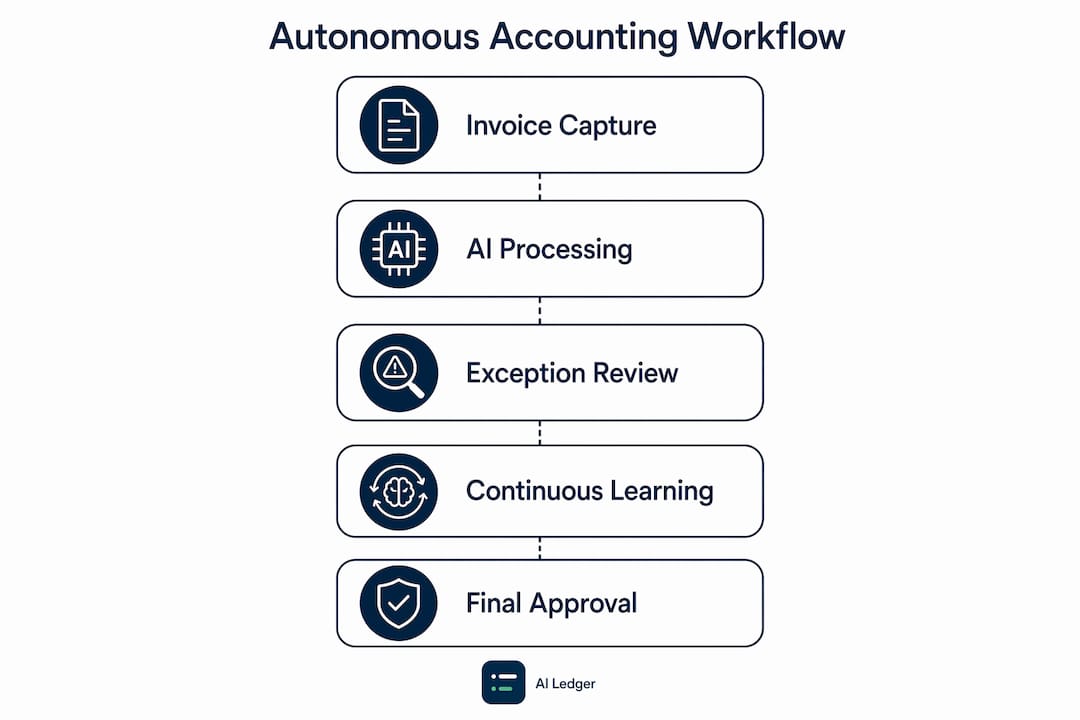
The efficiency gains from autonomous accounting are well documented and significant. Firms adopting autonomous accounting report up to a 95% reduction in manual errors and a 44% improvement in service speed. Senior accountants reclaim nearly a full week per month previously lost to verification and correction.
That reclaimed time is the real prize. An accountant spending four hours a day on data entry cannot also be advising clients on tax planning or cash flow strategy. Autonomous accounting systems free professionals to shift focus to advisory roles that add greater business value. That is not a soft benefit. It is a direct driver of revenue per head.
The scalability argument is equally compelling. Early adopters have reported revenue growth of up to 50% without increasing headcount. A firm handling 200 clients can take on 300 without hiring proportionally, because the agents absorb the volume increase. That changes the economics of practice growth entirely.
Audit readiness also improves. Autonomous accounting systems generate comprehensive internal control documentation and audit trails that often surpass what manual processes produce. Every agent action is logged with the decision context and policy applied. Audit sampling improves too: AI can review 10,000 transactions where a human team would sample 100, cutting audit time significantly.
The benefits in summary:
- Dramatic reduction in manual errors across invoice processing and reconciliation
- Faster month-end close and reporting cycles
- Scalable capacity without proportional headcount growth
- Stronger audit trails and internal control documentation
- Accountants freed for higher-value advisory and analytical work
What challenges and best practices exist for implementing autonomous accounting?
The biggest implementation mistake is treating autonomous accounting as a full replacement for accountants. It is not. The primary misconception is that AI takes over. The reality is that accountants become controllers who manage AI agent activities, retain professional accountability, and handle the judgement calls that agents cannot make.
A second common pitfall is trying to automate everything at once. Firms that deploy autonomous systems across all workflows simultaneously creates governance gaps and lose visibility quickly. The correct approach is modular.
- Start with repetitive, rule-based workflows. Invoice matching and bank reconciliation are ideal first targets. They have clear rules, high volume, and low ambiguity.
- Build governance before you scale. Define who reviews exceptions, what the escalation path is, and how audit trails are stored before adding more agents.
- Integrate with existing systems first. Autonomous agents need clean data feeds from your ERP, practice management software, and bank connections. Fix data quality issues before deploying agents.
- Train your team on the new rhythm. Staff accustomed to processing transactions need to learn how to monitor agent queues, review exceptions, and interpret AI-generated reports.
- Document every control point. Regulators and auditors will ask how decisions were made. Your governance documentation is your defence.
Continuous human oversight and audit trails are not optional extras. They are the foundation of a compliant autonomous accounting system. Firms that skip this step create liability, not efficiency.
Pro Tip: Run a 30-day pilot on a single workflow, such as supplier invoice processing, before expanding. Measure error rates, exceptions volume, and staff time saved. Use those numbers to build the business case for the next phase.
The mindset shift is as important as the technology. Finance professionals must embrace their new role as operators and controllers of AI agent activities rather than manual doers. Firms that reframe this as a promotion rather than a threat see faster adoption and better outcomes.
How is autonomous accounting shaping the future of the profession?
The long-term impact of autonomous accounting extends well beyond efficiency. It is restructuring business models, pricing strategies, and career paths across the profession.
The most visible shift is in billing. Hourly billing becomes difficult to justify when an AI agent processes 500 invoices in the time a junior accountant would process 20. The shift to autonomous accounting drives a move from hourly billing to service-as-software outcome pricing. Firms charge for the result, not the hours. That model rewards efficiency rather than penalising it.
Junior staff roles are evolving in parallel. The entry-level accountant of 2026 does not spend their day keying in source documents. They monitor AI agent workflows, review exception queues, and escalate edge cases. That is a more analytical role from day one, which changes both recruitment and training requirements.
| Shift | Traditional model | Autonomous model |
|---|---|---|
| Billing structure | Hourly rate | Outcome-based pricing |
| Junior staff activity | Data entry and transaction processing | Agent monitoring and exception review |
| Audit sampling | 100 transactions reviewed manually | 10,000 transactions reviewed by AI |
| Error rate | Variable, dependent on staff | Up to 95% reduction reported |
| Scalability | Headcount grows with client volume | Revenue grows without proportional hiring |
Large firms are already moving at scale. EY plans to deploy over 100,000 AI agents by 2028, with cumulative investments exceeding $1 billion. That level of commitment signals where the profession is heading, not where it might go.
"Autonomous AI accounting systems enable accountants to shift focus from day-to-day operations to strategic advisory roles that add greater business value. The firms that make this shift earliest will define the competitive standard for the rest of the decade."
The strategic opportunity for smaller practices is real. A solo bookkeeper or a ten-person firm can deploy the same agent technology as a Big Four firm. The playing field narrows considerably when the limiting factor is no longer headcount.
Key takeaways
Autonomous accounting is the most significant structural change to hit the profession since cloud accounting, and the firms that adopt it thoughtfully will outgrow those that wait.
| Point | Details |
|---|---|
| Core definition | Autonomous accounting uses AI agents to run financial workflows independently, with accountants retaining oversight and judgement. |
| Efficiency gains | Firms report up to 95% fewer manual errors and a 44% improvement in service speed after adoption. |
| Scalability without hiring | Early adopters have achieved revenue growth of up to 50% without increasing headcount. |
| Implementation approach | Start with rule-based, repetitive workflows and build governance and audit trails before scaling. |
| Future of the profession | Billing shifts to outcome pricing and junior roles evolve from data entry to agent monitoring and exception review. |
My take on the autonomous accounting shift
I have watched accounting firms approach new technology in two distinct ways. The first group asks, "What does this replace?" The second asks, "What does this make possible?" The firms in the second group are the ones worth watching right now.
Autonomous accounting does not make accountants redundant. It makes the accountant's judgement more valuable, because it is the only thing the system cannot replicate. The firms I see struggling with adoption are not struggling with the technology. They are struggling with the identity shift. Telling a senior accountant that their job is now to supervise an AI agent feels like a demotion. Framing it as moving from operator to controller, with a smaller exceptions queue and more time for client strategy, lands very differently.
The regulatory dimension is where I urge caution. Audit trails and governance documentation are not bureaucratic overhead. They are what keeps your licence when something goes wrong. Build those controls before you scale, not after.
The practices that will look back on 2026 as a turning point are the ones that start small, measure carefully, and treat autonomous accounting as a professional upgrade rather than a cost-cutting exercise. The technology is ready. The question is whether your firm's mindset is.
— aaron
Autonomous accounting tools and resources from Ailedger
Ailedger is built specifically for accounting professionals navigating the shift to AI-driven workflows.
The Ailedger Finder helps you identify, compare, and switch to the right autonomous accounting software for your practice, whether you need help with data entry, reconciliation, month-end close, or tax prep. Ailedger Pro gives you access to deeper analysis, curated tool reviews, and workflow guidance tailored to practices scaling with AI agents. The Ailedger Workspace supports team collaboration around autonomous workflows, and Deal Vault covers contract and deal lifecycle management integrated with your accounting stack. If you are ready to find the right tools for your practice, the Ailedger directory is the fastest place to start.
FAQ
What is the autonomous accounting definition?
Autonomous accounting is the use of AI agents to execute financial workflows, including invoice processing, reconciliation, and reporting, independently and with minimal human input, while accountants retain oversight and professional accountability.
How does autonomous accounting differ from traditional RPA?
Traditional RPA follows fixed scripts and breaks when conditions change. Autonomous accounting systems use reasoning to handle exceptions without reprogramming, adapting continuously as new data and edge cases arise.
Is autonomous accounting effective at reducing errors?
Firms adopting autonomous accounting report up to a 95% reduction in manual errors, with senior accountants reclaiming nearly a full week per month previously spent on verification and correction.
Does autonomous accounting replace accountants?
Autonomous accounting does not replace accountants. It shifts their role from performing routine tasks to directing AI agents, reviewing exceptions, and retaining professional responsibility for audit and judgement.
What workflows should firms automate first?
Start with repetitive, rule-based workflows such as supplier invoice matching and bank reconciliation. These have high volume, clear rules, and low ambiguity, making them the lowest-risk entry point for autonomous accounting adoption.