Artificial intelligence in accounting is defined as the application of machine learning, natural language processing, and autonomous systems to automate and augment core accounting functions, from data entry and reconciliation to financial analysis and reporting. AI in accounting explained simply means software that learns from financial data, applies rules at scale, and flags exceptions for human review. The profession has moved well past the pilot stage. 81% of financial services firms had adopted AI at some level by Q2 2026, with 40% reporting advanced use. That is not a trend to watch. It is a shift already under way in practices of every size.
How does AI improve accounting efficiency and accuracy?
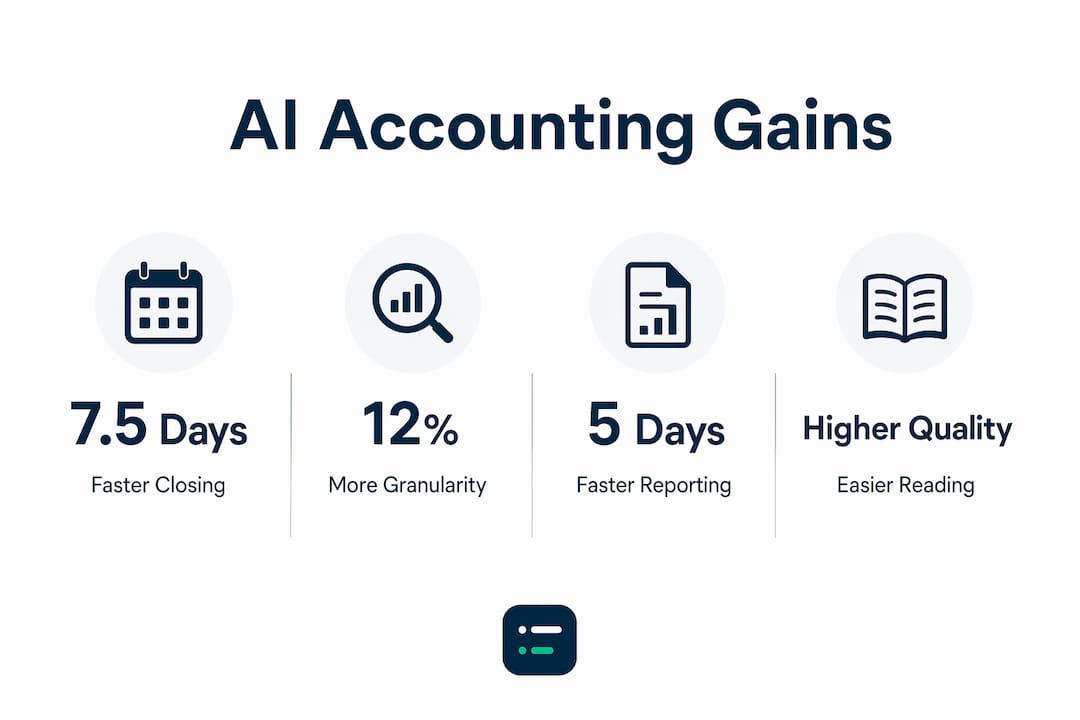
The clearest evidence of AI's impact comes from a 2026 Stanford study of 79 small and mid-sized firms. Accountants using generative AI tools completed monthly statement preparation 7.5 days faster and cut routine back-office processing time by 8.5%. That is not a marginal gain. For a firm running month-end close across dozens of clients, 7.5 days recovered per cycle changes what is possible.
The same study found a 12% increase in reporting granularity. AI broke expenses into more detailed subcategories than human preparers typically would. That level of detail improves audit readiness and gives clients a clearer picture of where money is going.

Firms using higher AI levels also filed annual reports 5 days faster, and those reports were rated as easier to read by stakeholders. Speed and clarity together increase the practical value of every report your practice produces.
The table below summarises the key efficiency and quality gains from recent research.
| Metric | Gain |
|---|---|
| Monthly statement preparation time | 7.5 days faster |
| Routine back-office processing | 8.5% reduction |
| Reporting granularity | 12% increase |
| Annual report filing speed | 5 days faster |
| Report readability | Improved stakeholder utility |
Pro Tip: Pair AI output with a senior reviewer rather than a junior one. AI catches volume errors well, but a senior accountant spots the contextual anomalies that a junior reviewer might miss. The combination produces higher-quality work than either alone.
What accounting processes does AI currently transform?
AI performs best on tasks with high transaction volumes and well-defined rules. Bank reconciliations, accounts payable automation, expense categorisation, and individual tax return preparation are the clearest wins. These workflows involve repetitive matching, classification, and consistency checking at a scale that makes manual processing slow and error-prone.
Best-in-class AI automates more than 80% of the mechanical work in individual tax return preparation. That includes data gathering, form completion, and consistency checks. The remaining 20% requires professional judgement, particularly where client circumstances are unusual or where interpretation of tax law is genuinely ambiguous.
The top AI-automated accounting functions, ranked by current adoption and maturity, are:
- Bank and account reconciliation
- Accounts payable processing and invoice matching
- Expense capture and categorisation using OCR and ML classifiers
- Individual tax return data gathering and form completion
- Anomaly detection and fraud flagging in transaction data
- Financial report generation and variance analysis
AI does not yet replace human judgement in external audits, strategic tax planning, business valuation, or complex multi-entity consolidations. These tasks require contextual reasoning, professional scepticism, and regulatory knowledge that current AI systems cannot reliably replicate. Treating AI as a full replacement in these areas creates serious risk.
One caution worth stating plainly: AI produces erroneous outputs when not properly integrated with core ERP or ledger systems. A poorly connected AI can generate inaccurate invoices or account balances with apparent confidence. That is not a theoretical risk. It is a documented failure mode in live deployments.
What are the risks and challenges of AI adoption in accounting?
The risks of AI in accounting are real and deserve direct attention. The 2026 Global AI in Financial Services Report found that 74% of firms cite data privacy and protection as a top concern, and 70% flag unreliable AI outputs as a significant risk. Those two figures together describe the core tension: AI is powerful, but its outputs require structured validation before they reach a client or regulator.
Measuring the profitability impact of AI investment also remains genuinely difficult. Higher AI investment correlates with greater adoption maturity and reported profitability gains, but the causal link is hard to isolate. Firms that invest more in AI also tend to invest more in training, process design, and system integration, all of which contribute independently to performance.
The workforce implications are more nuanced than most headlines suggest. AI augments rather than displaces accounting capacity. Firms using AI handle more clients and produce higher-quality outputs, not fewer staff. The shift is in what those staff do. Junior roles focused on data entry and routine processing are declining. New roles centred on AI oversight, exception management, and output validation are growing.
The key risk factors and recommended mitigations are:
- Unreliable outputs: Implement structured validation workflows before any AI output reaches a client or filing.
- Data privacy: Confirm that AI tools comply with GDPR and your firm's data handling policies before deployment.
- Poor system integration: Connect AI tools directly to your ERP or general ledger. Avoid standalone tools that operate on exported data.
- Accountability gaps: Define clearly who is responsible for reviewing and approving AI-generated work. Do not leave this ambiguous.
- Reskilling lag: Invest in training alongside tool deployment. AI tools underperform when staff do not understand their outputs.
Human-AI hybrid finance requires decision architectures that allocate authority, oversight, and accountability clearly. AI and humans jointly participate in prediction, approval, monitoring, and audit. The firms that get this right build explicit governance around it, not informal workarounds.
How should you integrate AI into your accounting workflows?
Effective AI adoption starts with selecting workflows that have high transaction volumes and well-defined rules. Reconciliation, AP processing, and expense categorisation meet both criteria. Strategic advisory work and complex tax planning do not. Matching the tool to the right task is where most of the return on investment is won or lost.
Integration with your existing ERP or general ledger is non-negotiable. AI tools that operate on exported spreadsheets or disconnected data sources introduce the exact errors they are supposed to prevent. The reliability of AI outputs depends directly on integration quality. Structured validation at the point where AI output enters your core system is the single most important technical control you can put in place.
Accounting roles are shifting as a result. Traditional roles are moving away from manual processing toward managing system-generated exceptions and interpreting AI outputs. This is not a future state. It is already the day-to-day reality in firms with mature AI adoption. If your team is still spending the majority of its time on data entry, you are behind the curve on workflow bottlenecks that AI can address now.
A phased deployment approach works better than a full rollout. Start with one high-volume, rule-based process. Measure the output quality with senior oversight for the first two to three months. Expand only once you have validated that the integration is stable and the outputs are reliable. This approach also builds staff confidence, which matters more than most firms acknowledge.
Pro Tip: Before selecting an AI tool, confirm it has a documented integration path with your current general ledger or ERP. A tool that cannot connect cleanly to your core system will create more work than it saves. Check the AI tool finder at Ailedger to filter by integration compatibility.
Key takeaways
AI in accounting delivers measurable efficiency gains, but only when matched to the right workflows and integrated properly with core financial systems.
| Point | Details |
|---|---|
| Efficiency gains are proven | AI cuts statement prep by 7.5 days and reduces routine processing by 8.5%. |
| Automation has clear limits | AI handles over 80% of mechanical tax work, but professional judgement covers the rest. |
| Integration quality is critical | Poorly connected AI produces confident errors; always link tools to your ERP or ledger. |
| Risks require governance | 74% of firms cite data privacy risk; define accountability before deploying any AI tool. |
| Roles are shifting, not disappearing | AI expands capacity and changes what accountants do, rather than replacing them. |
My honest view on where AI is taking this profession
I have watched the accounting profession absorb a lot of technology promises over the years. Cloud accounting, blockchain, robotic process automation. Each wave arrived with bold claims and delivered something more modest. AI feels different, and the 2026 data backs that up.
What strikes me most is not the speed gains, impressive as they are. It is the granularity improvement. A 12% increase in reporting detail is not a headline number. It is a signal that AI is changing what accountants can actually deliver to clients, not just how fast they deliver it. That is a qualitative shift in the value of the profession.
The traditional accounting firm pyramid is flattening. Fewer junior staff doing volume work, more mid-level professionals managing AI outputs and client relationships. That is uncomfortable for firms built around a leverage model, but it is the direction of travel. The practices that adapt their structure now will be better positioned than those waiting for the model to stabilise.
The human-AI partnership is not a compromise. It is the right model for a profession where professional liability, client trust, and regulatory accountability cannot be delegated to software. AI expands what you can do. Your judgement determines whether it is done well. Keep that distinction clear, and you will use these tools to genuine advantage.
— Aaron
AI tools worth evaluating for your practice
Ailedger tracks and evaluates AI tools built specifically for accounting and bookkeeping workflows. The directory covers tools across document capture, reconciliation, tax preparation, and financial analysis, with honest assessments of integration requirements and practical fit.
If you are starting with document capture and bookkeeping automation, Datamolino is worth a close look for its extraction accuracy and ledger connectivity. For AI-assisted tax and advisory workflows, CPA Pilot covers a broad range of use cases. For workflow orchestration across the full accounting cycle, Puzzle offers a structured approach to managing AI-generated outputs. Browse the full directory and filter by workflow type to find the right fit for your practice.
FAQ
What is AI in accounting?
AI in accounting is the use of machine learning, natural language processing, and autonomous systems to automate and augment accounting tasks such as reconciliation, data entry, tax preparation, and financial reporting.
Does AI replace accountants?
AI augments accounting capacity rather than replacing accountants. Research shows firms using AI handle more clients and produce higher-quality outputs, with roles shifting toward oversight and exception management rather than disappearing.
What accounting tasks are best suited to AI?
High-volume, rule-based tasks deliver the best results. Bank reconciliation, accounts payable processing, expense categorisation, and individual tax return preparation are the most mature use cases for AI in accounting.
What are the main risks of using AI in accounting?
The top risks are unreliable outputs (cited by 70% of firms) and data privacy concerns (cited by 74% of firms). Poor integration with core financial systems is the leading technical cause of AI errors in live deployments.
How do I choose the right AI tool for my accounting practice?
Match the tool to a workflow with high transaction volume and well-defined rules, then confirm it integrates directly with your existing ERP or general ledger. Use the Ailedger tool finder to filter options by workflow type and integration compatibility.