
Accounting workflow bottlenecks are defined as specific points in a financial process where tasks, information, or approvals accumulate faster than they can be resolved, causing delays that ripple across reporting, reconciliation, and month-end close. These are not productivity failures caused by slow staff. Most accounting delays stem from unclear ownership, missing information, and silent queues that go unnoticed until deadlines are already at risk. The industry term for this class of problem is "process constraint," borrowed from the Theory of Constraints, and recognising it as a structural issue rather than a personnel one is the first step towards fixing it. This guide covers the most common accounting workflow bottlenecks, what causes them, and how to address each one.
1. What are common accounting workflow bottlenecks?
An accounting workflow bottleneck is any constraint that causes work to pile up at a specific stage. The constraint might be a person, a system, an approval step, or a missing piece of data. The result is always the same: downstream tasks stall, deadlines compress, and your team spends time chasing rather than completing.
The scale of this problem is significant. 80% of corporate finance professionals identify waiting for data from other departments or systems as the primary cause of month-end close delays. That figure tells you the bottleneck is rarely inside the finance function itself. It lives in the handoffs between people, systems, and teams.

2. Unclear ownership and task handoffs
Ambiguity about who owns a task is the single most common cause of accounting process inefficiencies. When no one is explicitly responsible for a step, the task sits in a grey zone. Everyone assumes someone else is handling it.
This creates what practitioners call "silent queues." Work appears to be in progress but is actually waiting unaddressed. The problem compounds because silent queues are invisible. You cannot see them on a task list, and no one flags them until a deadline forces the issue.
Common signs of an ownership problem include:
- Tasks that move between inboxes without a clear next action
- Review steps with no named reviewer and no deadline
- Approval requests that sit in email threads for days
- Month-end checklists with shared ownership across multiple people
Pro Tip: Assign a single named owner to every task in your workflow, including review and approval steps. "Finance team" is not an owner. A person's name is.
Clarifying responsibility does not require new software. A simple RACI matrix (Responsible, Accountable, Consulted, Informed) applied to your month-end checklist will expose ownership gaps within an hour. Once gaps are visible, they are fixable. You can also use workflow templates to pre-assign owners to recurring tasks before each cycle begins.
3. Fragmented systems and integration gaps
The average company uses 60 SaaS applications, creating fragmented data environments that require constant manual data movement between platforms. Each manual transfer is a potential error and a guaranteed time cost.
When your accounts payable system does not talk to your general ledger, someone must re-enter data by hand. That re-entry creates rework loops. Errors introduced at the transfer stage require reconciliation later, which extends your reporting timeline. More than 50% of finance professionals cite reconciling data across multiple platforms as a significant barrier to faster close.
| Integration state | Typical impact |
|---|---|
| Fully integrated systems | Single data entry, automated reconciliation, faster close |
| Partially integrated systems | Selective manual transfers, moderate rework risk |
| No integration | Full manual re-entry, high error rate, extended timelines |
Pro Tip: Audit your current tech stack and map every manual data transfer between systems. Each transfer is a bottleneck candidate. Prioritise integrations that touch your month-end close process first.
The fix is not always a full system replacement. Many practices resolve integration gaps with API connectors or middleware tools that link existing platforms without replacing them. The goal is to eliminate the manual handoff, not necessarily the software.
4. Manual data entry and poor document collection
Manual data entry remains one of the most persistent bottlenecks in accounting processes. Every keystroke is a chance for error, and errors at the input stage create clean-up work that falls on the finance team at the worst possible time.
Manual finance processes generate errors, duplicate payments, and compliance risks beyond the obvious time cost. Non-finance staff entering data incorrectly push correction work downstream to your team, amplifying the bottleneck at month-end. The problem is not just internal. Client data collection is equally disruptive.
Typical document collection problems include:
- Clients submitting receipts in inconsistent formats across email, WhatsApp, and post
- Missing supporting documents that require multiple chasing cycles
- Invoices arriving without purchase order references, blocking three-way matching
- Bank statements provided as scanned images rather than structured files
Attaching supporting documents at task origin reduces the context switching that stalls month-end closes. When a transaction arrives with its documentation attached, your team processes it once. Without documentation, the task stops, someone chases, and the cycle restarts.
The practical fix is a structured client data request. Define exactly what you need, in what format, and by what date. Use a digital portal rather than email so submissions are tracked and visible. This single change removes a significant volume of chasing from your workflow.
5. Review and approval cycles that create invisible queues
Review stages are necessary. They also create some of the most damaging bottlenecks in accounting workflows because the delays they generate are invisible until it is too late to recover.
Visual dashboards showing work states outperform task lists for exposing these bottlenecks. A task list tells you what needs doing. A dashboard showing "in-review for 4 days" tells you where work is stuck. The distinction matters enormously when you are managing a team through a close cycle.
Common review bottlenecks include:
- No standardised criteria for what constitutes a complete review
- A single senior reviewer who is the bottleneck for all approvals
- Late detection of errors that require rework and restart the cycle
- No centralised tracking of where each item sits in the approval chain
The fix requires two things: standardised review criteria and workload visibility. Define what a reviewer is checking for before the review stage begins. Distribute approval authority so no single person holds up the entire workflow. Flag items that have been in review for more than 24 hours so they surface automatically rather than disappearing into someone's inbox.
Real-time bookkeeping tools that surface live transaction data can also reduce the volume of items requiring manual review, because exceptions are caught earlier in the process.
6. Non-standardised processes that undermine automation
Automation is not a cure for a broken process. Automating fragmented or non-standardised workflows amplifies inefficiencies by increasing the volume of exceptions that require manual handling. If your input data is inconsistent, your automation will produce inconsistent outputs at speed.
Nearly two-thirds of organisations fail to scale AI beyond pilot stage due to poor integration into workflows. The technology works. The process around it does not. This is the most expensive mistake accounting teams make when fixing workflow issues.
Standardisation must come before automation. That means:
- Defining standard data input formats for every transaction type
- Documenting approval paths with named owners and time limits
- Agreeing on service level agreements (SLAs) for each workflow stage
- Removing ad hoc exceptions by building them into the standard process
Once your process is consistent, automation delivers genuine time savings. Before that point, it creates a faster version of the same problem. Pre-automation process standardisation around data inputs, approvals, and roles reduces exception fixes and improves the utility of any software you deploy.
Key takeaways
Fixing accounting workflow bottlenecks requires visible ownership, integrated systems, and standardised processes before any automation is deployed.
| Point | Details |
|---|---|
| Ownership drives flow | Assign a single named owner to every task, including review and approval steps. |
| Integration gaps cause rework | Map every manual data transfer between systems and prioritise eliminating those that touch month-end close. |
| Document at source | Attach supporting documents when a task is created to prevent chasing cycles later. |
| Standardise before automating | Define consistent data inputs and approval paths before deploying any automation tool. |
| Visibility exposes bottlenecks | Use dashboards showing real-time task states rather than static task lists to find where work stalls. |
The uncomfortable truth about accounting bottlenecks
Most of the practices I speak with assume their bottlenecks are a technology problem. They are not. They are a process design problem that technology has been asked to paper over.
The clearest example I see repeatedly is the automation trap. A firm invests in an AI-powered data extraction tool, runs it over their existing document intake process, and then wonders why exceptions have tripled. The answer is always the same: the underlying process was inconsistent, and the automation made that inconsistency visible at scale. The tool did exactly what it was supposed to do. The process was not ready for it.
What actually works is unglamorous. Map your current workflow on paper or a whiteboard. Identify every point where a task waits for a person, a system, or a piece of information. Assign a name and a time limit to each waiting point. That exercise alone will surface your top three bottlenecks within an afternoon.
The second thing that works is upstream data quality. Every error that enters your workflow at the client data collection stage costs you three to five times more to fix at month-end. Tightening your intake process is the highest-return investment most practices can make. It is also the one most teams skip because it requires a difficult conversation with clients about changing their habits.
Technology should come last, not first. Once your process is clean and your ownership is clear, the right tools will deliver real gains. Until then, they will deliver faster chaos.
— Aaron
How Ailedger helps you fix workflow bottlenecks
Identifying where your workflow stalls is the hardest part of the process. Ailedger builds tools specifically for accounting professionals who are ready to move from diagnosis to action.
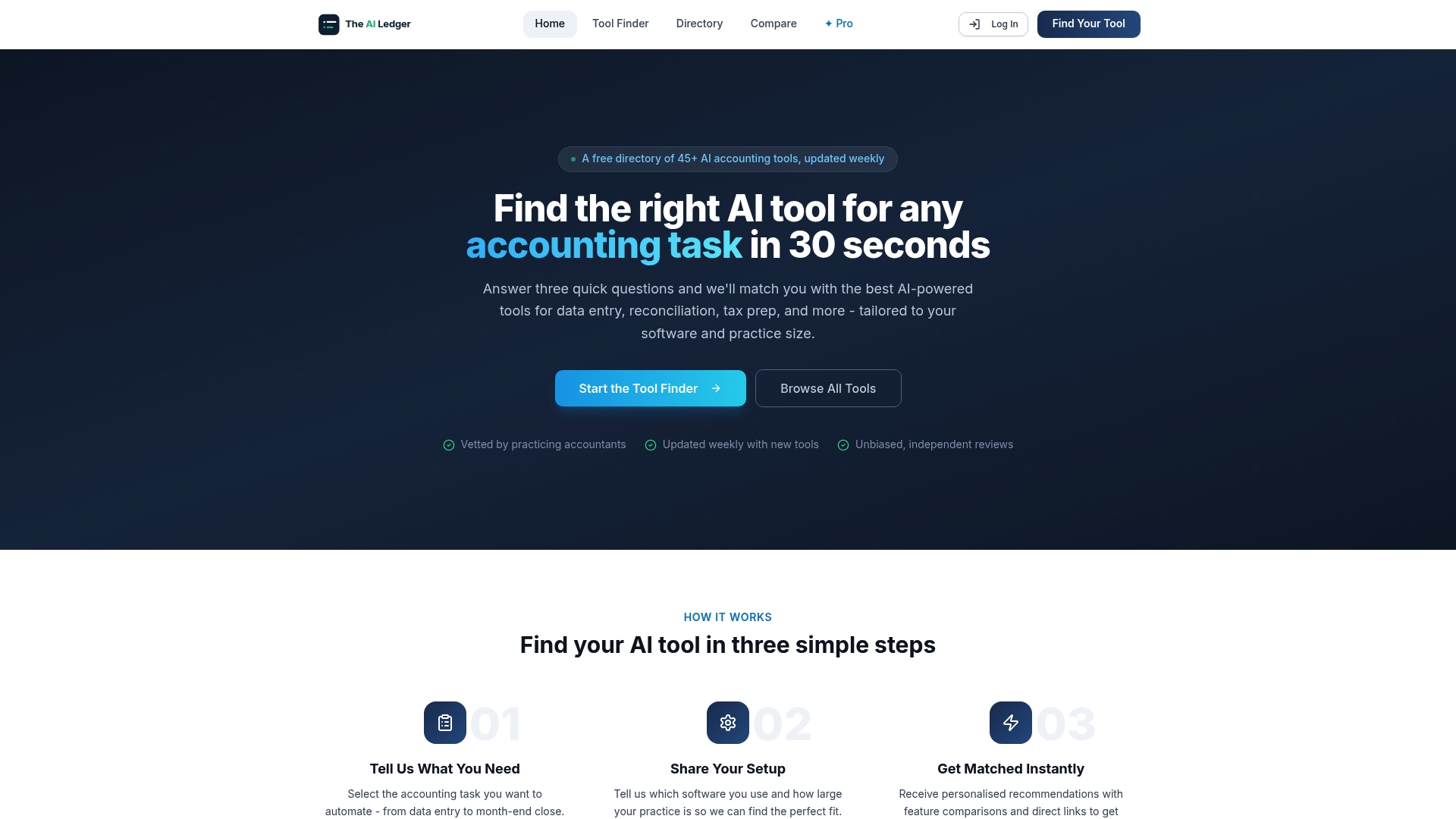
The Ailedger Finder helps you evaluate and compare AI tools for specific tasks including data entry, reconciliation, and month-end close, so you can match the right technology to a well-defined process rather than guessing. The Ailedger Workspace gives your team a centralised view of task ownership and progress, making silent queues visible before they become deadline problems. If you are researching where to start, the Ailedger Pro newsletter delivers weekly briefings on new tools and workflow automations, curated for practices of every size.
FAQ
What is an accounting workflow bottleneck?
An accounting workflow bottleneck is a point in a financial process where tasks or information accumulate faster than they can be processed, causing delays in reporting, reconciliation, or close cycles. The cause is most often unclear ownership or missing data rather than staff capacity.
Why does manual data entry cause so many accounting delays?
Manual data entry introduces errors at the input stage that require correction downstream, typically at month-end when time pressure is highest. Non-finance staff entering data incorrectly push clean-up work to the finance team, amplifying the bottleneck.
Does automation fix accounting workflow bottlenecks?
Automation alone does not fix bottlenecks if the underlying process is inconsistent. Automating a fragmented workflow increases the volume of exceptions requiring manual handling. Standardise your process first, then deploy automation.
How do I identify bottlenecks in my accounting workflow?
Map every stage of your workflow and note where tasks wait for a person, a system, or information. Visual dashboards showing real-time task states are more effective than task lists for surfacing hidden delays.
What is the fastest way to reduce month-end close delays?
Assign a single named owner to every task in your close checklist and require supporting documents to be attached at the point of entry. These two changes remove the most common sources of chasing and rework without requiring new technology.