An AI-powered trial balance is a system that imports ledger data, groups and foots account balances automatically, then flags anomalies for a human accountant to review before sign-off. It handles the arithmetic and the pattern spotting; you handle the judgement calls.
In practice, the software does three jobs at once:
- Import and mapping: pulling data from your ledger and matching accounts to standard groupings
- Footing and totalling: adding up balances and checking the trial balance actually balances
- Anomaly detection: flagging unusual variances, missing entries, or figures that break historical patterns
The verdict is straightforward. AI drafts the trial balance. You remain the reviewer and the signatory. Nothing here removes your professional responsibility, it just removes the hours you used to spend keying in source documents and chasing rounding errors.
Key Takeaways
AI-powered trial balance tools draft the numbers and flag the anomalies, but the accountant's review, confidence-score judgement, and sign-off remain the control that prevents errors reaching the client.
| Point | Details |
|---|---|
| Definition | AI imports, maps, foots and flags a trial balance; a human accountant still reviews and signs it. |
| Balancing isn't correctness | A balanced trial balance can still hide omitted or misposted transactions, so anomaly checks matter. |
| Human oversight drives accuracy | Selective intervention based on confidence scores improves classification accuracy, blanket trust does not. |
| Governance is non-negotiable | Require an audit trail, materiality thresholds, and a decision log before trusting any tool with live client data. |
| Evaluate before adopting | Check independent accuracy benchmarks, connector coverage, and configurable materiality settings first. |
Table of Contents
- What is AI-powered trial balance: how the technology actually builds one
- Benefits of AI trial balance: what the evidence actually shows
- Where AI trial balance tools fall short
- Running an AI-assisted trial balance from start to sign-off
- How to evaluate an AI trial balance tool or build one in-house
- Where to research AI trial-balance tools properly
- Security and data privacy considerations for AI trial-balance tools
- Connecting AI trial balance tools to your existing software stack
- What accountants get wrong about AI and trial balances
- Sources
What is AI-powered trial balance: how the technology actually builds one
Understanding trial balance AI starts with the data pipeline, because that is where most of the time savings actually happen. Most tools offer three ingestion routes: direct connectors to your ledger (Xero, QuickBooks, Sage), CSV or Excel import, or simply pasting data into a template. Xero's own guidance on trial balances confirms that generating a TB straight from ledger data is now a standard, expected capability rather than a novelty.

Once the data lands, the software attempts automated account mapping, matching your chart of accounts to standard groupings. The better systems build a persistent mapping cache: correct a misclassified account once, and the tool remembers that correction for every future run on that client. This is the single biggest differentiator between a genuinely useful AI trial balance and a glorified spreadsheet macro.
From there, the workflow typically runs like this:
- Footing and cross-checks confirm debits equal credits and flag any imbalance immediately
- Prior-period variance columns compare this period against the last, surfacing swings that need explaining
- Anomaly detection applies thresholding logic, so a £50 variance in office supplies gets ignored while a £15,000 swing in accrued revenue gets a severity flag
- Proposed adjustments are drafted by the system but never posted automatically
Integration points vary. Some tools sit as an add-on within your existing ledger; others operate as a standalone layer that pulls data via API. Either way, expect manual intervention at account mapping exceptions and at any anomaly the system cannot classify with confidence.
Pro Tip: Run your first AI trial balance in parallel with your existing manual process for one full close cycle. You'll spot mapping errors and calibrate your materiality thresholds before you trust the tool to run solo.
Benefits of AI trial balance: what the evidence actually shows
The efficiency case for AI in trial balance work isn't speculative. Research from Stanford GSB found that generative AI adoption in accounting correlates with faster month-end closes and more granular reporting, with accountants stepping in selectively when the system's confidence scores drop.
That selectivity matters more than raw speed. Practices that adopt AI well aren't removing human judgement, they're redirecting it toward the transactions that actually need it.
The gains cluster around a few specific tasks:
- Transaction classification improves in both speed and consistency once mapping caches mature
- Variance detection catches swings a tired reviewer might skim past on page four of a spreadsheet
- Month-end close compresses because footing, mapping, and first-pass anomaly review no longer eat a full day
- Client capacity rises, since less time on data entry means more clients per practitioner without proportional headcount growth
A study drawing on transaction-level data from 79 firms and a survey of 277 accountants found that GenAI integration improved classification accuracy on average, but only where human intervention followed confidence scores rather than blanket trust in the output. The gain is real, but it is conditional on the review discipline sitting underneath it.
Where AI trial balance tools fall short
No AI system guarantees a correct trial balance, only a balanced one. Investopedia's explainer on trial balances makes this point clearly: a trial balance that balances can still hide omitted transactions, duplicated entries, or figures posted to the wrong account entirely. AI doesn't change that mathematical reality, it just changes who (or what) is doing the footing.
The sharper risk sits with generative models asked to do more than extraction. Editorial testing of large language models on trial balance tasks found confident but incorrect classifications, and in some cases outright fabricated figures, when the model was pushed to generate narrative statements rather than tag and extract data.
A trial balance is not a statement of correctness. It is a mechanical check. Anomalies still need a human to ask "why" before anyone signs anything.
Governance controls that matter here:
- Audit trail: every mapping change, every adjustment, every override logged with who and when
- Confidence scores: visible per line, not buried in a summary screen
- Versioning: locked runs you can return to if a figure gets questioned later
- Materiality settings: configured thresholds so review time goes where the risk actually sits
Running an AI-assisted trial balance from start to sign-off
The workflow that works reliably follows five stages, and skipping any of them is where firms get burned.
- Clean the ledger first. Reconcile obvious errors and clear suspense accounts before you run the import. AI cannot fix a dirty source file, it just processes the mess faster.
- Run the import and check the mappings. Review any account the system flags as newly mapped or low confidence, not just the ones it got obviously wrong.
- Investigate anomalies by severity. Start with the highest-flagged variances and document your findings against each one, even the ones you dismiss as immaterial.
- Accept, override, or adjust. Post nothing automatically. Every proposed adjustment needs a human decision recorded against it.
- Lock the run and archive it. Retain the full audit trail so next period's comparatives, and any future query, have a clean record to point back to.
Pro Tip: Document why you dismissed a flagged anomaly, not just why you acted on one. Auditors and reviewers care more about the reasoning behind a "no action needed" than they do about the fixes you made.
How to evaluate an AI trial balance tool or build one in-house
Judge any tool, whether you buy it or build it, against five criteria rather than the marketing copy.
- Accuracy benchmarks: ask for independent testing methodology, not vendor-reported percentages with no methodology attached
- Connector coverage: confirm it talks directly to your ledger and data provenance is traceable back to source
- Confidence transparency: a decision log that shows why a line was flagged, not just that it was
- Configurability: custom lead schedules and adjustable materiality thresholds for different client sizes
- Operational fit: reviewer-friendly interface, sensible security posture, and compliance with your firm's data policies
| Criterion | What good looks like |
|---|---|
| Accuracy testing | Independent benchmarks with stated methodology, not self-reported figures |
| Audit trail | Full mapping history, confidence scores per line, sign-off record |
| Materiality controls | Configurable thresholds that route only high-risk items to reviewers |
Where to research AI trial-balance tools properly
The AI Ledger runs an independent directory of 100 or more AI tools for accountants and bookkeepers, each carrying an editor score, an honest verdict, and a last verified date, so nothing you read is stale marketing copy dressed up as review.
- Use the category guides to shortlist tools built specifically for reconciliation and close work
- Run a side by side comparison before committing to any single connector or workflow
- Try the 30 second tool finder to match your practice size and existing software to relevant options
- Sign up to the free weekly Friday newsletter for plain-English updates on feature and pricing changes
Security and data privacy considerations for AI trial-balance tools
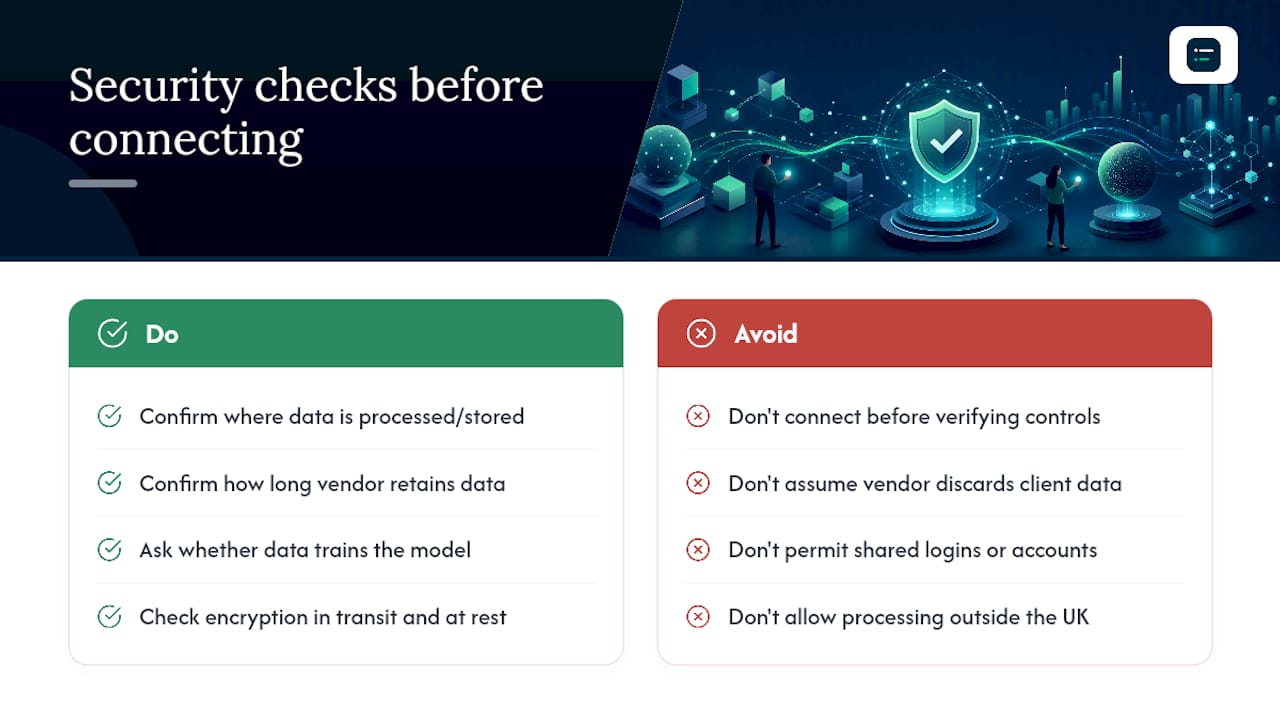
Ledger data is about as sensitive as accounting data gets: client identities, revenue figures, payroll amounts, all in one export. Before connecting any AI tool to a live ledger, confirm where that data is processed and stored, and for how long the vendor retains it after a run completes.
Ask specifically whether your data trains the vendor's underlying model. Some tools use client data purely for the session and discard it; others feed anonymised data back into model training unless you opt out. That distinction matters for client confidentiality agreements, particularly if you act for regulated clients who expect strict data segregation.
Check for encryption in transit and at rest, and confirm the vendor's approach to access controls, specifically whether staff logins are individually tracked or shared under one account. A shared login defeats the purpose of an audit trail before you've even started.
Data residency is worth a direct question too. If a vendor processes data outside the UK, you need to know that before you connect a client ledger, not after a data protection query lands on your desk. The ACCA's guidance on AI adoption stresses that governance and data management need to sit alongside the technology, not be bolted on afterwards. That means a written policy on which tools can touch live client data, and who signs off on adding a new connector.
Connecting AI trial balance tools to your existing software stack
Most AI trial balance tools are built to sit on top of your existing ledger rather than replace it. That means the integration question isn't "do I switch software", it's "does this tool talk cleanly to the software I already run".
Direct API connectors to platforms like Xero, QuickBooks, Sage, or FreeAgent tend to be the most reliable route, since they pull data in real time and reduce the manual export step that introduces errors. CSV and Excel import remain the fallback for less common ledger systems or for firms running bespoke ERP setups that don't have a native connector built yet.
The practical friction usually shows up at the chart of accounts level. A tool designed around a generic account structure needs your custom groupings mapped in manually at first, which is exactly where the persistent mapping cache mentioned earlier starts paying off. Once mapped, subsequent periods import faster.
For firms running larger ERP systems alongside client-facing ledger software, check whether the AI tool can operate at both layers or only one. A tool that reconciles beautifully against Xero but can't touch your practice's internal ERP data leaves you running two separate review processes, which defeats much of the time saving the tool promised in the first place.
What accountants get wrong about AI and trial balances
The conventional pitch around AI trial balance tools oversells the automation and undersells the governance work sitting underneath it. Vendors talk about "hands-off" close cycles. The research doesn't support that framing. The field study of 79 firms found the accuracy gains came from selective human intervention, not from trusting the output wholesale.
What gets underestimated is how much value sits in the audit trail itself, not the automation. A confidence score with no decision log attached is just a number nobody can defend later. Firms that treat AI output as draft working papers, subject to the same scrutiny as a junior's first attempt, get the accuracy gains without the exposure.
If you're starting from zero, prioritise the mapping cache and the materiality thresholds before you worry about which connector looks flashiest in a demo. Those two settings determine whether your reviewers spend their time on genuine risk or on noise. Start there, and treat everything else as secondary.
— Aaron
Sources
This article draws on Investopedia's trial balance definition, Stanford GSB research on AI in accounting, and the ACCA Smart Alliance report.
- Investopedia: trial balance
- Stanford GSB: AI is reshaping accounting jobs
- Human + AI in Accounting: Early Evidence from the Field