
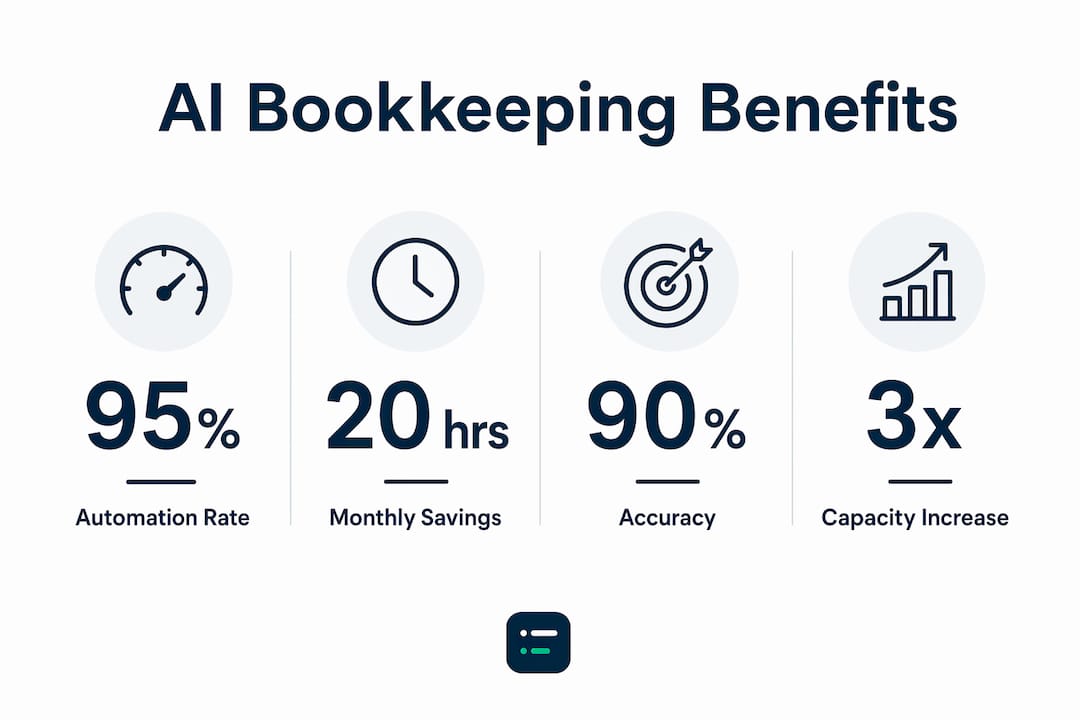
AI bookkeeping is defined as the use of machine learning and large language models to automate routine financial data tasks, including transaction categorisation, bank reconciliation, and invoice data entry. The role of AI in bookkeeping has shifted from a niche experiment to a mainstream practice, with tools now handling 80–95% of routine transaction coding and freeing human bookkeepers for exception review and advisory work. Automated coding accuracy typically starts at 85% and climbs above 90% as the system learns your client's patterns. That shift matters because it changes what you are paid to do, not just how fast you do it.
How does AI improve accuracy and efficiency in bookkeeping?
AI handles the grunt work of bookkeeping faster and with fewer errors than manual processing. The most significant gains come from three task categories: transaction coding, bank reconciliations, and invoice data capture.

Transaction coding and reconciliation
AI classifies bank and card transactions against your chart of accounts using pattern recognition. Each time you correct a miscategorisation, the model updates its confidence score for that transaction type. Automated coding accuracy typically starts at 85% and rises above 90% with continued learning. That compounding improvement means the system gets more accurate the longer it runs on a given client file.
Invoice data capture
AI-driven OCR combined with large language model parsing reduces manual invoice entry time by 70–80% and cuts data entry errors by around 90%. That is not a marginal gain. It means a bookkeeper processing 200 invoices a month can redirect most of that time to reviewing exceptions rather than keying in figures.
Time savings across the practice
- Firms save between 5 and 60 hours monthly depending on client volume and complexity
- Month-end close times can drop from several days to under 4 hours using AI workflows
- Accountants estimate AI saves roughly 5 hours per week on average
- 60% of accountants identify bookkeeping as the prime area for AI-driven efficiency gains
Those numbers reflect real capacity. A solo bookkeeper saving 20 hours a month can take on two or three additional clients without working longer hours.
Pro Tip: Set up anomaly detection alerts from day one. AI flags unusual transactions automatically, but only if you configure the threshold correctly at the outset.
What still requires a human bookkeeper despite AI advances?
AI excels at patterns. It fails on context. That distinction defines where human judgement remains non-negotiable.
Pure AI bookkeeping carries real risk. Hybrid approaches, where AI handles volume and humans handle complexity, are the dominant model for good reason. The tasks that still require a trained bookkeeper include:
- Tax strategy decisions: Choosing between capital and revenue treatment, or advising on timing of deductions, requires professional judgement that no model currently replicates reliably.
- Multi-entity and equity transactions: Intercompany eliminations, share issuances, and director loan accounts involve rules that vary by jurisdiction and entity structure.
- Edge cases: AI struggles with barter arrangements, security deposits, and multi-jurisdiction tax quirks. Without explicit routing rules, these transactions get miscategorised.
- Client communication: Explaining a VAT adjustment or a cash flow concern to a client requires relationship skills and professional credibility that AI cannot substitute.
The practical model is what practitioners call the "sandwich" approach. AI processes the volume at the bottom. A human reviews flagged exceptions in the middle. A senior bookkeeper or accountant handles judgement calls and client-facing advisory at the top. AI shifts bookkeepers from data processors to oversight and advisory professionals. That is a better use of your expertise.
Pro Tip: Build explicit routing rules into your AI setup for known edge cases. If a transaction type regularly confuses the model, tell it to flag rather than categorise. Catching a miscategorisation before it compounds is far cheaper than correcting a quarter's worth of bad data.
How to integrate AI into your existing bookkeeping workflows
The most effective approach to AI adoption is to add it as a layer over your existing platforms rather than replacing them. Firms that add AI as an overlay to QuickBooks or Xero report capacity increases of 20–30% without additional headcount. That is the practical case for integration over replacement.
Step-by-step integration framework
- Standardise your processes first. AI performs best on repeatable, well-defined workflows. If your chart of accounts is inconsistent across clients, fix that before you switch on automation. AI for anomaly detection and exception flagging works only when "normal" is clearly defined.
- Connect AI to your existing platform. Most AI bookkeeping tools integrate directly with QuickBooks, Xero, or FreeAgent via API. You do not need to migrate data or retrain your team on a new general ledger.
- Configure confidence thresholds per client. Confidence threshold calibration is critical. Set the threshold too low and bad data flows through unchecked. Set it too high and you recreate the manual workload you were trying to avoid. Tune this per client, not globally.
- Run a parallel review period. For the first four to six weeks, have a human check every AI-coded transaction. This builds your correction dataset and accelerates the model's learning curve.
- Shift your review cadence. Once accuracy exceeds 90%, move from transaction-level review to exception-only review. Use the time saved to build accounting workflow templates that make the process repeatable across your client base.
Capacity and cost benchmarks
| Practice size | Monthly hours saved | Capacity increase | Typical AI tool cost |
|---|---|---|---|
| Solo bookkeeper | 5–20 hours | 1–3 additional clients | £12–£70/month |
| Small firm (2–5 staff) | 20–40 hours | 15–25% more clients | £50–£150/month |
| Mid-size firm (6–20 staff) | 40–60 hours | 20–30% more clients | £100–£300/month |
These figures reflect industry benchmarks rather than guaranteed outcomes. Your results will vary based on client complexity and how well you standardise before adopting AI.
Pro Tip: Address common workflow bottlenecks before deploying AI. Automation amplifies whatever process you already have. A broken workflow becomes a faster broken workflow.
What emerging AI technologies are reshaping bookkeeping?
The next wave of AI in accounting goes beyond transaction coding. Several technologies are already in production use at forward-thinking firms.
- AI chatbots and conversational interfaces: Bookkeepers can query a client's ledger in plain English. "Show me all transactions over £500 coded to entertainment this quarter" returns an instant result without a manual filter. AI chatbots and continuous ledger monitoring improve both client communication speed and audit readiness.
- Real-time ledger monitoring: Rather than catching errors at month-end, continuous monitoring flags anomalies the moment a transaction posts. This compresses the audit preparation cycle significantly.
- Automated client communication: AI drafts routine client updates, payment reminders, and document request emails. The bookkeeper reviews and sends. This alone can save several hours per week on client-facing admin.
- Advisory layer tools: AI now surfaces cash flow forecasts, margin trends, and tax liability estimates directly from the ledger. This gives bookkeepers the data to have advisory conversations without building reports manually.
The direction of travel is clear. AI in accounting is moving from back-office automation to front-office intelligence. Bookkeepers who adopt these tools early will be positioned to offer services that were previously the domain of larger advisory firms.
Key takeaways
AI bookkeeping automates up to 95% of routine transaction tasks, but the practices that benefit most combine AI volume processing with structured human oversight at every exception point.
| Point | Details |
|---|---|
| Accuracy improves over time | AI coding accuracy starts at 85% and rises above 90% as the model learns client patterns. |
| Human judgement stays essential | Tax strategy, equity events, and edge cases like barter arrangements require trained human review. |
| Integration beats replacement | Adding AI as a layer over QuickBooks or Xero increases capacity by 20–30% without new hires. |
| Threshold calibration is critical | Confidence thresholds must be tuned per client to balance automation with accuracy. |
| Emerging tools extend AI's reach | Real-time ledger monitoring and AI chatbots are moving AI from data entry into advisory territory. |
AI is a partner, not a replacement: my honest assessment
I have watched a lot of bookkeepers approach AI with one of two attitudes. Either they treat it as a threat to their livelihood, or they treat it as a magic fix that will run their practice on autopilot. Both views are wrong, and both lead to poor decisions.
The bookkeepers I see getting the most from AI are the ones who treat it like a very fast, very consistent junior member of staff. It processes volume without complaint. It never misfiles because it was tired on a Friday afternoon. But it also has no idea why a client's director loan account looks unusual, and it cannot pick up the phone to ask. That is your job, and it is a better job than keying in bank statements.
The real risk I see is not AI replacing bookkeepers. It is bookkeepers who adopt AI without standardising their processes first, then blaming the tool when it produces inconsistent results. AI succeeds when it operates on clean, repeatable inputs. If your client onboarding is chaotic, your chart of accounts is inconsistent, and your review cadence is ad hoc, AI will not fix that. It will automate the chaos.
My advice: spend two weeks standardising before you spend a penny on AI tooling. Map your most common transaction types, define your chart of accounts clearly, and document your exception rules. Then switch on the automation. You will get better results faster, and you will actually understand what the model is doing.
The future of bookkeeping is not AI or humans. It is AI handling the volume so that humans can do the work that actually requires a human.
— Aaron
Find the right AI tools for your bookkeeping practice
Choosing the right AI tool matters as much as deciding to adopt AI at all. The wrong tool for your client mix wastes time on configuration and produces lower accuracy than a well-matched solution.
Ailedger's curated tool directory lists vetted AI solutions for data entry, reconciliation, month-end close, and tax prep, with clear information on pricing, integrations, and use cases. Whether you run a solo practice or a multi-partner firm, the directory helps you compare options by the tasks that matter to your workflow. Use the AI tool finder to filter by practice size, platform compatibility, and task type, and get to a shortlist in minutes rather than hours.
FAQ
What is AI bookkeeping?
AI bookkeeping is the use of machine learning and large language models to automate routine financial tasks such as transaction categorisation, bank reconciliation, and invoice data entry. Tools typically achieve 80–95% accuracy on routine coding, with human bookkeepers reviewing exceptions.
How much time can AI save in a bookkeeping practice?
Firms save between 5 and 60 hours per month depending on client volume. Accountants report saving roughly 5 hours per week on average, and month-end close times can drop to under 4 hours with AI workflows in place.
Can AI replace a bookkeeper entirely?
AI cannot replace a bookkeeper. It handles volume processing reliably but fails on complex judgements such as tax strategy, multi-entity transactions, and edge cases like barter arrangements. Hybrid models combining AI automation with human oversight are the standard approach.
How do I start integrating AI into my bookkeeping workflow?
Standardise your chart of accounts and document your exception rules before adopting any AI tool. Then add AI as a layer over your existing platform, configure confidence thresholds per client, and run a parallel review period for four to six weeks before switching to exception-only review.
What AI bookkeeping features are emerging in 2026?
Real-time ledger monitoring, AI chatbots for plain-English ledger queries, and automated client communication tools are all in active use. These extend AI's role from data entry automation into advisory support and audit readiness.