Accountants adopt AI tools because these technologies cut the grunt work that consumes billable hours and replace it with faster, more accurate outputs that free professionals to focus on advisory work. The shift is already measurable. Firms using generative AI completed monthly statements approximately 7.5 days faster and saw a 12% increase in reporting granularity. That is not a marginal gain. It is a structural change in what an accounting practice can deliver. Bodies including the AICPA and CIMA have formalised this shift through dedicated skills programmes, signalling that AI literacy is now a professional baseline, not an optional extra.
What measurable benefits do AI tools bring to accounting workflows?
The productivity case for AI in accounting is grounded in hard numbers, not aspiration. AI systems in public accounting reduce tax-return preparation labour by more than 80%, automating the mechanical work of data entry and deduction identification. That frees senior accountants to spend time on interpretation and client communication rather than keying in source documents.
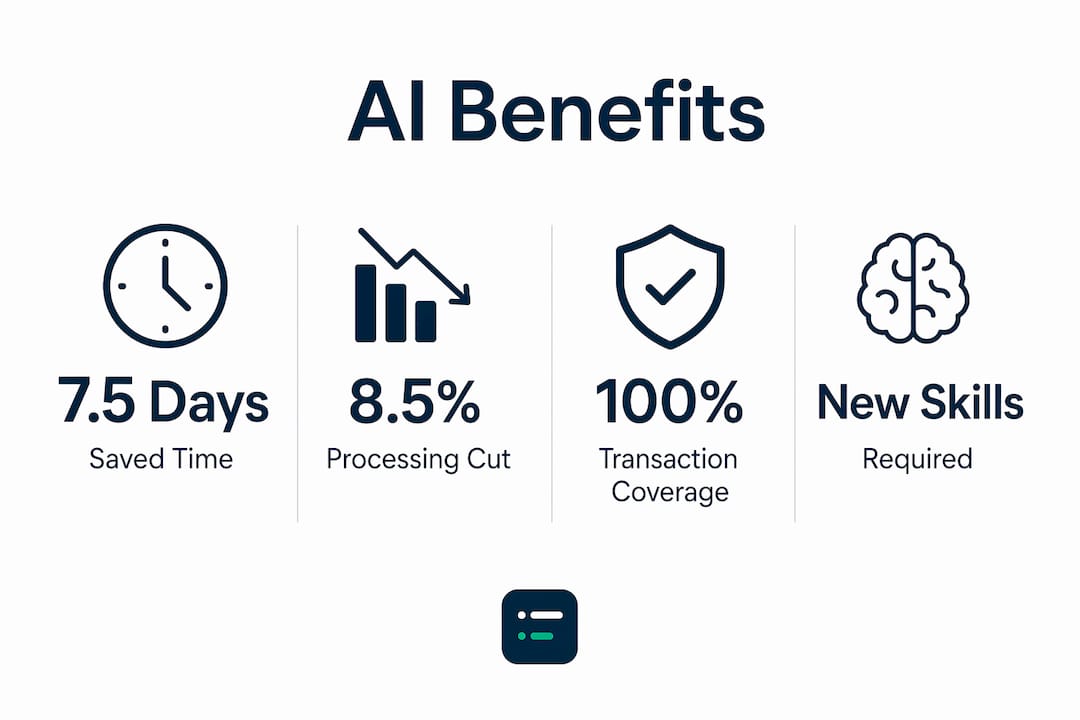
The gains extend beyond tax work. Generative AI tools cut back-office processing time by 8.5% and push reporting granularity up by 12%. Reporting granularity matters because clients increasingly expect detailed, real-time financial pictures rather than quarterly summaries. AI makes that level of detail achievable without proportionally increasing staff hours.

Anomaly detection is another area where AI delivers clear value. Rather than auditors sampling a subset of transactions, AI reviews complete transaction sets and flags irregularities for human review. The auditor's role shifts from manual checking to interpreting what the system has already surfaced.
| Metric | AI-assisted outcome |
|---|---|
| Monthly statement preparation | Approximately 7.5 days faster |
| Back-office processing time | Reduced by 8.5% |
| Reporting granularity | Increased by 12% |
| Tax-return preparation labour | Reduced by more than 80% |
| Professionals reporting positive ROI | 89% |
Pro Tip: Start measuring your current time on monthly close and tax prep before adopting any AI tool. A baseline makes it easy to quantify gains and build the internal case for further investment.
How does AI reshape the roles and skill requirements of accountants?
AI does not eliminate the accountant. It changes what the accountant does. Routine data entry, mechanical reconciliation, and first-pass document processing shift to AI, while professionals move toward interpretation, client advisory, and governance. 89% of accounting professionals using AI report a positive return on investment, but they also confirm that human oversight remains the critical variable for accuracy.
That oversight demands new skills. Digital and AI literacy have become fundamental professional competencies, covering the ability to interrogate AI outputs, spot errors the system flags as uncertain, and safeguard client data. These are not IT skills. They are professional judgement skills applied to a new class of tool.
The AICPA and CIMA's AI Accelerator Skills Programme provides up to 42 CPE credits across strategic, transitional, and operational tiers. The programme covers leadership, ethics, adoption, and productivity. It is the clearest signal yet that the profession treats AI competency as a formal requirement, not a personal interest.
Key skills accountants should develop now:
- AI literacy: the ability to evaluate, prompt, and critically review AI outputs rather than accept them at face value
- Data governance: understanding how client data is handled, stored, and protected within AI systems
- Workflow design: knowing which tasks are suitable for AI first-pass and which require human judgement from the start
- Ethical reasoning: applying professional standards to AI-generated recommendations, especially in tax and audit contexts
- Change communication: explaining AI-assisted processes to clients and colleagues in plain terms
Pro Tip: Pair every AI output with a senior reviewer during the first three months of adoption. Junior staff are more likely to accept AI-generated results without challenge. A structured review process catches errors before they reach clients.
What organisational changes enable successful AI adoption in accounting firms?
Buying an AI tool is the easy part. Embedding it is where most firms stall. Only 30% of firms have fully embedded AI into their workflows, while 54% use it situationally. Situational use means staff reach for AI when it feels convenient, not as a standard part of every relevant process. The gap between embedded and situational firms is widening, and 77% of professionals agree on that point.
The distinction matters because situational use captures only a fraction of AI's capacity. Embedding AI as infrastructure means redesigning standard operating procedures so that AI handles the first pass on repetitive tasks by default. That requires deliberate workflow redesign, not just tool access.
Leadership and governance are the two factors that most often determine whether embedding succeeds. Without a partner or director who owns the AI adoption agenda, decisions about which workflows to redesign get deferred indefinitely. Without governance, staff make inconsistent choices about when to trust AI outputs and when to override them.
Steps for effective AI integration in an accounting firm:
- Audit current workflows to identify high-volume, rule-based tasks where AI delivers the strongest return.
- Redesign standard operating procedures to position AI as the first-pass tool on those tasks, with human review as the defined second step.
- Appoint a named owner for AI adoption at partner or director level to maintain momentum and accountability.
- Train all staff on AI literacy before deployment, with particular focus on critical review of outputs.
- Set governance rules covering data handling, client consent, and escalation procedures when AI flags uncertainty.
- Review and iterate quarterly, measuring time saved and error rates against your pre-adoption baseline.
Avoid the common pitfall of deploying AI in workflows that require professional judgement from the outset. AI delivers the most value in high-volume, well-defined tasks. Attempting to use it in ambiguous or sparse-data contexts commonly leads to unreliable outputs and erodes staff confidence in the technology.
What types of AI tools are accountants adopting?
AI tools for finance professionals fall into several distinct categories, each suited to different parts of the accounting workflow. Understanding the categories helps practices choose where to start rather than attempting to automate everything at once.
The strongest use cases cluster around tasks with high transaction volume and clear rules. Tax preparation, invoice scanning, bank reconciliation, and anomaly detection across complete transaction sets all fit this profile. These are the areas where AI consistently reduces labour and improves accuracy without requiring the kind of professional judgement that still needs a human in the loop.
Common AI tool categories in accounting practices:
- Generative AI assistants: draft client communications, summarise financial reports, and answer plain-English queries about account data
- Anomaly detection engines: scan full transaction sets for irregularities, replacing manual sampling in audit workflows
- Document extraction tools: read invoices, receipts, and bank statements to populate ledgers automatically, cutting manual data entry
- Tax preparation automation: identify deductions, cross-reference prior-year returns, and flag missing information before filing
- Cash flow and forecasting tools: model scenarios using live ledger data to support client advisory conversations
- Fraud detection systems: monitor transaction patterns in real time and alert accountants to unusual activity
Tools like Datamolino handle document extraction, while platforms built for month-end close support reconciliation and reporting. The right choice depends on where your practice loses the most time. Ailedger's tool directory lets you filter by task type so you can match a tool to a specific workflow gap rather than buying on reputation alone.
Practices that grow through automation typically start with one high-volume task, prove the return, and then expand. That sequenced approach avoids the digital overwhelm that derails broader adoption programmes.
Key takeaways
Accountants who embed AI into standard workflows, rather than using it occasionally, capture the largest efficiency and quality gains while maintaining the human oversight that professional standards require.
| Point | Details |
|---|---|
| Productivity gains are measurable | AI cuts monthly close by up to 7.5 days and reduces tax prep labour by more than 80%. |
| Human oversight is non-negotiable | 89% of AI users report positive ROI, but accuracy depends on senior review of AI outputs. |
| Embedding beats situational use | Only 30% of firms have fully embedded AI; the gap with situational users is widening. |
| New skills are now professional requirements | AI literacy, data governance, and workflow design are baseline competencies, not optional extras. |
| Start with high-volume, rule-based tasks | AI delivers the strongest return where transaction volume is high and rules are well-defined. |
The uncomfortable truth about AI adoption in accounting
Most conversations about AI in accounting focus on the technology. Which tool? Which price point? Which integration? That framing misses the real obstacle, which is organisational inertia dressed up as caution.
I have watched firms spend months evaluating tools and then deploy them in a way that changes almost nothing. Staff use the AI when they remember to. Partners do not review the outputs. No one redesigns the workflow. Six months later, the tool is quietly abandoned and the conclusion is that "AI did not work for us." The technology was never the problem.
The firms that actually benefit are the ones that treat AI adoption as a workflow project, not a software purchase. They map the process first. They decide who reviews what. They build the AI step into the standard operating procedure so it is not optional. That is unglamorous work, but it is the work that determines whether the 7.5-day time saving on monthly close actually shows up in your practice.
The other thing I would push back on is the idea that AI is coming for accountants' jobs. The evidence points the other way. AI handles the mechanical layer and surfaces the data. Accountants who understand what the AI is doing, and who can interrogate its outputs, become more valuable, not less. The risk is not replacement. The risk is being the practice that did not bother to learn.
If you want to read more on what this shift looks like in practice, the Ailedger piece on autonomous accounting is worth your time.
— Aaron
AI tools built for accounting practices
Knowing why AI works is one thing. Finding the right tool for your specific workflow is another.
Ailedger's curated directory covers AI tools built for accounting and bookkeeping tasks, from document extraction and reconciliation to tax prep and month-end close. Each listing includes task coverage, pricing, and integration details so you can compare options without wading through vendor marketing. Whether you run a solo bookkeeping practice or a multi-partner firm, the directory is filtered by task type so you find tools that fit your actual workflow gaps. Start with Datamolino for document extraction or browse the full accounting AI tool directory to find where automation fits your practice next.
FAQ
Why do accountants adopt AI tools?
Accountants adopt AI tools to cut time on repetitive tasks like data entry, reconciliation, and tax preparation, freeing capacity for advisory work. Firms using generative AI complete monthly statements approximately 7.5 days faster and report a 12% increase in reporting granularity.
Does AI replace accountants?
AI does not replace accountants. It automates the mechanical layer of accounting work while professionals focus on interpretation, client advisory, and governance. 89% of accounting professionals using AI report a positive return on investment, with human oversight identified as the critical factor for accuracy.
What skills do accountants need to use AI effectively?
Accountants need AI literacy, data governance knowledge, and the ability to critically review AI outputs. The AICPA and CIMA's AI Accelerator Skills Programme offers up to 42 CPE credits covering these competencies across strategic, transitional, and operational levels.
Which accounting tasks are best suited to AI automation?
Tax preparation, invoice scanning, bank reconciliation, and anomaly detection across full transaction sets deliver the strongest results. AI performs best in high-volume, rule-based workflows and struggles in areas requiring professional judgement or sparse training data.
How do firms successfully embed AI into their workflows?
Successful embedding requires redesigning standard operating procedures so AI handles the first pass on repetitive tasks by default, with a named senior owner driving adoption and governance rules covering data handling and output review.