AI lease accounting automation is defined as the use of artificial intelligence to extract, classify, and report lease data in compliance with standards including ASC 842, IFRS 16, GASB 87, and FRS 102, replacing the manual processes that have long made lease portfolios one of the most labour-intensive areas of corporate accounting. The technology combines optical character recognition, large language models, and vision models to read complex multipage lease documents and produce structured, audit-ready outputs. For finance professionals managing dozens or hundreds of leases, the impact is immediate: what is ai lease accounting automation in practice is a shift from weeks of manual abstraction to hours of supervised processing. Ailedger tracks this space closely, and the efficiency gains reported in 2026 are no longer theoretical.
What is AI lease accounting automation and how does it work?
AI lease accounting automation covers two distinct but connected phases: lease abstraction and lease accounting. Abstraction is the process of reading a lease document and pulling out the data points that matter, such as commencement dates, payment schedules, renewal options, and responsibility splits. Accounting takes that structured data and applies the correct treatment under whichever GAAP or IFRS standard applies to your organisation.

Leading AI systems handle complex multi-page PDFs without templates, using a combination of OCR, large language models, and vision models to extract structured data directly. This matters because lease documents are notoriously inconsistent in layout and language. A system that requires a template for each landlord's format is not truly automated.
The output feeds directly into a lease accounting platform, which calculates right-of-use assets, lease liabilities, and the associated journal entries. The best platforms do this in real time, updating calculations automatically when a lease is amended or renewed. The result is a live, compliant lease register rather than a spreadsheet that goes stale between audits.
How does AI reduce the manual workload in lease processing?
The workload reduction from automated lease accounting is the most compelling argument for adoption. Processing time drops from 125–250 hours per lease batch to as little as 2–4 hours for comparable data volumes. That is not a marginal improvement. It represents the difference between a dedicated team spending weeks on a portfolio review and a small team completing the same work before the end of the week.
The efficiency gains come from several specific capabilities:
- Document ingestion at scale. AI reads PDFs and scanned images without manual keying, processing hundreds of leases in parallel.
- Automatic data extraction. Key fields including rent amounts, escalation clauses, lease terms, and break options are extracted and mapped to a structured schema.
- Anomaly flagging. AI scans full transaction populations rather than random samples, surfacing unusual entries for human review.
- Audit trail creation. Every extracted field is logged with its source location in the original document, making audit queries straightforward to answer.
- Amendment handling. When a lease is modified, the system re-runs calculations automatically rather than requiring a manual rebuild.
Audit readiness improves significantly because the system maintains a complete record of every data point and its origin. Auditors can trace any figure back to the source clause in seconds.
Pro Tip: Validate AI outputs against known benchmarks for your portfolio before going live. If your average rent per square foot sits in a predictable range, flag any extraction that falls outside it. This catch misreads early, before they reach your trial balance.
Why AI lease accounting is a hybrid process, not full automation
A common misconception is that AI lease accounting automation removes the need for lease expertise. It does not. Fewer than 3% of accounting job postings in 2026 are AI-specialist roles, and 98% of professionals use AI to augment their work rather than replace their judgement. The pattern holds in lease accounting specifically.
The reason is straightforward: lease documents contain ambiguous language, unusual responsibility splits, and clauses that require interpretation rather than extraction. AI handles the routine cases well. The edge cases still need a qualified person.
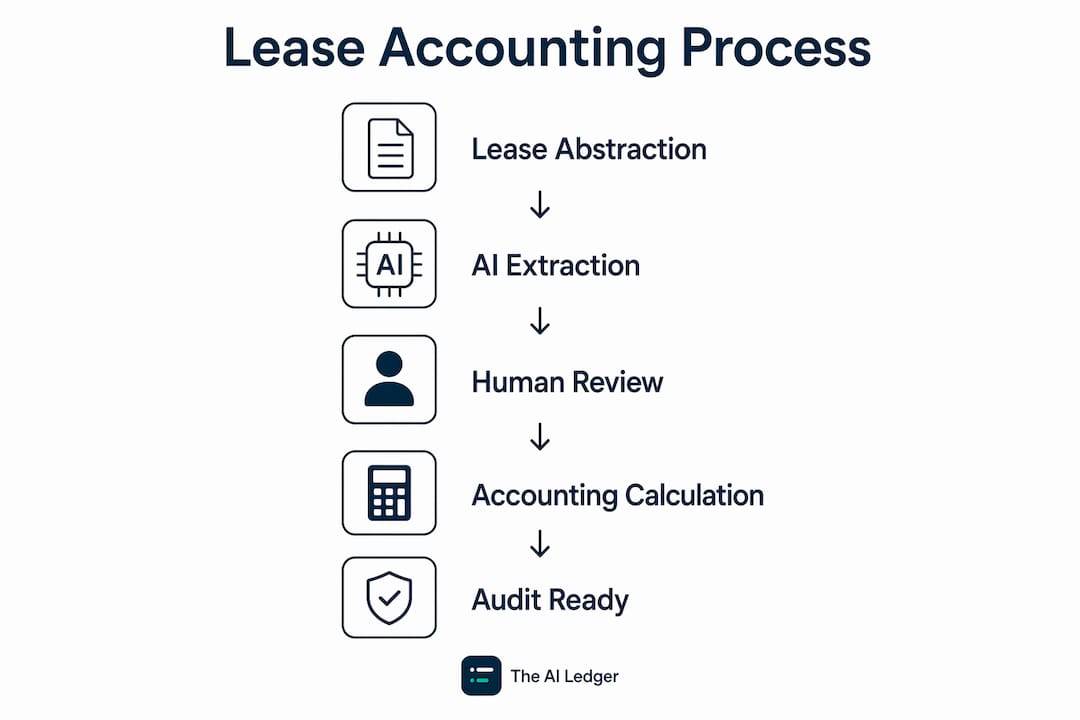
The best AI lease abstraction systems are built on proprietary prompts and validation checks designed by lease experts to handle these ambiguities. The workflow typically runs as follows:
- The AI reads the lease document and extracts all relevant fields.
- Each extraction is assigned a confidence score based on the clarity of the source text.
- Low-confidence extractions are routed to a specialist review queue before the data enters production.
- A qualified reviewer examines flagged items, corrects errors, and approves the final record.
- The approved data feeds into the lease accounting platform for compliance calculations.
This human-in-the-loop design is not a workaround for AI limitations. It is the correct architecture for a process where errors carry financial reporting consequences. No AI system should be trusted to make final accounting decisions on ambiguous lease language without human sign-off.
Pro Tip: Build your review queue thresholds around your portfolio's known complexity. If you hold a lot of ground leases or subleases, set stricter confidence thresholds for those document types. The AI will flag more items, but your error rate will be lowed.
Key features of AI lease accounting platforms
Finance professionals evaluating AI lease management software need to assess platforms against a consistent set of functional criteria. The compliance layer is the foundation. Institutional-grade platforms provide out-of-the-box support for ASC 842, IFRS 16, GASB 87, and FRS 102, with typical implementations completing in 4–6 weeks.
Beyond compliance, the features that separate capable platforms from basic tools are:
- Configurable validation rules. The ability to set custom checks against your own benchmarks for rent, square footage, and tenant allowances, catching AI misinterpretations before they reach the ledger.
- Automated journal entries. The platform generates the correct debit and credit entries for each lease event, including commencement, payment, modification, and termination.
- Document classification. The system distinguishes leases from licences, service contracts, and other agreements that do not qualify for on-balance-sheet treatment.
- Lease grouping. Portfolios with large numbers of low-value leases benefit from the practical expedient grouping tools that reduce the volume of individual calculations.
- Amendment and reassessment workflows. When a lease is modified, the platform recalculates the right-of-use asset and lease liability automatically and records the adjustment.
| Feature | Benefit |
|---|---|
| Multi-GAAP compliance engine | Supports ASC 842, IFRS 16, GASB 87, and FRS 102 from a single data set |
| Automated journal entries | Removes manual posting errors and speeds up month-end close |
| Configurable validation rules | Catches extraction anomalies before they affect financial statements |
| Document classification | Correctly identifies which contracts qualify as leases under each standard |
| Amendment handling | Recalculates liabilities automatically when lease terms change |
The most effective implementations separate the abstraction and accounting phases, integrating a specialist AI abstraction tool with a dedicated lease accounting platform. This decoupled approach gives you best-of-breed capability in both areas rather than a compromise product that does neither well.
Best practices for implementing AI lease accounting automation
Implementation success depends more on data preparation than on the technology itself. Firms that go live with poorly organised lease portfolios find that the AI surfaces problems they did not know existed. That is useful, but it creates remediation work that delays the benefits.
The practical steps that make implementations go smoothly are:
- Audit your lease inventory before you start. Know how many leases you have, what formats they are in, and which ones have been amended since the original execution.
- Apply sanity checks against benchmarks for rent, square footage, and allowances during the extraction phase. These validation layers catch misinterpretations before they reach your accounting system.
- Decouple abstraction from accounting. Run the AI extraction and human review cycle to completion before feeding data into your compliance platform. Mixing the two phases creates reconciliation problems.
- Set up anomaly monitoring from day one. AI systems flag unusual entries automatically. Build a process for reviewing those flags on a regular cadence rather than treating them as noise.
- Plan for amendments. Lease portfolios change constantly. Your implementation should include a clear process for feeding amendments back through the abstraction and validation cycle.
The 4–6 week implementation timeline for institutional platforms assumes clean data and a defined scope. Portfolios with legacy leases in non-standard formats will take longer. Budget for that realistically.
Pro Tip: Do not switch off your existing accounting workflow processes the moment the AI goes live. Run both in parallel for at least one reporting period. The comparison will surface any discrepancies and give you confidence in the new system before you rely on it exclusively.
Key takeaways
AI lease accounting automation delivers its greatest value when AI-driven extraction is paired with structured human validation and a dedicated compliance platform.
| Point | Details |
|---|---|
| Processing time drops sharply | AI reduces lease batch processing from 125–250 hours to 2–4 hours for comparable volumes. |
| Human oversight remains essential | 98% of accounting professionals use AI to augment judgement, not replace it. |
| Compliance coverage is broad | Leading platforms support ASC 842, IFRS 16, GASB 87, and FRS 102 from a single data set. |
| Decouple abstraction from accounting | Separating the two phases improves accuracy and simplifies data governance. |
| Data quality determines outcomes | Sanity checks against rent and square footage benchmarks prevent errors reaching the ledger. |
My honest view on where AI lease accounting is heading
I have watched the accounting profession adopt new technology in waves, and lease accounting automation feels different from previous cycles. The efficiency numbers are real. Cutting a 200-hour process to under four hours is not a vendor claim you can dismiss. But the professionals I see getting the most from these tools are not the ones who treat AI as a replacement for expertise. They are the ones who treat it as a way to redirect expertise.
The shift from data entry to advisory roles that AI enables is genuinely significant. When your team is not spending three weeks manually abstracting a lease portfolio, they have time to analyse the portfolio, model renewal scenarios, and advise on lease versus buy decisions. That is where lease accountants add real value, and AI makes that time available.
What concerns me slightly is the assumption that AI handles the hard parts. It handles the repetitive parts. Complex lease language, unusual structures, and ambiguous clauses still require someone who understands the accounting standards deeply. The best AI solutions blend proprietary training and human validation precisely because the hard parts cannot be fully automated. Finance teams that understand this distinction will implement these tools well. Teams that expect full autonomy will be disappointed.
My advice: adopt early, but invest in your team's ability to interpret and validate AI outputs. The competitive advantage goes to practices that combine good tooling with genuine lease accounting expertise, not to those who simply buy a platform and hope for the best. Ailedger's tool finder is a useful starting point for identifying which platforms suit your portfolio size and compliance requirements.
— Aaron
Ailedger's resources for AI lease accounting tools
Finance professionals ready to move from research to action need a reliable way to compare AI lease management software without wading through vendor marketing. Ailedger's curated directory lists and evaluates AI tools built specifically for accounting workflows, including lease accounting automation.
The directory includes tools suited to document-heavy workflows where extraction accuracy and compliance coverage are the primary criteria. You can filter by task type, compliance standard, and firm size to find options that match your portfolio. For practices looking at document ingestion and data extraction specifically, the Datamolino listing on Ailedger covers a tool with strong document processing capabilities. The CPA Pilot listing is worth reviewing for firms that want AI assistance across a broader set of accounting workflows alongside lease processing.
FAQ
What is AI lease accounting automation?
AI lease accounting automation is the use of artificial intelligence, including OCR and large language models, to extract lease data from documents and apply compliance calculations under standards such as ASC 842 and IFRS 16, replacing manual abstraction and data entry.
How much time does AI save in lease processing?
AI reduces lease batch processing from 125–250 hours to as little as 2–4 hours for comparable data volumes, according to 2026 implementation data.
Does AI replace lease accountants?
AI does not replace lease accountants. As of 2026, 98% of accounting professionals use AI to augment their work rather than replace human judgement, and complex lease clauses still require expert interpretation.
Which compliance standards do AI lease platforms support?
Leading AI lease accounting platforms provide out-of-the-box compliance for ASC 842, IFRS 16, GASB 87, and FRS 102, typically implemented within 4–6 weeks.
What is the biggest risk when implementing AI lease accounting automation?
Poor input data quality is the primary risk. Firms that skip sanity checks against benchmarks for rent and square footage allow AI misinterpretations to reach the ledger, creating errors that are costly to unwind.