Machine learning in accounting is defined as the application of algorithms that learn patterns from historical financial data to automate decisions, detect anomalies, and forecast outcomes. This is a subset of artificial intelligence in accounting, sitting alongside neural networks and deep learning as a core discipline. Techniques such as supervised learning and unsupervised learning now underpin everything from transaction classification to fraud detection in practices of every size. Understanding the basics of machine learning gives you a concrete edge: firms using AI report a 7.5-day reduction in monthly close times. That is not a marginal gain. It is a fundamental shift in how accounting work gets done.
What are the core machine learning techniques used in accounting?
Machine learning techniques fall into two broad families: supervised and unsupervised learning. Each serves a distinct purpose in accounting data analysis, and knowing which to apply is the first practical skill you need.
Supervised learning trains a model on labelled historical data. In accounting, this means feeding the model thousands of past transactions already tagged as "payroll," "travel expense," or "revenue." The model learns the pattern and classifies new transactions automatically. Regression, a supervised technique, predicts continuous values. Revenue forecasting and budget modelling with ML both rely on regression to project future figures from past trends.

Unsupervised learning works without labels. It finds natural groupings in data. Clustering algorithms segment your client base by payment behaviour or group journal entries by risk profile. Anomaly detection, one of the most valuable unsupervised applications, flags transactions that sit outside normal patterns without you having to define what "abnormal" looks like in advance.
Beyond these two families, three specific techniques appear repeatedly in accounting workflows:
- Decision trees map out branching rules to classify transactions or assess credit risk. They are easy to audit, which matters when you need to explain a decision to a client or regulator.
- Neural networks handle complex, non-linear patterns. They power document recognition, signature verification, and multi-variable fraud detection where simpler models fail.
- Support vector machines (SVMs) draw boundaries between categories. They are particularly effective for expense categorisation against GAAP or IFRS standards, where the line between allowable and non-allowable costs must be precise.
| Technique | Primary accounting use | Key benefit |
|---|---|---|
| Supervised learning | Transaction classification, revenue forecasting | Automates repetitive sorting with high accuracy |
| Unsupervised learning | Anomaly detection, client segmentation | Finds patterns without pre-labelled data |
| Decision trees | Risk assessment, compliance checks | Transparent, auditable logic |
| Neural networks | Document recognition, fraud detection | Handles complex, multi-variable patterns |
| Support vector machines | Expense categorisation | Reliable boundary-setting for GAAP/IFRS |
Pro Tip: Start with supervised learning for your first ML project. You almost certainly have labelled historical data already sitting in your accounting system. That makes the training step far simpler than starting from scratch.
How does accounting data preparation impact ML effectiveness?
Data quality determines whether your ML model is useful or misleading. This is the part of financial modelling with ML that practitioners underestimate most. A model trained on dirty data learns dirty patterns and reproduces them at scale.
Accounting data carries specific challenges that general data science courses rarely address. Financial records often arrive as unstructured documents: scanned invoices, PDF statements, and handwritten receipts. Indirect measures are common too. Days sales outstanding, for instance, is a derived figure, not a raw transaction. Varying scales across data sets, where one column contains figures in thousands and another in units, can distort model outputs significantly.
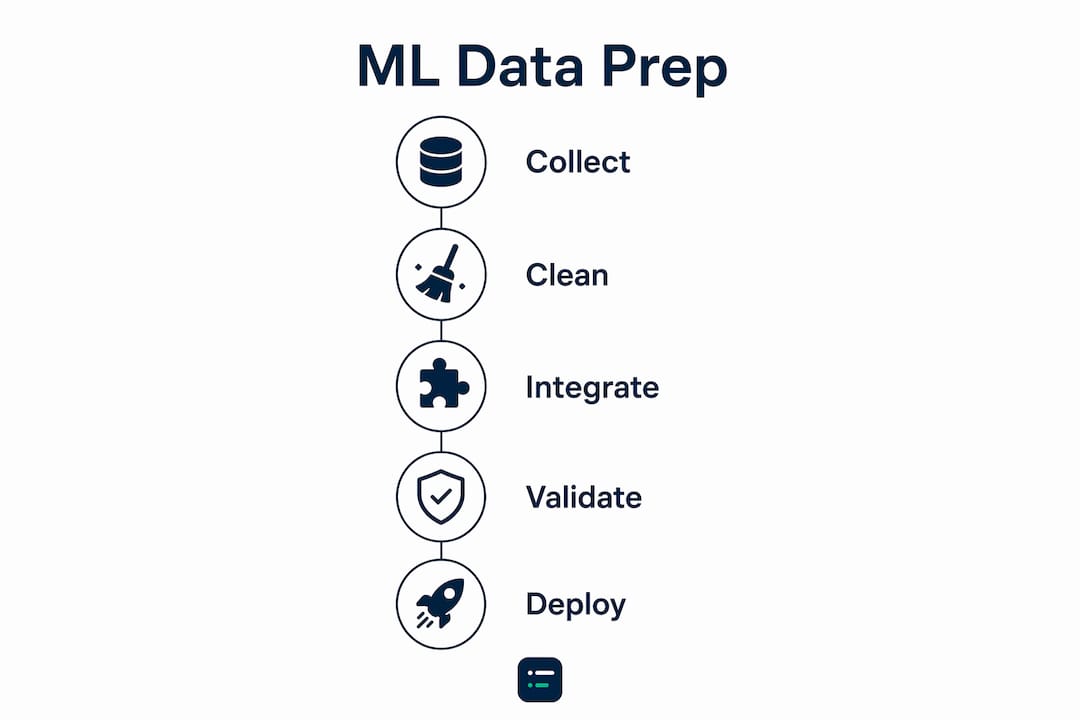
Effective ML requires careful data preparation to overcome these obstacles. The core steps are:
- Remove duplicates. Duplicate journal entries skew frequency counts and confuse classification models.
- Fix inconsistent labels. "Travel" and "T&E" and "Travel and Entertainment" are the same category. Standardise them before training.
- Handle missing values. Decide whether to impute, exclude, or flag missing figures. Each choice affects model behaviour differently.
- Normalise and standardise. Bring all numeric fields onto a comparable scale so no single variable dominates the model.
- Select relevant features. Not every column in your general ledger adds predictive value. Irrelevant features add noise and slow training.
Accounting information systems rarely export data in ML-ready format. You will likely need to integrate data from multiple sources: your ERP, your CRM, and external data such as market indices or supplier credit ratings. Governance procedures must be in place before you connect these sources. That means documented data ownership, access controls, and a clear audit trail.
Pro Tip: Before you deploy any ML model in a live environment, establish a data quality scorecard. Define acceptable thresholds for completeness, consistency, and accuracy. If your data does not meet the threshold, fix the data first.
What practical applications does ML have in everyday accounting tasks?
The most immediate applications of ML in accounting are the ones that replace the most repetitive work. Automating reconciliation and anomaly detection reduces manual errors and frees your time for higher-value analysis. These are not experimental capabilities. They are production-ready in 2026.
Here is how ML fits into a typical accounting cycle:
- Transaction ingestion and classification. ML models read incoming transactions and assign account codes automatically, matching against your chart of accounts and historical patterns.
- Three-way matching. Models compare purchase orders, delivery notes, and invoices, flagging discrepancies for human review rather than passing them through unchecked.
- Anomaly flagging. Unsupervised models monitor the general ledger continuously, surfacing entries that deviate from expected patterns. This is continuous auditing in practice.
- Revenue forecasting. Regression models trained on historical sales, seasonality, and pipeline data produce rolling revenue forecasts that update as new data arrives.
- Contract and invoice analysis. Natural language processing (NLP) automates extraction from contracts and regulatory filings, pulling key dates, payment terms, and compliance obligations without manual review.
- Compliance checking. Models trained on GAAP and IFRS rules flag transactions that may breach reporting standards before the period closes.
Fraud detection deserves particular attention. ML models learn the normal signature of your firm's transactions: typical amounts, counterparties, timing, and approval chains. When a transaction breaks that signature, the model raises an alert. This is faster and more consistent than periodic manual spot-checks.
Pro Tip: Use ML for continuous monitoring rather than end-of-period review. A model watching your ledger in real time catches problems when they are still small and correctable, not after the period has closed.
How is the accountant's role evolving alongside ML adoption?
The accountant's role is shifting from primary calculator to supervisor of machine-generated inference. Experienced accountants outperform less experienced colleagues in ML environments because they know when to trust a model's confidence score and when to override it. That judgement is not something a model can replicate.
Nearly two-thirds of accountants identify routine task automation as the primary benefit of AI adoption. The freed capacity flows into analysis, client advisory, and strategic planning. This is a genuine improvement in job quality, not just productivity.
The skills that matter most in this environment are:
- Critical thinking about model outputs. Can you identify when a classification looks wrong, even if the model is confident? This requires domain knowledge that only comes from accounting experience.
- Prompt engineering. Interacting with generative AI tools through plain-English prompts is now a core skill. The quality of your prompt determines the quality of the output.
- Data literacy. You do not need to write Python. You do need to understand what training data means, what a confidence score represents, and what overfitting looks like in practice.
- Governance and oversight. Firms use AI sandboxes to trial ML tools safely before full deployment. Understanding why that matters, and how to evaluate results from a sandbox test, is a leadership skill.
The role of AI in bookkeeping is expanding rapidly, and the professionals who thrive are those who treat ML as a tool they direct, not a system they defer to. Autonomous accounting is already a reality in some firms. Understanding what that means for your practice is covered in depth in Ailedger's guide to autonomous accounting.
Key takeaways
Machine learning improves accounting by automating classification, detecting anomalies, and forecasting outcomes, but its value depends entirely on data quality and the accountant's ability to supervise model outputs.
| Point | Details |
|---|---|
| ML techniques vary by task | Use supervised learning for classification, unsupervised for anomaly detection, and NLP for document analysis. |
| Data quality is non-negotiable | Clean, standardised, and well-governed data is the foundation of any effective ML model in accounting. |
| Practical applications are live now | Transaction classification, fraud detection, and revenue forecasting are production-ready in 2026. |
| Experienced accountants lead in ML environments | Domain knowledge enables better interpretation of model confidence scores and more effective intervention. |
| Governance must come first | AI sandboxes and documented oversight procedures protect client data and ensure compliance before full deployment. |
My honest view on where accountants get this wrong
Most accountants I speak with approach ML adoption in one of two ways. They either wait for their software vendor to handle everything, or they try to learn data science from scratch. Both approaches miss the point.
The real opportunity is in the middle ground. You do not need to build models. You need to understand them well enough to ask the right questions, spot a bad output, and make a sound judgement call. That is exactly what experienced accountants already do with financial statements. ML just adds another layer of data to interpret.
The firms I see getting genuine results from AI are the ones that invest in governance first. They define what the model is allowed to do, what triggers a human review, and how outputs get documented for audit purposes. They also test in sandboxes before going live, which is not optional when client data is involved.
The uncomfortable truth is that ML does not make accounting easier in the short term. The setup, the data cleaning, the governance work: it all takes time upfront. The payoff comes later, and it compounds. A model that classifies transactions accurately today gets better as your data grows. That is the kind of return that manual processes simply cannot match.
— Aaron
AI tools built for accountants who are ready to act
Understanding ML concepts is the first step. Putting them to work in your practice is where the real gains appear.
Ailedger's curated directory lists AI tools built specifically for accounting workflows, covering document processing, anomaly detection, reconciliation, and financial reporting. Each tool is evaluated for extraction accuracy, integration depth, and compliance readiness. If you are looking for a starting point, the document automation tools on Ailedger are a practical entry point for practices that want to reduce manual data entry fast. For firms focused on financial modelling and forecasting, the AI forecasting tools directory covers platforms that bring ML-driven projections into your existing workflow without requiring a data science team.
FAQ
What is machine learning in accounting?
Machine learning in accounting is the use of algorithms that learn from historical financial data to automate tasks such as transaction classification, anomaly detection, and revenue forecasting. It is a subset of artificial intelligence that improves its own accuracy over time as more data becomes available.
What is the difference between supervised and unsupervised learning in accounting?
Supervised learning trains on labelled data to classify or predict, such as sorting transactions by account code. Unsupervised learning finds patterns in unlabelled data, making it the standard approach for anomaly detection and client segmentation.
Do accountants need to know how to code to use ML tools?
Accountants do not need to write code to benefit from ML. The critical skills are data literacy, critical thinking about model outputs, and the ability to interact with AI tools through plain-English prompts and interpret confidence scores accurately.
How does data quality affect ML performance in accounting?
Poor data quality produces unreliable model outputs. Missing values, duplicate entries, and inconsistent labels all degrade accuracy. Establishing data governance procedures before deployment is the single most effective step a firm can take to protect ML performance.
Is ML in accounting compliant with GAAP and IFRS standards?
ML models can be trained and configured to flag transactions that breach GAAP or IFRS rules, supporting compliance rather than undermining it. Governance frameworks, including AI sandboxes for pre-deployment testing, are the standard approach for ensuring models operate within regulatory boundaries.