Accounting automation software sits in five functional layers that wrap around your core ledger: document capture, AI data extraction, transaction categorisation, bank reconciliation, and management reporting. Most UK firms run Xero, QuickBooks, Sage, or FreeAgent as their ledger of record, then layer specialised automation tools on top to cut the grunt work. No single platform covers every layer well, which is why the best-performing practices build a stack rather than hunting for one all-in-one solution.
Here is a quick map of those five layers:
- Capture — scanning, emailing, or photographing source documents so they enter the system without manual keying
- Extraction — OCR and AI parsing to pull supplier names, amounts, VAT codes, and dates from unstructured documents
- Categorisation — mapping extracted data to the right nominal ledger codes, cost centres, or projects
- Reconciliation — matching bank feed transactions to ledger entries and flagging unmatched items for review
- Reporting — generating dashboards, variance commentary, and management accounts from live ledger data
Pro Tip: Start your automation investment at the layer consuming the most manual hours. For most UK practices, that is AP invoice processing. Automating that single workflow typically delivers the fastest return because it combines high volume with high error risk.
Table of Contents
- What types of accounting automation software actually do
- Which accounting automation tools are available in the UK?
- How do you choose accounting automation software in the UK?
- What The AI Ledger sees in UK accounting automation in 2026
- Key takeaways
- The UK accounting automation market is maturing faster than most firms realise
- Cut through the noise on accounting automation
What types of accounting automation software actually do
The phrase "accounting automation software" covers a wide range of tools, so it helps to understand what each type is actually replacing.
Capture and extraction tools
These handle the front door of your finance workflow. A supplier sends a PDF invoice; capture software ingests it via email, a mobile app, or a direct integration. Extraction software then reads the document using optical character recognition combined with AI parsing to pull structured data: supplier name, invoice number, line items, VAT amount, due date.

Hubdoc (built into Xero) and AutoEntry are common UK examples. The accuracy of this layer is foundational. Poor extraction quality corrupts every downstream process, from categorisation through to your management accounts.
Automated tasks at this layer include:
- Bulk email ingestion of supplier invoices
- Receipt scanning via mobile camera
- Automated supplier statement matching
- Duplicate invoice detection before posting
Categorisation and AP automation
Once data is extracted, categorisation tools map it to ledger codes. Early tools used static rules ("if supplier = BT, post to Telecoms"). Modern platforms like Puzzle use agentic AI that learns from corrections over time, improving coding accuracy without manual rule maintenance. Rillet and Tipalti extend this into full AP lifecycle automation: approval workflows, payment runs, and audit trails.
Automated tasks here include:
- Nominal code suggestion and auto-posting
- Multi-level approval routing
- Supplier payment scheduling
- Purchase order matching
Bank reconciliation tools
Reconciliation software matches bank feed transactions to ledger entries automatically. Xero and QuickBooks both have native bank rules, but dedicated tools like BlackLine and FloQast go further, handling complex multi-entity matching and providing close management checklists. Botkeeper automates the full reconciliation cycle, including categorisation and exception flagging.
Automated tasks include:
- Rule-based and AI-driven transaction matching
- Unmatched item queuing for human review
- Multi-currency reconciliation
- Month-end close tracking
Reporting and analytics tools
The reporting layer turns reconciled ledger data into management accounts, variance commentary, and forecasts. Numeric automates variance detection and generates written commentary. Sage Intacct and NetSuite produce consolidated reports across multiple entities. Trullion focuses on document-level extraction for compliance reporting, particularly lease accounting under IFRS 16.
Automated tasks include:
- Automated variance analysis and narrative generation
- Consolidated multi-entity reporting
- Cash flow forecasting
- KPI dashboards with live ledger feeds
Spend management and expense automation
A distinct category sits around employee spend: corporate cards, expense claims, and supplier invoices raised outside the AP process. Spendesk, Brex, and ANNA combine card issuance with automated receipt capture and real-time ledger syncing. These tools reduce the month-end expense reconciliation pile significantly.

Which accounting automation tools are available in the UK?
The table below covers the main options across all five layers. Every tool listed is available to UK businesses.
| Tool | Best for | Automation focus | UK ledger integrations | Pricing model |
|---|---|---|---|---|
| The AI Ledger | Finding and comparing UK automation tools | Directory, comparison, tool finder | All major ledgers | Free |
| Xero | SMEs wanting integrated ledger and automation | Bank feeds, reconciliation, receipt capture | Native | Subscription tiers |
| QuickBooks Online | SMEs needing rule-based AP and bank feeds | Bank feed rules, receipt scanning, tax metadata | Native | Subscription tiers |
| Sage | UK businesses needing payroll and AP automation | Payroll, AP, UK tax compliance | Native | Subscription tiers |
| FreeAgent | Freelancers and sole traders | Invoicing, bank feeds, self-assessment | Native | Subscription |
| Microsoft Dynamics | Large enterprises needing ERP-level automation | General ledger, financial close, AP | Native ERP | Enterprise licensing |
| NetSuite | Mid-large businesses with multi-entity needs | Full-suite financial automation, consolidation | Native ERP | Custom pricing |
| Sage Intacct | Growing businesses with complex reporting needs | Reporting, consolidations, expense management | Native | Custom pricing |
| BlackLine | Enterprise reconciliation and close management | Account matching, close workflow | Xero, QBO, SAP, Oracle | Enterprise licensing |
| FloQast | Mid-large finance teams at month-end close | Reconciliation checklists, close visibility | Xero, QBO, NetSuite | Custom pricing |
| Botkeeper | Firms wanting full bookkeeping automation | Transaction coding, reconciliation | Xero, QBO | Per-entity pricing |
| Tipalti | Global AP with tax compliance | End-to-end AP, payments, tax controls | Xero, QBO, NetSuite | Custom pricing |
| Rillet | AP lifecycle automation | Invoice capture, approvals, payments | Xero, QBO | Custom pricing |
| Puzzle | AI-assisted ledger categorisation | Agentic AI transaction coding | Native | Subscription |
| Trullion | Compliance document extraction | Document parsing, audit trails | Xero, QBO, SAP | Custom pricing |
| Numeric | Automated variance analysis | Month-end commentary, variance detection | Xero, QBO, NetSuite | Custom pricing |
| Financial Cents | Accounting firm workflow management | Client workflow automation, deadlines | Xero, QBO | Subscription |
| Deltek | Project-based professional services | Project accounting, costing, reporting | Native ERP | Custom pricing |
| Spendesk | Spend controls and expense automation | Expense reporting, card management, approvals | Xero, QBO, Sage | Subscription |
| Brex | Startups needing spend and accounting integration | Real-time expense syncing, reconciliation | Xero, QBO, NetSuite | Free and paid tiers |
| ANNA | SMEs wanting banking and accounting combined | Invoice chasing, expenses, business banking | Native | Subscription |
| FreshBooks | Small businesses and freelancers | Invoicing automation, time tracking, expenses | Native | Subscription tiers |
| Wave | Micro-businesses needing free automation | Invoicing, bank syncing, receipt scanning | Native | Free (paid add-ons) |
A few tools warrant a closer look given their distinct positioning in the UK market.
Xero remains the default ledger for most UK small and mid-size practices. Its bank feed reconciliation, Hubdoc receipt capture, and extensive app marketplace mean it functions as both a ledger and a light automation layer. Most of the specialist tools in the table above integrate with it natively.
Sage holds a strong position in UK payroll and AP automation, particularly for businesses that need Making Tax Digital compliance built in rather than bolted on. Sage Intacct serves the more complex end of that market with multi-entity consolidation and advanced reporting.
BlackLine and FloQast occupy the enterprise close management space. BlackLine's transaction matching handles high-volume reconciliation at scale; FloQast focuses on the checklist and visibility side of the close process. Both integrate with major ERP platforms and are used by UK finance teams in listed and PE-backed businesses.
Botkeeper is worth attention for accounting firms specifically. It automates the full bookkeeping cycle, including coding and reconciliation, and is designed to sit between the firm and its clients' ledgers rather than replacing the ledger itself.
Tipalti is the strongest option for businesses managing global supplier payments. Its built-in tax controls and multi-currency payment capabilities make it particularly relevant for UK businesses with international supply chains.
Pro Tip: Before committing to a specialist tool, check whether your existing ledger already covers that layer adequately. Xero's bank rules handle straightforward reconciliation well. You only need a dedicated reconciliation tool like BlackLine when volume or complexity outgrows native functionality.
How do you choose accounting automation software in the UK?
Choosing the right tool comes down to four practical questions.
1. Which layer is costing you the most time? Map your current workflow and identify where manual hours accumulate. AP invoice processing is the most common answer for UK practices, followed by bank reconciliation and month-end reporting. Start there. Automating a low-volume, low-error process first produces little visible return and risks losing internal buy-in for further investment.
2. Does it integrate with your existing ledger? Every tool in the comparison table above integrates with at least one major UK ledger. But integration depth varies. Some tools push summarised journal entries; others sync at transaction level with full audit trails. For compliance purposes, you want audit trails that link every ledger entry back to its source document. Confirm this before signing a contract.
3. What is the actual pricing model? Subscription, per-user, per-entity, and custom enterprise pricing all appear in this market. Wave is free at the base level. FreshBooks and FreeAgent charge monthly per user. BlackLine, Tipalti, and NetSuite price on custom contracts that scale with transaction volume or entity count. For small practices, per-user pricing is usually most predictable. For firms managing multiple client entities, per-entity pricing can escalate quickly.
4. How sophisticated is the automation? There is a meaningful difference between rule-based automation (static "if/then" logic) and agentic AI that learns from corrections and handles exceptions autonomously. Rule-based tools require ongoing maintenance as suppliers change invoice formats. Agentic tools reduce that overhead over time. For high-volume AP or complex categorisation, the investment in AI-driven tools pays back faster.
Key factors to assess during evaluation:
- Workflow fit with your existing AP, payroll, or close process
- Integration depth with Xero, QuickBooks, Sage, or FreeAgent
- UK compliance support, including Making Tax Digital and VAT handling
- Vendor update frequency and roadmap transparency
- Trial availability and onboarding support
- Automation ROI metrics you can track post-implementation
For UK-specific compliance, check whether the tool supports Making Tax Digital for VAT and Income Tax, handles UK payroll reporting formats, and produces outputs compatible with HMRC requirements. Not every US-origin tool does this out of the box.
What The AI Ledger sees in UK accounting automation in 2026
The clearest shift in the UK market right now is the move from single-tool adoption to deliberate stack building. Practices that adopted one automation tool two or three years ago are now layering a second or third, connecting capture, categorisation, and reporting tools into a coordinated workflow rather than treating each as a standalone fix.
Agentic AI is the technology making this practical. Unlike static rule-based systems, agentic AI adapts autonomously, handling transaction categorisation exceptions without requiring a human to update a rule set every time a new supplier appears. Puzzle is the clearest example of this in the categorisation layer; Botkeeper applies a similar approach across the full bookkeeping cycle.
UK-specific compliance requirements are shaping tool selection in ways that do not always appear in global software reviews. Making Tax Digital for Income Tax is expanding its scope, and tools that handle MTD-compatible submissions natively, rather than requiring a separate bridging step, are gaining ground. Sage and FreeAgent have the strongest native MTD support among the ledger platforms; specialist tools layered on top need to be checked individually.
A few observations from tracking the market through The AI Ledger's directory of 100+ tools:
- AP automation delivers the clearest ROI signal because it combines high transaction volume with measurable error reduction and late payment risk
- Reporting automation is the fastest-growing layer in terms of new tool releases, driven by demand for faster management accounts
- Spend management tools like Spendesk and Brex are increasingly used as a first automation step by smaller businesses because they require no ledger migration
- The gap between enterprise close management tools (BlackLine, FloQast) and SME-grade reconciliation is still wide; mid-market businesses often find neither fits perfectly
The role of AI in bookkeeping is also shifting the skills conversation. As categorisation and reconciliation become increasingly automated, the value of a bookkeeper or accountant moves towards exception management, client advisory, and interpretation of automated outputs rather than data entry.
Key takeaways
Accounting automation software works best when deployed as a layered stack matched to your highest-volume manual tasks, integrated tightly with your core UK ledger platform.
| Point | Details |
|---|---|
| Five functional layers | Capture, extraction, categorisation, reconciliation, and reporting each require different tools. |
| Start with AP automation | AP invoice processing delivers the clearest ROI due to high volume and error reduction. |
| Integration depth matters | Confirm tools sync at transaction level with full audit trails, not just summary journals. |
| Agentic AI vs rule-based | Agentic AI reduces ongoing maintenance; rule-based tools require manual updates as formats change. |
| The AI Ledger | The AI Ledger's free directory covers 100+ tools with independent editor scores and a 30-second tool finder. |
The UK accounting automation market is maturing faster than most firms realise
The conventional wisdom says: pick a good ledger, add one automation tool, and you are done. That was reasonable advice in 2021. It is not adequate now.
The practices pulling ahead are not the ones that found the single best platform. They are the ones that mapped their workflow layer by layer, identified where manual time was actually going, and built a stack where each tool does one thing well and hands off cleanly to the next. That requires more upfront thinking, but it produces a more resilient and adaptable workflow than any all-in-one platform can.
What I find underappreciated is the compliance dimension. UK practitioners are operating under MTD obligations that US-designed tools often handle poorly, and IFRS reporting requirements that demand proper audit trails at every layer. Choosing a tool because it has a polished interface and strong US reviews, without checking its UK compliance capabilities, is a mistake that surfaces at the worst possible moment: during a VAT return or an audit.
The other thing worth saying plainly: agentic AI is not hype in this context. The difference between a tool that learns from corrections and one that requires you to maintain a rule set manually is genuinely significant at scale. If you are processing more than a few hundred invoices a month, that difference shows up in hours saved and error rates reduced. The tools that have invested in this capability, Puzzle and Botkeeper being the clearest examples, are worth the extra evaluation time.
The market will keep moving. New tools appear in The AI Ledger's directory regularly, and pricing models shift. The practices that build a habit of reviewing their stack annually, rather than treating software as a set-and-forget decision, will stay ahead of the curve.
Cut through the noise on accounting automation
Comparing 24 tools across five functional layers is exactly the kind of research that eats a Friday afternoon. The AI Ledger exists to save you that time.
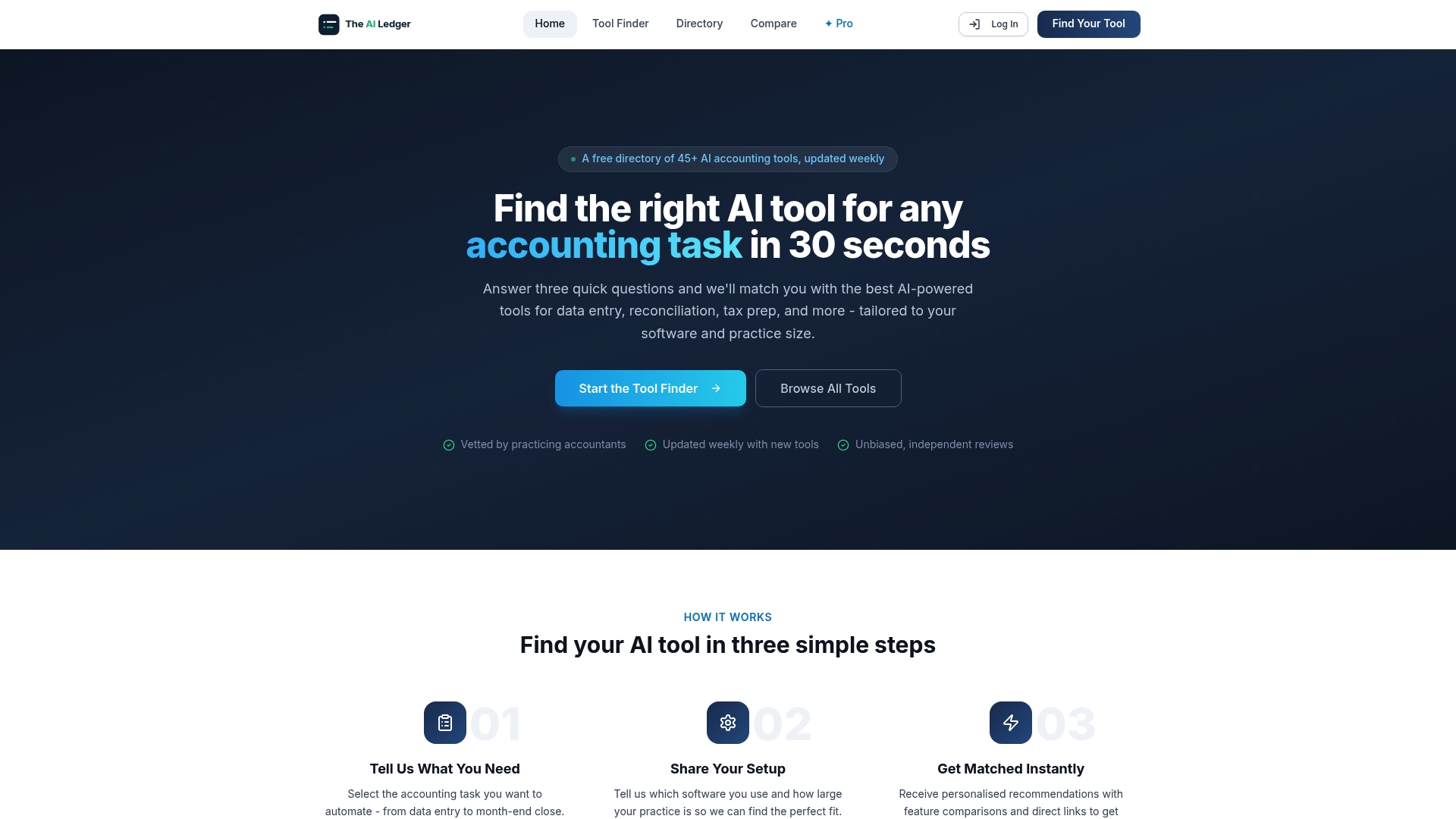
The directory covers 100+ AI accounting tools with independent editor scores, honest verdicts, and a last verified date on every listing. Scores are never for sale. The 30-second tool finder matches your practice size, your ledger platform, and the specific task you want to automate, whether that is AP processing, bank reconciliation, month-end close, or reporting, and returns a shortlist you can act on immediately. There is also a free weekly Friday newsletter covering new tool releases, feature updates, and pricing changes in plain English, with no vendor spin.
If you want a faster way to find the right fit for your stack, start with the directory and use the tool finder to narrow it down.