Accounting workflow automation is defined as the use of software rules, triggers, and AI agents to route tasks, enforce approvals, and process financial data without manual handling. The most impactful accounting workflow automation examples cut processing times by up to 93% and recover hundreds of staff hours annually. Firms that automate client onboarding, bank reconciliation, month-end close, and bookkeeping report measurable gains in accuracy, capacity, and control. This article covers the most practical automated accounting processes available to practices of every size in 2026.
1. What are the best accounting workflow automation examples?
Accounting workflow automation covers any process where software replaces a manual, repetitive step. The industry term for the broader discipline is workflow management in accounting, and it spans task routing, approval gates, document handling, and data extraction. The examples below move from client-facing processes to back-office operations, ordered by the volume of time they typically recover.
2. Client onboarding automation
Client onboarding is the highest-friction process in most practices. A five-component automation pipeline integrating tax software, DocuSign, billing, document classification, and intake forms can reduce onboarding from hours to under an hour.

One CPA firm achieved a 78% reduction in onboarding time, cutting 4.2 hours per client down to 47 minutes and recovering 690 staff hours annually. The firm reached ROI in 34 days. That result is not exceptional. It reflects what happens when conditional logic and API workflows replace email chains and manual data re-entry.
The automation pipeline works like this:
- A new client submits an intake form, which triggers account creation in the billing system.
- DocuSign sends engagement letters automatically, with conditional clauses based on service type.
- Uploaded documents are classified and filed without staff intervention.
- Tax software receives client data directly from the intake form via API.
- A completion trigger notifies the assigned accountant when onboarding is ready for review.
Pro Tip: Map your current onboarding steps on paper before building any automation. Every manual decision point is a candidate for a conditional rule.
3. Bank reconciliation automation
Bank reconciliation is the most time-consuming daily task for bookkeepers. AI finance agents now handle the bulk of transaction matching, learning vendor patterns and applying them consistently across accounts.
Firms using AI agents in reconciliation reduced reconciliation time by 80–93%, with one firm cutting month-end close from five days to one. Another reduced reconciliation from 15 hours to under one hour per account. That shift moves staff from data entry to exception handling and advisory work.
The accuracy curve matters here. AI reconciliation agents improve from roughly 80% to over 95% accuracy as they learn client-specific vendor patterns through human-in-the-loop feedback. The practical implication is that you should expect a calibration period of two to four weeks before accuracy stabilises.
A typical automated reconciliation workflow includes:
- Automated import of bank feeds and ledger transactions.
- AI matching of transactions by vendor name, amount, and date pattern.
- Exception queue for unmatched or ambiguous items requiring human review.
- Tiered approval routing based on transaction value thresholds.
- Audit trail generated automatically for every matched and reviewed item.
| Task | Manual process | Automated process |
|---|---|---|
| Transaction matching | 15 hours per account | Under 1 hour per account |
| Month-end close | 5 days | 1 day |
| Accuracy rate | Variable, error-prone | 95%+ with feedback loop |
| Staff focus | Data entry | Exception review and advisory |
4. Month-end close workflow automation
Month-end close is traditionally a high-pressure, compressed event. Automation converts it into a controlled, evidence-driven flow that runs throughout the month rather than collapsing into a final-week scramble.
Automating month-end close for a client with 80 entities saved 6,000 hours annually by automating report pulling, data analysis, and journal entry generation. New workflows save 3–7 hours per branch monthly by scripting recurring tasks. That scale of saving comes from standardising the process first, then automating each scripted step.
The key components of an automated close workflow are:
- Recurring task checklists that trigger on a set date each month.
- Dependency routing, so task B only becomes available after task A is signed off.
- Automated status tracking visible to all team members and partners.
- Approval gates that require attached evidence before a task can be marked complete.
- Journal entry templates that pre-populate from prior-period data and flag variances.
Automation also captures the audit trail that manual close processes often miss. Every approval, every document upload, and every variance flag is recorded automatically. That evidence supports both internal review and external audit without additional preparation.
Pro Tip: Start with one close task, such as the bank reconciliation sign-off, and automate that single step before building the full close workflow. A working proof of concept is more persuasive than a plan.
You can find detailed guidance on building these processes in Ailedger's guide to accounting workflow templates.
5. AI bookkeeping agents for data extraction and posting
Modular AI agents handle the individual micro-tasks that make up bookkeeping: reading PDFs, applying tax codes, creating transactions, and uploading documents. Each agent does one job well, which makes the overall system easier to maintain and debug.
Splitting responsibility among specialised agents for extraction, categorisation, and filing avoids the failure modes of monolithic workflows. When one agent fails, the others continue. You fix the broken component without rebuilding the entire pipeline.
Trigger-based workflows make this accessible without coding knowledge. An email arrives with a receipt attached. The trigger fires. An extraction agent reads the document, a categorisation agent applies the correct nominal code, a posting agent creates the transaction in the ledger, and a filing agent archives the original document. The whole sequence runs in seconds.
Automated bookkeeping workflows triggered by email can extract, categorise, post, and archive documents with minimal manual review. One implementation reduced receipt processing from minutes to seconds per item. Across a month, that compounds into hours recovered.
Pro Tip: Build your categorisation agent around your existing chart of accounts. The more specific the rules, the fewer exceptions land in the review queue.
For a broader view of how AI fits into bookkeeping practice, Ailedger's guide on AI in bookkeeping covers the full range of applications.
6. Automated invoice processing
Invoice processing automation handles the full lifecycle from receipt to payment approval. The process begins when an invoice arrives by email or upload, and ends when the payment is approved and posted.
The automation reads the invoice using optical character recognition or AI extraction, matches it against the relevant purchase order, routes it to the correct approver based on value thresholds, and posts the transaction once approved. Discrepancies trigger an exception flag rather than a manual chase. This is one of the clearest examples of time-saving accounting automations because the volume is high and the steps are highly repetitive.
Firms that automate invoice processing typically report a sharp reduction in late payment penalties and duplicate payments. Both outcomes follow directly from removing manual re-keying, which is the primary source of invoice errors.
7. Automated financial reporting
Automated financial reporting pulls data from the ledger, applies pre-set templates, and generates management accounts, variance reports, and board packs on a scheduled basis. The report runs without a staff member pulling figures manually.
The practical benefit is consistency. Every report uses the same data source, the same calculation logic, and the same format. That removes the version-control problems that arise when reports are built manually in spreadsheets. Ailedger covers the implementation detail in its guide to automated financial reporting.
Variance analysis is the area where automation adds the most value beyond time saving. When the system flags a variance automatically, the accountant reviews the cause rather than spending time finding it. That shift is the practical definition of moving from data entry to advisory work.
8. Choosing the right automation for your practice
The right automation depends on task volume, process complexity, and the level of human judgement required. A solo bookkeeper and a multi-partner firm face different constraints, but the selection criteria are the same.
| Automation type | Best for | Human oversight required |
|---|---|---|
| Client onboarding pipeline | Firms with high new-client volume | Low, post-setup review only |
| Bank reconciliation AI | Any practice with regular bank feeds | Medium, exception queue review |
| Month-end close workflow | Multi-entity or multi-partner firms | High, approval gates at each stage |
| Bookkeeping AI agents | High-volume transaction processing | Low to medium, categorisation review |
| Invoice processing automation | Practices with AP or purchase ledger work | Medium, discrepancy handling |
Standardising workflows before automation is the most consistent best-practice recommendation across all automation types. Automating a broken process makes it break faster. Document the current process, identify the decision points, and then build the automation around a clean, agreed workflow.
Automation enforces control by applying approval rules, evidence requirements, and audit trails. That addresses the most common partner concern about automation, which is loss of oversight. The evidence shows the opposite is true.
Key takeaways
Accounting workflow automation delivers the greatest returns when applied to high-volume, repetitive processes with clear decision rules and documented approval requirements.
| Point | Details |
|---|---|
| Onboarding automation saves the most time | A five-component pipeline can cut onboarding from 4.2 hours to 47 minutes per client. |
| Reconciliation AI reaches 95%+ accuracy | Human-in-the-loop feedback trains AI agents to near-full accuracy within weeks. |
| Month-end close becomes continuous | Dependency routing and approval gates replace the end-of-month scramble with a controlled flow. |
| Modular agents outperform monolithic systems | Specialised agents for extraction, categorisation, and posting are easier to fix and maintain. |
| Standardise before you automate | Documenting your current process is the prerequisite for any automation that holds up under audit. |
Why I think most firms automate in the wrong order
The instinct is to grab the most impressive-looking tool and point it at the biggest problem. I understand that instinct. But the firms that get lasting results from automation almost always do the unglamorous work first: they write down exactly what happens today, step by step, before they touch a single workflow builder.
Accounting workflow automation is a coordination layer that improves scheduling and task tracking. It does not replace professional judgement. That distinction matters because it tells you where automation belongs in your practice: handling the routing, the matching, the filing, and the reminders, while your team handles the decisions that require context and expertise.
The controls-first approach is the one I keep coming back to. Define your approval rules and evidence requirements before you automate any posting. That single discipline keeps you audit-ready and gives partners the visibility they need to trust the system. The controls-first approach to automation is not a constraint on speed. It is what makes speed sustainable.
Small, modular automations also beat large, ambitious ones in practice. A workflow that automates one step reliably is more valuable than a pipeline that automates ten steps inconsistently. Build the bank reconciliation trigger first. Get it working. Then add the exception routing. Then add the approval gate. Compounding small wins is how practices end up recovering hundreds of hours a year without a single dramatic implementation project.
— Aaron
Ailedger's tool directory for accounting automation
Ailedger tracks and rates the AI tools that accounting professionals are actually using to automate their workflows. The directory covers tools for onboarding automation, bank reconciliation AI, bookkeeping agents, and month-end close workflows, with plain-English assessments of what each tool does well and where it falls short.
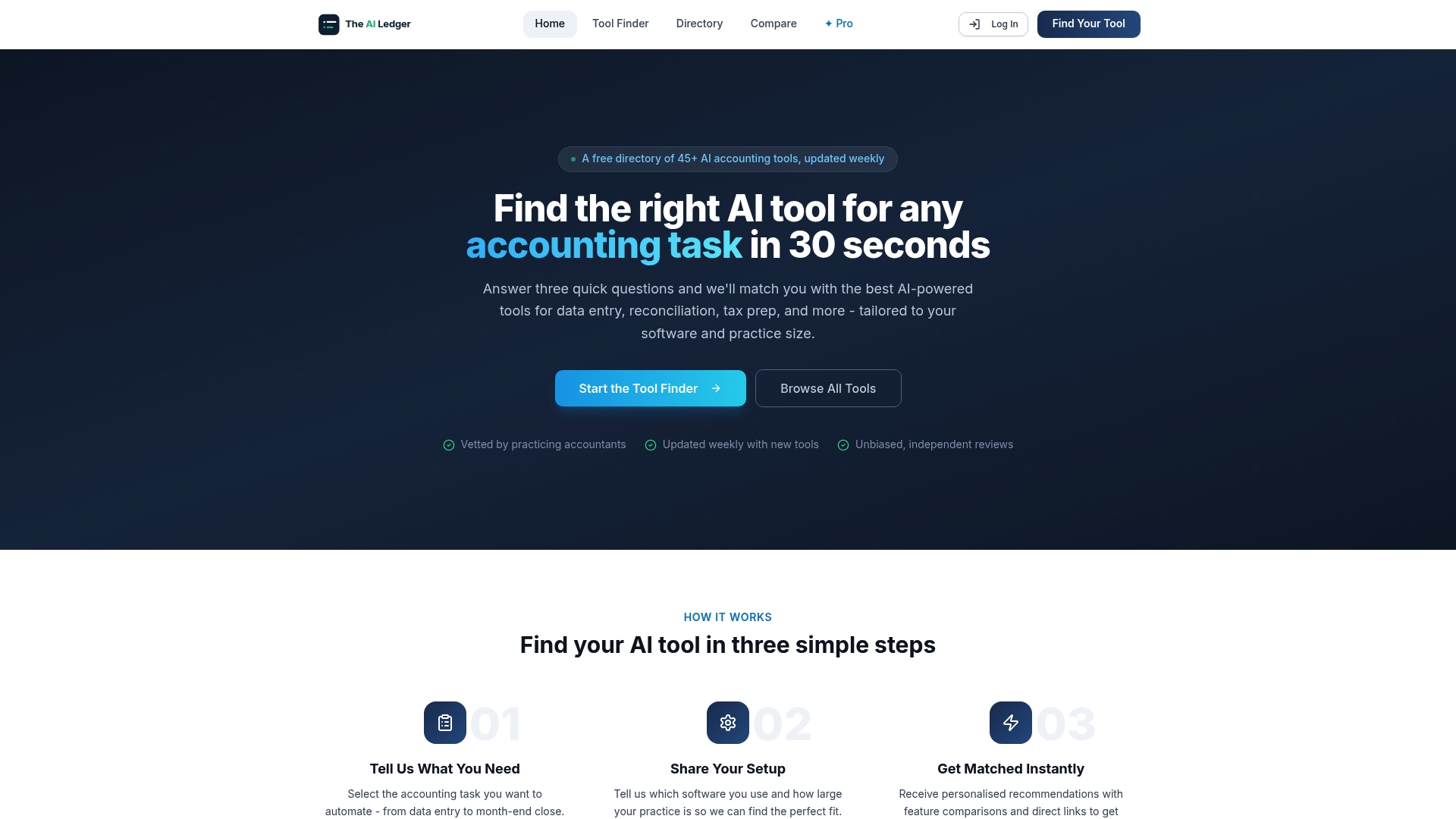
If you are evaluating AI tools for your practice, the CPA Pilot listing covers AI-assisted workflow automation built specifically for accounting firms. The Mesh tool page covers AI-driven workflow support from onboarding through close. Both listings include feature breakdowns and use-case guidance to help you match the tool to your process before you commit.
FAQ
What is accounting workflow automation?
Accounting workflow automation is the use of software rules, triggers, and AI agents to route tasks, enforce approvals, and process financial data without manual handling. It acts as a coordination layer that improves consistency and traceability across accounting processes.
How much time can automation save in a typical accounting practice?
Time savings vary by process. Bank reconciliation automation reduces reconciliation time by 80–93%, while client onboarding automation can cut processing time by 78%. Month-end close automation has saved firms with multiple entities up to 6,000 hours annually.
Do I need coding skills to automate accounting workflows?
Trigger-based workflow tools allow accountants to build automations using plain-English rules and conditional logic, without writing code. Most modern cloud accounting solutions include no-code workflow builders as standard features.
Is automated accounting less accurate than manual processing?
AI reconciliation agents reach over 95% accuracy with human-in-the-loop feedback, which exceeds typical manual accuracy rates affected by fatigue and re-keying errors. Automation also enforces consistent rules and generates audit trails that manual processes rarely produce.
Where should a practice start with workflow automation?
Standardise and document your current process before building any automation. Start with one high-volume, repetitive task such as bank reconciliation or invoice receipt, and expand once that first automation runs reliably.