AI-powered spend categorisation is machine learning and natural language processing that automatically assigns bank transactions, invoices and receipts to the correct ledger accounts, expense categories and VAT or tax codes, without a bookkeeper manually keying in each line.
- Hybrid models combining BERT-style text embeddings with gradient boosting classifiers have hit classification accuracy above 97% on complex transaction datasets.
- Common algorithms range from logistic regression and random forest through to transformer-based neural networks, each suited to different volumes and complexity.
- The AI Ledger's directory lets you compare over 100 of these tools by feature, integration and editor score in minutes, not weeks.
The practical verdict: done well, it cuts manual coding time sharply, pushes genuine judgement calls into a review queue, and leaves the bookkeeper firmly in control of what actually gets posted.
Key Takeaways
| Point | Details |
|---|---|
| Definition matters | It maps bank transactions, invoices and receipts to ledger accounts, categories and tax codes using ML and NLP. |
| Hybrid models lead on accuracy | BERT plus gradient boosting architectures have reached above 97% accuracy on complex transaction datasets. |
| Confidence thresholds drive workflow | Auto-post typically sits between 88% and 92% confidence, with lower scores routed to review. |
| Validation needs multiple metrics | Exact match, near match, recall and precision each reveal different weaknesses, don't rely on one figure. |
| Compare tools before committing | The AI Ledger's directory and 30 second tool finder shortlist options by integration and editor score. |
Table of Contents
- How does AI categorise spending in bookkeeping software?
- Which machine learning methods power automated spend categorisation?
- What are the practical benefits for accounting practices?
- How accurate is AI spend categorisation, and how do you validate it?
- How do you implement AI categorisation in a practice?
- Should you buy off-the-shelf or build a custom model?
- Find and compare AI categorisation tools with The AI Ledger
- Frequently asked questions
- Sources
How does AI categorise spending in bookkeeping software?
The pipeline starts with raw inputs: bank feed rows, OCR-extracted text from invoices and receipts, transaction metadata (amount, date, currency, counterparty), plus historical labels and vendor libraries built up from past coding decisions. None of that is usable as-is, so preprocessing comes first.

Merchant names get normalised ("AMZN MKTP UK" becomes "Amazon"), free text is tokenised and cleaned, and structured fields are converted into features the model can actually use. From there, the classification pipeline runs in stages: an NLP model creates a text embedding from the description, that embedding gets fused with structured features like amount and vendor history, and a classifier assigns a category with a confidence score attached.
That confidence score decides what happens next: auto-post if it clears the threshold, route to a review queue if it doesn't, or flag for client confirmation on genuinely ambiguous items.
- Bank feed rows, OCR text, transaction metadata and vendor libraries feed the model.
- Preprocessing normalises merchants, tokenises text and builds structured features.
- NLP embedding plus feature fusion plus classifier equals a category with a confidence score.
- Confidence scoring routes transactions to auto-post, to review, or to client confirmation.
Pro Tip: Get your vendor mapping and confidence thresholds right before you touch model tuning. Most categorisation errors trace back to sloppy vendor libraries, not weak algorithms.
Which machine learning methods power automated spend categorisation?
Classic models still do a lot of heavy lifting here. Logistic regression and support vector machines handle straightforward, well-labelled data efficiently, and random forest and gradient boosting cope well with mixed structured features like amount, frequency and merchant category code. Where they struggle is messy, inconsistent free text, the kind you get from a payment description that reads "PYMT REF 88342 LONDON".
That's where transformer-based embeddings, the technology behind BERT, earn their keep. They read payment descriptions and invoice line items more like a human would, picking up context that a bag-of-words model misses entirely. The pattern gaining traction across comparative machine learning research combines both worlds: embed the text with a transformer, then feed those embeddings alongside structured features into a gradient boosting classifier such as XGBoost.

| Approach | Handles messy text | Training complexity | Inference speed | Typical accuracy band |
|---|---|---|---|---|
| Logistic regression / SVM | Poor | Low | Fast | Moderate |
| Random forest / gradient boosting | Moderate | Moderate | Fast | Good on structured data |
| Hybrid BERT + XGBoost | Strong | High | Moderate | Above 97% on tested complex datasets |
That top-end figure isn't a marketing claim. It's the reported result from testing a hybrid BERT+XGBoost architecture against genuinely messy, text-heavy transaction data, exactly the kind that trips up simpler models.
What are the practical benefits for accounting practices?
The headline benefit is time. Month-end close speeds up because most transactions never need a human hand at all, and what's left in the queue is the genuinely ambiguous stuff, not the routine coffee run or software subscription your team has coded a hundred times before.
- Faster month-end close with fewer transactions needing manual review
- Consistent categorisation across clients, removing the "different bookkeeper, different code" problem
- Lower headcount pressure as portfolios grow
- Better reporting quality, since categories stop drifting between periods
- Quicker anomaly detection, because odd transactions stand out against a clean baseline
Recurring vendor coding is the clearest win, followed by receipt matching and support for split transactions across multiple expense lines. Multi-client practices get an extra edge: the system learns patterns across an entire portfolio, not just one client's history. Practices deploying this kind of automation have reported handling 35% to 55% more clients per bookkeeper once vendor mapping and thresholds are properly tuned.
How accurate is AI spend categorisation, and how do you validate it?
Accuracy isn't one number, it's several, and vendors love quoting only the most flattering one. Exact match accuracy tells you how often the model picks the precise account you'd have chosen. Near-match (or parent category) accuracy is more forgiving, and recall, precision and F1-score matter most when you're worried about specific error types, like missed VAT-relevant transactions.
Independent testing on 10,000 real business transactions found AI exact-match accuracy around the low 90% range, with near-match accuracy higher, comfortably ahead of business owners self-categorising at a substantially lower rate. Processing speed was much faster with AI, processing 100 transactions in seconds compared to tens of minutes for self-categorisation.
Error modes cluster in predictable places: vague bank descriptors, first-time vendors with no history, merchants that serve mixed purposes (a supermarket that sells both groceries and office supplies), and receipts covering several expense categories at once.
- Check the vendor's labelled dataset size and how recent it is.
- Ask how the tool surfaces low-confidence rows, not just its headline accuracy figure.
- Confirm there's an audit trail for every automated decision.
- Expect accuracy to climb as the model learns from your corrections, typically stabilising after a few months of use.
How do you implement AI categorisation in a practice?
Rolling this out well is less about the algorithm and more about sequencing. Rush the integration and you'll spend months firefighting miscoded transactions instead of saving time.
- Map your integrations first: which bank feeds, which accounting platform (Xero, QuickBooks, Sage, FreeAgent), and how historical data will import.
- Build your initial vendor mapping and set confidence thresholds before going live.
- Run a pilot with one client or a small cohort for one to three months, reviewing everything the AI suggests.
- Roll out more broadly once the review queue shrinks to a manageable size.
- Keep refining, correction data trains the model, so review effort should keep falling.
At the demo stage, push vendors on specifics rather than accepting vague reassurance:
- How exactly is the confidence score calculated, and can thresholds be adjusted per client?
- How large and current is the vendor matching library?
- Is there an exportable audit trail and correction log?
- Does the system learn across your entire client portfolio, or only within one company file?
- What are the data retention and security policies?
Auto-post thresholds commonly sit between 88% and 92% confidence, with anything below routed to a review or client confirmation queue.
Pro Tip: Run a parallel period where the AI suggests categories but nothing posts automatically. It's the fastest way to tune thresholds and catch vendor mapping gaps before they hit a client's ledger.
Should you buy off-the-shelf or build a custom model?
Most practices don't need a custom model, and building one is expensive to get wrong. Off-the-shelf tools win when you need speed, standard integrations and ongoing vendor support, which covers the vast majority of small to mid-size practices.
Custom models only start to make sense for very large portfolios with genuinely unusual vendors, a non-standard chart of accounts, or specialised tax coding needs that no off-the-shelf tool handles well.
- Time to value: off-the-shelf deploys in weeks; custom builds take months.
- Transaction volume and diversity: high diversity favours flexible, well-trained commercial tools.
- In-house ML capability: few practices have this; most shouldn't try to build it.
Pro Tip: Start off-the-shelf and only build custom augmentations for the handful of edge cases that keep recurring, don't reinvent the whole pipeline for one awkward client.
A note from practising-accountant readers
AI doesn't replace the bookkeeper's judgement, it relocates it. Instead of keying in every line, you're managing exceptions and reading what the numbers say about a client's business. That shift only works if your chart of accounts is clean to begin with. Feed a messy structure into even the best model and you'll just get consistently wrong answers, faster.
Find and compare AI categorisation tools with The AI Ledger
Reading about hybrid BERT+XGBoost architectures is one thing, working out which commercial tool actually implements something close to it, at a price and integration level that suits your practice, is another problem entirely. The AI Ledger exists to close that gap: an independent directory of over 100 AI tools for accountants and bookkeepers, each carrying an editor score that's never for sale and a last verified date so you know the listing hasn't gone stale.
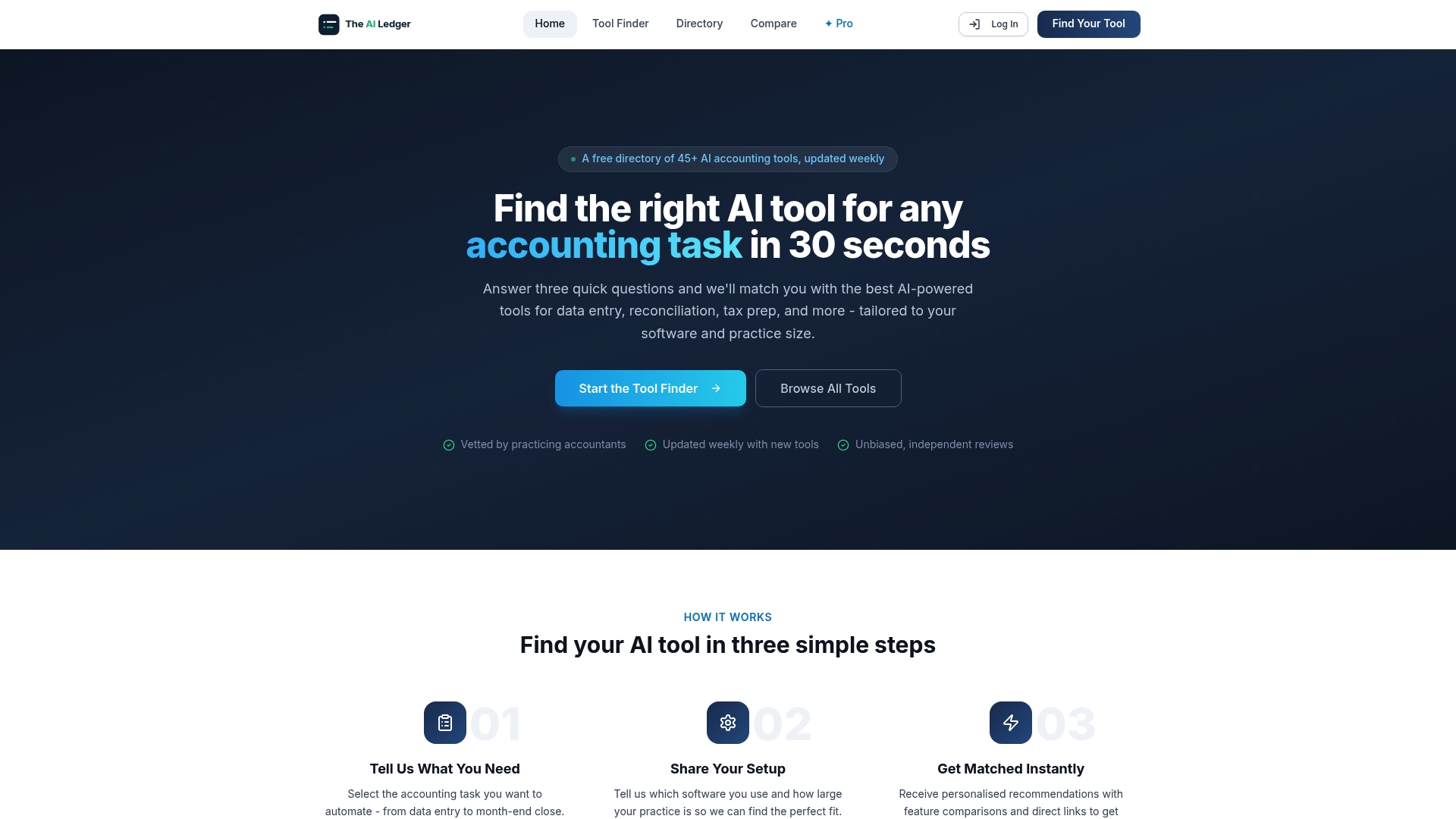
Run your requirements through the 30 second tool finder and it shortlists options that actually integrate with your accounting platform, whether that's Xero, QuickBooks, Sage or FreeAgent, rather than making you trawl marketing pages one by one. If receipt and invoice capture is your bottleneck, the Datamolino listing is worth a look, and for broader transaction categorisation features, compare the Puzzle and CPA Pilot pages side by side. Start with the tool finder, shortlist two or three candidates, and book demos armed with the vendor questions above.
Frequently asked questions
What is AI-powered spend categorisation in plain terms? It's software that reads a bank transaction or invoice and automatically assigns it to the right ledger account, expense category and tax code, using machine learning rather than manual keying.
How is this different from bank rules in Xero or QuickBooks? Bank rules are deterministic, matching exact text patterns you've set up. AI categorisation is probabilistic, so it can handle new or unfamiliar vendors that no rule was written for. Most effective setups combine both, rules for your top recurring vendors, AI for everything else.
Can AI categorisation handle VAT and tax codes, not just expense categories? Yes, provided the model is trained on your jurisdiction's coding structure. It's typically part of the same classification output alongside the ledger account and category.
Does AI categorisation replace the bookkeeper? No. It shifts the bookkeeper's time from manual coding towards reviewing exceptions, checking low-confidence transactions and interpreting what the categorised data actually shows about a client's business.
How long does it take to see accurate results after implementation? Expect a learning curve of one to three months as the model adapts to your vendor library and correction history, with accuracy typically improving steadily over that period rather than arriving fully formed on day one.
Sources
- Comparative analysis of machine learning algorithms for classifying accounting transactions (hybrid BERT+XGBoost) | TAJMEI (DOI)
- How Accurate Is AI Expense Categorization? Real Numbers from 10,000 Transactions | Finntree Blog
- Automate Bank Transaction Categorization for Bookkeeping in 2026