What is automated accrual accounting?
Automated accrual accounting is the use of software and AI to identify, calculate, post, and reverse accrual entries without manual intervention. Rather than relying on spreadsheets and email chains, the system pulls data directly from upstream sources, such as purchase orders, payroll files, and contracts, applies predefined rules, and posts the resulting journal entries to the general ledger automatically.
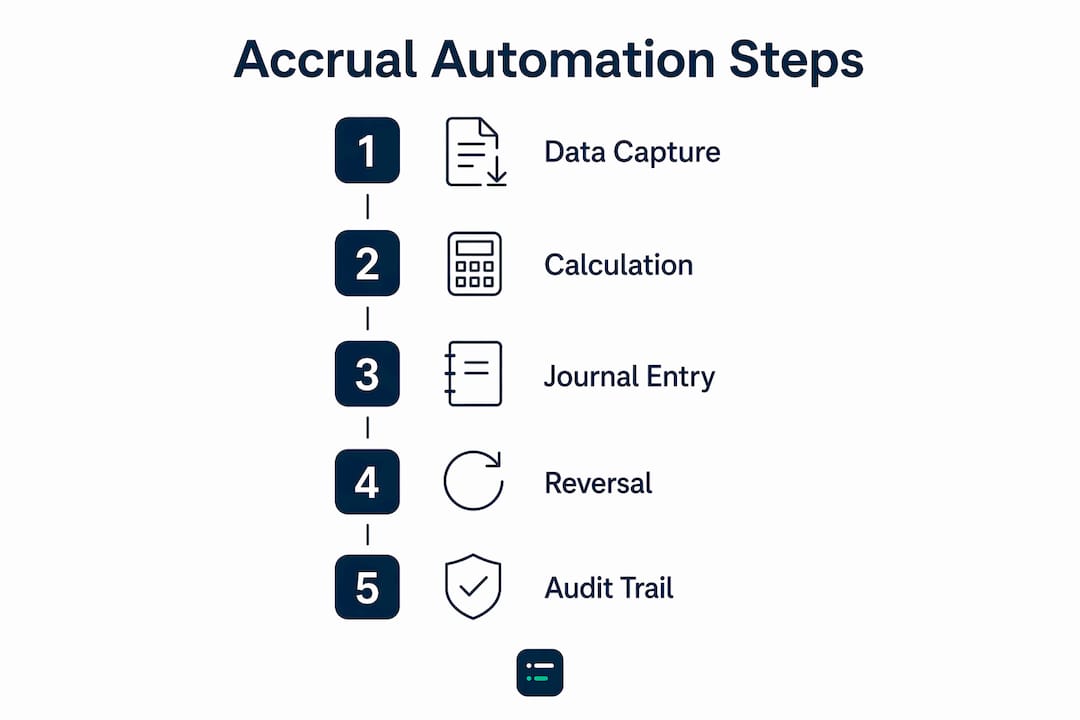
The full accrual lifecycle covers four stages:
- Data collection: the system gathers relevant figures from ERP modules, procurement platforms, and HR systems.
- Rule-based calculation: predefined logic determines the accrual amount for each entry type.
- Journal entry creation: entries post to the ledger with correct account coding, period assignment, and supporting documentation.
- Automatic reversal: the reversing entry schedules and posts at the start of the next period without any manual step.
The underlying accounting principle stays the same: revenues and expenses are recognised in the period they are earned or incurred, not when cash moves. Automation does not change that principle. It removes the manual execution that has historically made accruals the most labour-intensive part of the month-end close.
Table of Contents
- Why manual accrual processes create so many problems
- How automation transforms the accrual process
- What does automated accrual accounting do for your business?
- Real-world use cases in UK businesses
- How to implement automated accrual accounting successfully
- What does accrual automation mean for the future of finance teams?
- Defining automated accrual accounting: the standard industry term
- Key takeaways
Why manual accrual processes create so many problems
Ask any finance team where month-end pain concentrates, and accruals come up every time. The structural reason is straightforward: you are recording something that has happened economically but lacks the paperwork to prove it yet. That forces the team to piece together data from multiple disconnected sources under deadline.
The practical consequences are predictable:
- Data assembly is slow: teams gather figures from emails, procurement systems, budget owners, and prior-period spreadsheets, often manually copying numbers between files.
- Logic lives in spreadsheets: accrual calculations sit in Excel templates maintained by individuals, not in the ERP, so logic varies by preparer and period.
- Reversals get missed: automating the accrual entry but manually posting the reversal reintroduces error risk from manual reversals, one of the most common audit findings.
- Audit trails are weak: when logic is buried in offline models, auditors cannot reconstruct how an estimate was reached.
- Late postings cascade: accruals that post late delay ERP batch jobs, throw intercompany eliminations out of sync, and push dashboards to show estimates rather than actuals.
Replacing spreadsheet middlemen with direct upstream data collection addresses the root cause rather than the symptom. The problem is not that finance teams lack diligence. The problem is that the process was never designed to scale.
How automation transforms the accrual process

Automation does not eliminate judgement. It eliminates repetitive execution. The distinction matters because it sets realistic expectations about what software can and cannot do.
Here is how a well-built automated accrual workflow operates:
- Rule libraries and templates: recurring accruals, such as rent, subscriptions, and predictable monthly costs, are defined once and post automatically each period.
- Upstream data integration: accrual amounts pull directly from purchase orders, goods receipts, payroll files, and contracts rather than being keyed in manually.
- Full lifecycle handling: the system generates both the accrual entry and its reversing entry as a paired unit, so the reversal posts automatically at the start of the next period.
- Exception routing: accruals above a threshold or flagged as judgmental are routed to reviewers with pre-assembled data and a proposed entry, keeping human attention on cases that genuinely need it.
- Audit trail: every entry links back to its source transaction, calculation logic, and approval history, making the accrual reconstructable for auditors.
Pro Tip: Always automate the entry and reversal as a pair. Automating only the posting step and leaving reversals manual defeats the purpose. The reversal is where forgotten entries and double-counting creep in.
| Feature | Manual process | Automated process |
|---|---|---|
| Data assembly | Manual, from emails and spreadsheets | Pulled directly from ERP and upstream systems |
| Calculation logic | Varies by preparer | Standardised rule library, consistent each period |
| Reversal posting | Manual, often forgotten | Scheduled automatically as part of the same workflow |
| Audit trail | Offline, in spreadsheet files | Embedded, linked to source transactions |
| Exception handling | Ad hoc | Routed with pre-assembled data for human review |
What does automated accrual accounting do for your business?
The business case for accrual automation is not abstract. Finance teams that move from manual to automated processes see concrete changes in how the close runs and how confident they feel in the numbers.
Key impacts include:
- Faster month-end close: automated accruals reduce manual journals and last-minute adjustments, which are two of the biggest contributors to close delays.
- Fewer material misstatements: audit-ready logs link entries back to source transactions and approval history, reducing the risk of errors that auditors flag.
- Consistent period-over-period logic: because the same rules run each period, variance analysis becomes meaningful rather than an exercise in reconciling preparer differences.
- Scalability without headcount growth: high-volume recurring accruals run automatically, so the team can manage more entities or cost centres without adding staff.
- Shift from data entry to review: finance professionals spend time on judgement and variance analysis rather than on copying figures between systems.
Finance leaders increasingly treat accrual automation as a strategic priority rather than a tactical fix, precisely because manual close processes do not scale. The volume of recurring entries grows with the business; the manual effort grows with it unless the process changes.
Real-world use cases in UK businesses
Different accrual types automate to different degrees, and understanding that distinction is what separates a successful implementation from a frustrating one.
Accruals that automate cleanly:
- Recurring fixed costs (rent, insurance, subscriptions) where the amount is known or rule-based.
- Received-but-not-invoiced accruals calculated from purchase order and goods receipt data.
- Payroll accruals drawn directly from HR and payroll system outputs.
- Prepaid expense amortisation following a fixed schedule.
Accruals that benefit from automation support but need human review:
- Significant judgmental estimates, such as warranty provisions or litigation accruals, where professional judgement determines the amount.
- Project completion accruals where the underlying data is incomplete or contested.
- Accruals above a materiality threshold that require sign-off before posting.
Tools like ExpensePlus handle auto-accrual lifecycle management for recurring and rule-based categories, which is where the bulk of accrual volume sits in most UK businesses. The honest picture, as AI accounting analysis for 2026 confirms, is that AI handles the mechanical and calculable majority while genuinely judgmental estimates remain human-reviewed. That is not a limitation. It is the correct boundary, and it is where most of the time savings are.
UK firms operating under FRS 102 or IFRS benefit from the audit trail and consistency that automation provides, particularly where auditors scrutinise accrual estimates closely. Integration with ERP systems commonly used in the UK market, including SAP, Oracle, and Microsoft Dynamics, means automated workflows can connect to existing infrastructure rather than requiring a wholesale system change.

How to implement automated accrual accounting successfully
Getting accrual automation right requires more than switching on a new feature. The teams that see the biggest gains treat it as a process redesign, not a software installation.
- Categorise your accruals first: map every recurring accrual type and classify it by automation suitability. High-volume, rule-based accruals are your starting point. Judgmental estimates come later, with automation supporting data assembly rather than replacing review.
- Automate the full lifecycle, not just the entry: full lifecycle automation covering both the accrual and its reversal is what makes the process reliable period over period. Partial automation creates a false sense of control.
- Connect to source systems directly: pulling data directly from source systems eliminates the spreadsheet layer that introduces errors and delays. Prioritise integrations with your ERP, procurement platform, and payroll system.
- Build governance into the workflow: approval routing, materiality thresholds, and reviewer sign-off should be part of the automation design, not bolted on afterwards.
- Define exception handling clearly: automation platforms route exceptions to reviewers with pre-assembled data. Define who reviews what, and at what threshold, before go-live.
- Train the team on the new role: the shift from data entry to exception review is a genuine change in how finance professionals spend their time. Change management matters.
Pro Tip: Standardise your accrual logic enterprise-wide before automating it. If different departments use different calculation methods for the same accrual type, automation will embed the inconsistency rather than fix it. Agree the rules first, then codify them.
For finance teams exploring AI-driven bookkeeping automation, the accrual process is often the highest-value starting point because it combines high volume, repeatable logic, and significant manual effort.
What does accrual automation mean for the future of finance teams?
The shift is already underway. Finance professionals who spent the close chasing accrual data and posting journals are increasingly spending it reviewing exceptions, analysing variances, and advising on forward-looking decisions. Automation is what makes that shift possible at scale.
The strategic implications are worth naming directly:
- Finance roles evolve toward control and analysis: AI automation frees finance from mechanical accrual processing, allowing focus on high-value judgement and variance analysis.
- AI acts as a digital workforce for complex accruals: sophisticated AI agents can handle end-to-end tasks from data collection to draft journal entry creation, with humans reviewing rather than building.
- Human judgement remains essential: significant estimates, unusual items, and accruals with incomplete data still require professional review. Automation assembles the information; the accountant makes the call.
- Speed and auditability improve together: faster close cycles and cleaner audit trails are not a trade-off under automation. They happen simultaneously because the process is governed and documented by design.
- Scalability becomes a genuine option: as businesses grow, automated accrual workflows handle increased volume without proportional increases in manual effort.
Pro Tip: Think of accrual automation as a control framework, not a journal generator. The real value is in the governance it embeds: consistent logic, documented approvals, and a reconstructable audit trail. That is what transforms accruals from a close bottleneck into a controlled, repeatable process.
For a broader view of how accounting workflow automation fits into the 2026 finance function, the accrual process is a useful lens. Get it right here, and the same principles apply across reconciliation, reporting, and financial close.
Defining automated accrual accounting: the standard industry term
The recognised industry term is accrual accounting automation, sometimes called automated accrual management. Automated accrual accounting, as a phrase, describes the same concept: using software to handle the full accrual lifecycle without manual journal entries.
At its core, accrual accounting records revenues and expenses in the period they are earned or incurred, regardless of when cash changes hands. This is what distinguishes it from cash accounting and what both GAAP and UK GAAP (FRS 102) require for most businesses. The accrual is the mechanism: an entry that records something that has economically happened but is not yet reflected in the books because the invoice or documentation has not arrived.
Automation applies to that mechanism. The software identifies what needs accruing, calculates the amount from source data, posts the entry, and schedules the reversal, all without a preparer manually building a spreadsheet or keying in a journal. The accrual accounting lifecycle becomes a governed, repeatable process rather than a period-end scramble.
For teams evaluating where to start, agentic AI for back-office automation increasingly covers the accrual process as part of a broader finance automation programme, connecting source systems, applying business rules, and maintaining the audit trail that regulators and auditors expect.
Key takeaways
Automated accrual accounting replaces manual journal entry and reversal processes with governed, rule-based software workflows that pull data directly from source systems, improving close speed, accuracy, and audit readiness.
| Point | Details |
|---|---|
| Full lifecycle automation | Automating both the accrual entry and its reversal is what makes the process reliable; partial automation reintroduces error. |
| Accrual types vary | Recurring and rule-based accruals automate cleanly; judgmental estimates need human review with automation supporting data assembly. |
| Audit trail by design | Automated systems embed governance, linking every entry to its source transaction, calculation logic, and approval history. |
| Finance roles shift | Automation moves finance professionals from data entry to exception review, variance analysis, and forward-looking financial control. |
| Standardise before automating | Agreeing calculation logic enterprise-wide before codifying it prevents inconsistencies from being embedded into automated workflows. |