A finance digital twin is a continuously synchronised virtual replica of your organisation's financial state that lets finance teams run governed what-if simulations against the current books. Unlike a static model or a spreadsheet scenario, it maintains a live data bond to your core systems, so every simulation reflects today's actual position, not last month's snapshot.
Use one when the stakes of a wrong assumption are high and the speed of insight matters: intraday liquidity monitoring, regulatory stress testing, continuous scenario-based planning, fraud detection, and ESG-value mapping across product lifecycles.
Three components every finance leader should expect:
- Live data bond: real-time or near-real-time feeds from ERP, treasury, CRM and payments via change-data-capture (CDC) or event streaming
- Model layer: balance sheet, liquidity, portfolio and margin models that consume those feeds continuously
- Scenario engine: a governed, auditable layer for running what-if simulations and stress tests against the live model
Key takeaways
A finance digital twin is only a twin when a live data bond and continuous validation keep the virtual model synchronised with reality; without both, it is a static simulation.
| Point | Details |
|---|---|
| Definition | A continuously synchronised virtual replica of your financial state, not a static model or a batch-refresh report. |
| Top business value | Faster scenario testing, continuous planning, and live ESG-to-financial linkage replace point-in-time forecasting cycles. |
| Implementation priority | Start with one narrow use case; validate the data bond and reconciliation before building any model. |
| Governance non-negotiable | Appoint a model owner and independent validator before build starts; audit every scenario run from day one. |
| The AI Ledger | Use the directory and 30-second tool finder at ailedger.uk to identify integration and automation tools for your pilot. |
Table of Contents
- How does a finance digital twin work technically?
- What business benefits does a finance digital twin deliver?
- What do you need before starting a finance digital twin?
- How long does implementation take and what drives cost?
- What are the common pitfalls and governance requirements?
- How do vendor approaches compare?
- A practical checklist for your first pilot this quarter
- Security considerations for finance digital twins
- Real-world examples of finance digital twin impact
- Future trends shaping finance digital twins
- Integration challenges with existing legacy systems
- Sources
How does a finance digital twin work technically?
The architecture typically runs in four layers, as described by IoT Digital Twin PLM: data integration, model layer, scenario engine, and decisioning/output. Understanding each layer helps you assess technical feasibility before committing budget.
Data integration layer ingests live transactions and state changes from ERP, treasury management systems, payments rails, CRM, trade systems and process-mining inputs. CDC captures row-level changes as they occur; event streams carry payment and trade events in near real time. The output is a continuous, ordered feed of financial facts.
Model layer holds the balance sheet, liquidity, portfolio and margin models. These consume the integration feed and maintain derived views of your financial position. The critical pattern here is incremental view maintenance (IVM), which updates complex joins and aggregations as each new transaction arrives rather than recomputing from scratch on a schedule. IVM is what separates a true twin from a nightly batch refresh.
Scenario engine sits above the model layer and lets finance teams run parameterised simulations: shift a funding rate, remove a counterparty, apply a regulatory shock. SAP frames this as a flight simulator for FP&A, where teams observe direct impacts on P&L, balance sheet and cash flow in near real time rather than debating assumptions in slide decks.
Decisioning and output layer delivers role-based dashboards, alerts and audit trails. Every simulation run is versioned and logged, which is a non-negotiable requirement for regulated UK environments.
Key technology patterns to know:
- CDC and event streaming (Apache Kafka, AWS Kinesis or equivalent) for sub-minute data freshness
- Graph or semantic models for representing complex entity relationships across legal entities and counterparties, as recommended by the TechRxiv enterprise digital twins paper
- Reconciliation and drift checking to detect when the virtual model diverges from the source systems
- Role-based access and audit trails for compliance and model governance
For finance workloads, sub-minute freshness is achievable but requires deliberate infrastructure choices. Concurrency matters too: multiple users running stress scenarios simultaneously must not degrade the live data feeds that other systems depend on.
"Implementing a digital twin commonly fails when teams rely on batch-oriented architectures rather than building live data pipelines and reconcilers that support sub-minute freshness." Materialize, Digital twins in financial services
Pro Tip: Before you build a single model, run a data freshness audit. Query your ERP and treasury system at five-minute intervals for two weeks and measure actual lag versus the SLA you need. If the gap is large, fix the integration layer first. A sophisticated model on a slow feed is still a batch system.
| Layer | Primary inputs | Key pattern | Output |
|---|---|---|---|
| Data integration | ERP, treasury, payments, CRM | CDC, event streaming | Ordered transaction feed |
| Model layer | Integration feed | IVM, graph models | Live financial position views |
| Scenario engine | Model layer + parameters | Parameterised simulation | What-if P&L, balance sheet, cash flow |
| Decisioning/output | Scenario engine | Role-based dashboards, audit logs | Decisions, alerts, regulatory reports |
What business benefits does a finance digital twin deliver?
The clearest benefit is speed of insight. Finance teams move from a cycle of building scenarios in spreadsheets, reconciling versions and presenting assumptions to running a governed simulation in minutes against the actual current position. This shift compresses the time between a business event and a financial decision.
Core benefits finance leaders consistently report:
- Faster scenario testing with no manual reconciliation overhead between model and actuals
- Continuous planning that replaces point-in-time forecasting cycles
- Tighter alignment between operational data and financial outcomes
- Reduced model sprawl, since one governed twin replaces multiple disconnected spreadsheet models
- Cleaner audit trails for regulatory submissions and internal governance
The highest-value use cases tend to cluster around liquidity, risk and ESG. Materialize identifies intraday liquidity monitoring and fraud detection as two of the most compelling financial services applications, precisely because both require continuous, queryable views of complex relationships that batch systems cannot support.
BCG documents that advanced twins bring financial and non-financial data together, allowing organisations to measure value across product lifecycles and supplier networks, including CO2 emissions and other ESG metrics. For UK finance leaders facing Scope 3 reporting obligations, that capability is increasingly material. Pairing a twin with ESG integration best practices gives FP&A a structured way to connect sustainability data to financial outcomes.
"Advanced financial digital twins integrate non-financial data such as CO2 emissions and other ESG indicators to produce holistic views of value across product lifecycles and supplier networks." BCG, Why companies need digital financial twins
Pricing and margin simulations benefit from the same live data bond. When cost inputs change in real time, the twin surfaces margin impact immediately rather than waiting for a monthly close. For treasury teams, intraday cash positioning replaces the morning spreadsheet with a live view that updates as payments settle.
What do you need before starting a finance digital twin?
Readiness matters more than ambition here. Organisations that skip the prerequisites spend the first six months fixing data problems rather than running scenarios.
Preconditions to confirm before you start:
- Clean, mapped master data across legal entities, cost centres and counterparties
- Event streaming or CDC capability on your ERP and treasury systems, or a credible plan to add it
- A named model owner with authority over model governance and versioning
- A cross-functional skills mix: finance quants who understand the business drivers, data engineers who can build and maintain the pipelines, and a platform architect who can design for scale and auditability
- Defined acceptance criteria for what "correct" looks like in the model, agreed before build starts
Stepwise implementation path:
- Select a high-impact pilot use case with a narrow scope: intraday cash positioning or a single stress-test scenario works well. Avoid starting with a full balance sheet twin.
- Validate streaming and reconciliation before writing a single model. Confirm that your data integration layer can deliver the freshness your use case requires.
- Build a lean model covering only the entities and relationships the pilot use case needs. Resist the urge to model everything.
- Run interactive scenario use cases with the finance team as active participants, not passive recipients of a dashboard.
- Expand incrementally, adding use cases and data sources as the governance framework matures.
Treating the twin as an operational architecting exercise rather than a reporting project is the distinction that separates successful implementations from expensive failures.
| Dimension | Pilot | Production (one use case) | Enterprise roll-out |
|---|---|---|---|
| Best for | Proof of concept, single use case | One high-value workflow | Multi-entity, multi-use case |
| Data integration complexity | Low to medium | Medium | High |
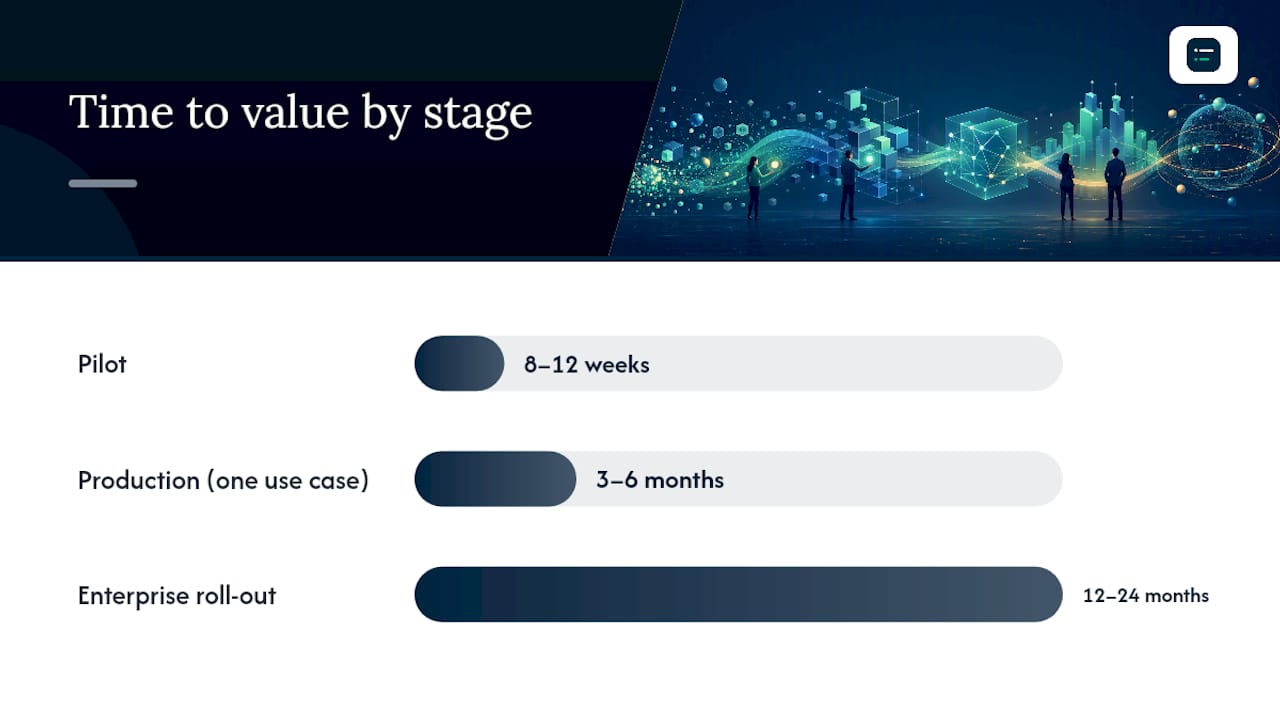
| Time to value | 8–12 weeks | 3–6 months | 12–24 months |
| Implementation effort | Small team, contained scope | Dedicated squad | Programme-level resource |
| Deployment model | Cloud (managed services) | Cloud or private | Cloud or private, often hybrid |
Pro Tip: Appoint your model validator before you appoint your model builder. Independent model validation (IMV) is far harder to retrofit than to build in from day one, and UK regulators expect it for models used in regulatory reporting.
Understanding accounting software integration patterns is useful groundwork here, since the same ERP and payment system connections that feed a twin are the ones your finance automation stack already depends on.
How long does implementation take and what drives cost?
Typical stages and timelines:
- Pilot (8–12 weeks): one use case, contained data scope, small team. Goal is to prove the data bond and run one governed scenario.
- Production of initial twin (3–6 months): one use case in production, full governance framework, integration with one or two core systems.
- Enterprise roll-out (12–24 months): multi-entity, multi-use case, full integration with ERP, treasury, CRM and trade systems.
The timeline variance is almost always driven by data integration effort, not model complexity. Organisations with mature CDC infrastructure and clean master data move faster. Those starting from a batch-oriented ERP with fragmented entity data spend the first phase on plumbing.
Primary cost drivers:
- Data integration engineering: building and maintaining live feeds from legacy systems
- Model engineering: finance quants and data engineers working together on model design and validation
- Validation and testing: IMV, reconciliation testing and scenario acceptance testing
- Infrastructure: cloud managed services are faster to start; private deployment costs more upfront but may be required for data residency reasons
- Ongoing operating cost: live feeds require monitoring, alerting and periodic recalibration as source systems change
Picking a narrow, high-leverage use case for the pilot is the single most effective way to compress time to value. Intraday liquidity for a single legal entity is a better pilot than a group-level planning twin. The finance automation metrics you define for the pilot should be measurable within the pilot window, not dependent on a full roll-out.
What are the common pitfalls and governance requirements?
The most frequent failure mode is calling a static model a twin. IoT Digital Twin PLM is direct on this point: the label is earned only when continuous data feeds keep the virtual model synchronised with reality. A nightly batch refresh is not a twin, regardless of how the vendor markets it.
Common pitfalls:
- Scope creep in the pilot: adding use cases before the data bond is validated
- Poor data lineage: no clear record of where each model input originates and when it was last updated
- Model drift: the model's assumptions diverge from the real system over time without anyone noticing
- Insufficient reconciliation: no automated check that the twin's outputs match the source systems within an agreed tolerance
- Governance by committee: too many stakeholders with sign-off authority and no single model owner
Governance checklist for UK finance leaders:
- Assign a named model owner with documented accountability
- Implement version control on all model definitions and parameter sets
- Run continuous automated reconciliation between twin outputs and source system actuals
- Conduct independent model validation (IMV) before any model is used for regulatory reporting or capital allocation decisions
- Maintain a full audit trail of every scenario run: who ran it, what parameters were used, what outputs were produced
- Review model assumptions quarterly or after any material change to the underlying business
For UK-regulated firms, the PRA and FCA have published model risk management expectations that apply to models used in stress testing and capital adequacy assessments. A finance digital twin used for those purposes sits within that framework. Data residency requirements may also constrain your deployment model if the twin processes personal or commercially sensitive data.
Without a defined threshold, drift goes unnoticed until it matters.*
How do vendor approaches compare?
No single vendor owns this space. The practical choice is between three broad approaches, each with different trade-offs on time to value, integration complexity and cost.
ERP-led assembly (SAP and similar): SAP's finance digital twin building blocks sit within its broader FP&A and analytics platform. The advantage is tight integration with SAP ERP data; the constraint is that organisations on non-SAP stacks face significant integration work. Best suited to large enterprises already standardised on SAP.
Consultancy-led transformation (BCG, Capgemini): BCG approaches the finance digital twin as a strategic transformation, connecting financial and non-financial data to produce enterprise-wide value measurement. Capgemini brings systems integration depth and a focus on data architecture and governance. Both are best suited to organisations that need programme-level change management alongside the technology. Time to value is longer; the output is more deeply embedded.
Specialised streaming and IVM engines (Materialize and similar): Purpose-built for the live data bond problem. Materialize's approach centres on IVM as the core pattern, enabling sub-minute freshness for complex financial views. Best suited to organisations with strong data engineering capability that want to build a custom twin rather than buy a packaged solution. Faster to a working prototype; requires more internal expertise to operate.
| Approach | Best for | Data integration complexity | Time to value | Implementation effort | Deployment model |
|---|---|---|---|---|---|
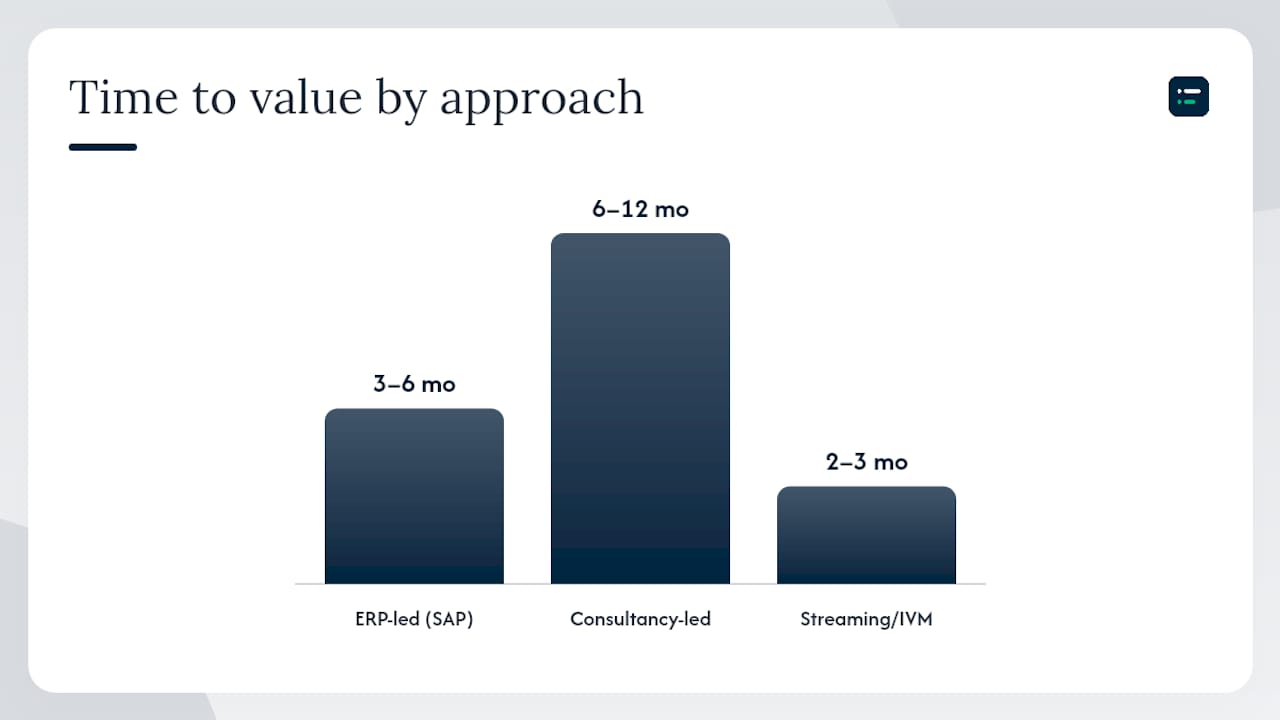
| ERP-led (e.g. SAP) | Large enterprises on SAP stack | Low within SAP; high outside it | 3–6 months for initial use case | High; requires SAP expertise | Cloud or private |
| Consultancy-led (e.g. BCG, Capgemini) | Enterprise transformation programmes | High; full data architecture work | 6–12 months | Very high; programme-level | Varies by client |
| Streaming/IVM engine (e.g. Materialize) | Data-engineering-led custom builds | Medium; requires pipeline expertise | 8–12 weeks for pilot | Medium; needs internal engineers | Cloud-native |
For AI-enabled scenario modelling that sits on top of a twin, the vendor choice at the model layer matters less than the quality of the data bond underneath it.
A practical checklist for your first pilot this quarter
Getting started does not require a full programme. A focused pilot with a narrow scope can produce a working proof of concept in 8–12 weeks.
Pilot readiness checklist:
- Pick one use case with a measurable outcome: intraday cash positioning, a single stress-test scenario, or a margin simulation for one product line
- Confirm live data feeds are available for the systems that use case requires; do not assume CDC is in place
- Appoint a model owner and a separate model validator before build starts
- Secure a small cross-functional team: one finance quant, one data engineer, one platform architect
- Define success metrics in advance: what does "correct" look like, and how will you measure it?
Suggested resources for deeper reading:
- SAP community post on reinventing FP&A with a financial digital twin — strategy and FP&A framing
- Materialize guide to digital twins in financial services — technical patterns and IVM
- BCG on why companies need digital financial twins — ESG and enterprise value measurement
- IoT Digital Twin PLM on architecture and use cases — governance and pitfalls
Pro Tip: Run your reconciliation checks before you run your first stress scenario. A scenario output is only as trustworthy as the data bond underneath it. Validate freshness and tolerance thresholds first, then stress test.
Security considerations for finance digital twins
A finance digital twin concentrates sensitive data in one place and keeps it continuously updated, which makes it a high-value target. Security cannot be an afterthought bolted on after the architecture is set.
The live data bond is the primary attack surface. CDC feeds and event streams carry transaction-level financial data in near real time. Any interception or manipulation of those feeds corrupts the twin's outputs without necessarily triggering an obvious alert. Encrypting feeds in transit and at rest, with strict authentication on every producer and consumer, is the baseline.
Role-based access control on the scenario engine matters as much as perimeter security. Not every finance user should be able to run arbitrary stress scenarios against live capital positions. Defining scenario permissions by role, and logging every run with the user identity and parameter set, limits both accidental misuse and deliberate manipulation.
For UK firms, data residency is a practical constraint. If the twin processes personal data (customer 360 use cases, for example) or data subject to UK GDPR, the deployment model must keep that data within approved boundaries. Cloud-native deployments require explicit confirmation of data residency from the cloud provider, not just a contractual assurance.
Model governance and security overlap at the audit trail. A twin used for regulatory reporting must produce outputs that an auditor can trace back to their source data and the model version that produced them. That traceability is both a governance requirement and a security control: it makes tampering detectable.
Real-world examples of finance digital twin impact
Consultancy-led implementations at large financial institutions have demonstrated the value of connecting operational and financial data in near real time. BCG's published work on digital financial twins describes organisations using twins to measure value across supplier networks and product lifecycles, incorporating ESG metrics that were previously tracked in separate systems with no financial linkage.
In treasury, the intraday liquidity use case has moved from theoretical to operational at several tier-one banks. The ability to query a live view of cash positions across legal entities and currencies, updated as payments settle, replaces a process that previously required manual aggregation from multiple systems each morning.
SAP's FP&A implementations show a different pattern: finance teams replacing a cycle of spreadsheet model builds and assumption debates with interactive scenario runs against a shared, governed model. The organisational benefit is as much about alignment as speed. When every stakeholder runs scenarios against the same live model, the conversation shifts from "whose numbers are right?" to "what should we do?"
Fraud detection in financial services benefits from the customer 360 capability a twin enables. Maintaining a continuously updated view of customer behaviour, transaction patterns and relationship data allows anomaly detection models to operate against current state rather than a batch snapshot that may be hours old by the time a suspicious pattern is flagged.
Future trends shaping finance digital twins
The convergence of enterprise architecture and systems engineering is pushing twins toward graph-based semantic models that can represent the full complexity of a large organisation's financial relationships, including multi-entity structures, intercompany flows and external counterparty networks.
Generative AI is beginning to appear as a scenario-generation layer on top of the twin. Rather than a finance analyst manually parameterising a stress test, an AI agent proposes a set of scenarios based on current market conditions and the organisation's specific risk exposures. The twin provides the governed, live substrate; the AI provides the scenario intelligence. For a practical view of how AI sits within financial operations more broadly, the role of AI in financial operations is worth reading alongside this.
ESG integration will deepen. As Scope 3 reporting obligations become more specific and auditable, the ability to connect supplier-level emissions data to financial outcomes in a single governed model becomes a competitive and compliance advantage. The twin is the natural home for that connection.
Regulatory interest in model risk management is also growing. UK regulators are paying closer attention to how firms govern the models they use for capital and liquidity decisions. A well-governed finance digital twin, with full audit trails and IMV, is better positioned for that scrutiny than a collection of spreadsheet models with no version control.
Integration challenges with existing legacy systems
Legacy ERP and treasury systems were not designed for continuous data extraction. Most expose data through batch exports, scheduled reports or overnight feeds. Building a live data bond on top of that architecture requires either a CDC layer that reads the database transaction log directly, or a significant re-engineering of how the source system exposes data.
The practical challenge is that CDC requires database-level access that many finance teams do not control. The ERP is often managed by IT or a managed service provider, and getting approval to attach a log reader can take months. Starting the integration conversation with IT early, and framing it as a data access project rather than a finance project, tends to move faster.
Data quality in legacy systems is a second constraint. Master data inconsistencies, such as duplicate cost centres, inconsistent legal entity codes and unmapped intercompany relationships, surface immediately when you try to build a coherent model across systems. A data quality remediation sprint before the pilot is not optional; it is the work that makes the pilot possible.
Multi-entity structures add complexity. A group with 20 legal entities, each running a slightly different ERP configuration, requires entity-level mapping before the twin can produce a consolidated view. Automation tools for multi-entity accounting address some of this mapping work, and the patterns they use are directly relevant to the integration layer of a twin.
Finally, the operational systems that feed a twin change over time. A payment system upgrade, an ERP migration or a new CRM deployment can break the data bond without warning. Building automated reconciliation and alerting into the integration layer from the start is the only reliable way to catch those breaks before they corrupt the model.
The FP&A team should lead this, not IT
Finance digital twins are ultimately a finance problem, not a technology problem. The technology is the enabler; the value comes from finance teams who understand the business drivers well enough to define the right models, the right scenarios and the right acceptance criteria.
FP&A is the natural owner of that conversation. They understand the causal links between operational decisions and financial outcomes, which is exactly what the model layer needs to encode. The immediate governance actions are straightforward: name a model owner, define acceptance criteria before build starts, and insist on independent model validation from day one. The organisations that get this right treat the twin as a finance discipline with a technology dependency, not the other way around.
The AI Ledger helps you find the right tools for your pilot
Building a finance digital twin means connecting a lot of moving parts: ERP integrations, data pipelines, reconciliation tools, and AI-powered scenario engines. Finding the right software for each layer is where most teams lose time. The AI Ledger's directory of 100+ independently reviewed AI tools for finance and accounting teams cuts that research time significantly. Every listing carries an editor score, an honest verdict and a last verified date, so you know what you are looking at is current. Use the 30-second tool finder to match tools to your specific tasks, from data integration and reconciliation to automated reporting and month-end close. Editor scores are never for sale. Browse the directory and sign up for the free weekly Friday newsletter to stay across new tools, feature changes and pricing updates as they happen.
Sources
- From spreadsheets to a financial digital twin: reinventing FP&A with SAP
- Why companies need digital financial twins — BCG
- Digital twins in financial services: a practical guide to getting started — Materialize
- Digital twin in finance: architecture & use cases — IoT Digital Twin PLM