For most UK mid-market finance teams, the right answer is a native multi-entity ERP (Sage Intacct or Oracle NetSuite) when you need full ledger control and built-in intercompany automation. When you need faster ROI without replacing your existing ERP, an automation or reporting layer is the smarter move.
TLDR:
- Choose a native multi-entity ERP for full intercompany automation and audit lineage from day one.
- Implementations for mid-market ERP often take several months; automation layers typically have shorter go-live times.
- Audit lineage and intercompany automation are the two criteria that separate genuinely useful tools from expensive spreadsheet replacements.
Shortlist:
- Sage Intacct — best for controls and self-balancing intercompany automation
- Oracle NetSuite — best for full cloud ERP consolidation at enterprise scale
- BlackLine — best for complex reconciliations and compliance controls
- Dext — best for accurate, entity-aware source document capture
- G-Accon — best for Google Sheets-based multi-entity reporting roll-ups
Table of Contents
- How do the top multi-entity accounting tools compare?
- Why Sage Intacct suits teams that need strong controls
- When does Oracle NetSuite make sense for consolidation?
- How BlackLine handles reconciliations and compliance at scale
- Is Xero the right fit for smaller multi-entity groups?
- QuickBooks Online (UK) and G-Accon for sheet-based reporting
- Dext and FloQast: capture and close orchestration in your stack
- How to choose the right automation approach for your organisation
- How does automation actually solve multi-entity accounting problems?
- How we selected and evaluated the tools in this article
- What can you actually customise, and where do tools hit their limits?
- Key takeaways
- The spreadsheet era is ending, but the transition requires discipline
- The AI Ledger helps you cut through the noise on multi-entity tools
- Sources and further reading
How do the top multi-entity accounting tools compare?
The table below covers the 18 tools most relevant to UK finance teams evaluating multi-entity accounting software in 2026. Columns reflect the dimensions that matter most during procurement: entity feature depth, automation capability, UK localisation, and typical cost band.
Column notes: "Multi-book support" means the ability to maintain parallel ledgers under different accounting standards (for example, UK GAAP alongside IFRS) within the same system. "Audit lineage" means a traceable link from every consolidated figure back to its originating source transaction, which is what auditors and HMRC enquiries require.
| Tool | Best for | Org size | Multi-entity features | Automation capabilities | Audit trail | Deployment / timeline | Pricing model | UK localisation |
|---|---|---|---|---|---|---|---|---|
| Sage Intacct | Controls and intercompany automation | Mid-market | Consolidation, self-balancing intercompany, elimination entity | Auto JE, intercompany netting, AI-assisted matching | Strong; full audit lineage | Cloud; several months | Subscription; quote-based | VAT, HMRC reporting, UK partners |
| Oracle NetSuite | Full cloud ERP consolidation | Mid-market to enterprise | Native intercompany, multi-book, real-time consolidated reporting | Auto intercompany transactions, eliminations, multi-currency | Comprehensive; entity-level drill-down | Cloud; several months | Subscription; quote-based | VAT, payroll, Companies House |
| BlackLine | Complex reconciliations and compliance | Large enterprise | Reconciliation management, close orchestration | Auto-reconciliation, task automation, control testing | Audit-grade; control-focused | Cloud; a few months | Subscription; quote-based | UK support; SOX and IFRS aligned |
| AccountsIQ | UK mid-market consolidation | Mid-market | Consolidation, multi-currency, intercompany | Auto consolidation, reporting automation | Good; entity-level trail | Cloud; a few months | Subscription; quote-based | VAT, UK statutory, local partners |
| Microsoft Dynamics 365 Business Central | Microsoft-stack organisations | Mid-market to enterprise | Multi-entity with modules/partners | ERP automation; partner-extended | Strong with right configuration | Cloud or on-premise; 4–9 months | Per-user subscription | VAT, payroll, UK localisation |
| Xero | Smaller multi-entity groups | Small to lower mid-market | Basic multi-entity via separate orgs; add-ons extend | Bank feeds, auto-coding, add-on automation | Good; transaction-level | Cloud; days to weeks | Tiered subscription | VAT, MTD, UK bank feeds |
| Xero plus Hubdoc | Simple capture-to-ledger for small groups | Small | Source capture plus cloud accounting | Auto document fetch, coding | Good | Cloud; days | Included with Xero plans | UK bank feeds, VAT |
| QuickBooks Online (UK) | Small to lower mid-market groups | Small to lower mid-market | Limited native; add-ons required | Bank feeds, auto-categorisation | Moderate | Cloud; days | Tiered subscription | VAT, MTD, HMRC |
| QuickBooks Online | Sheet-driven reporting with G-Accon | Small to lower mid-market | Limited native; connector-extended | Connector-based automation | Moderate | Cloud; days | Tiered subscription | VAT (UK version) |
| Dext (Receipt Bank) | Entity-aware source document capture | Any | Feeds multi-entity ledgers | High-accuracy capture, auto-classification | Capture-level trail | Cloud; days | Subscription; per-seat | UK VAT, HMRC-ready extraction |
| G-Accon | Google Sheets multi-entity roll-ups | Small to mid-market | Reporting layer; not a ledger | Automated data pipelines to Sheets | Reporting-level only | Cloud; days | Subscription | Connects to Xero, QBO (UK) |
| FloQast | Month-end close orchestration | Mid-market to enterprise | Close checklists across entities | Task automation, reconciliation tracking | Task and sign-off trail | Cloud; several weeks | Subscription; quote-based | UK customers supported |
| Trullion | Lease accounting and contract automation | Mid-market to enterprise | Lease and contract-driven entries | Contract extraction, auto JE | Document-to-entry trail | Cloud; several weeks | Subscription; quote-based | IFRS 16 support |
| Coupa | Procurement controls with financials | Enterprise | Procure-to-pay, inter-entity PO matching | PO matching, spend automation | Procurement audit trail | Cloud; several months | Quote-based | UK VAT, supplier network |
| Flow ERP | Integrated ERP with entity-aware routing | Mid-market | Consolidation, transaction routing | End-to-end ERP automation | ERP-level trail | Cloud; several months | Quote-based | UK availability; check localisation |
| Rillet | Flexible connectors between systems | Mid-market | Connector layer; not a ledger | Workflow routing, connector automation | Connector-level only | Cloud; weeks | Subscription; quote-based | UK availability; check localisation |
| Maxima | Vertical-specific accounting automation | Mid-market | Vertical features | Domain-specific automation | Vertical-level trail | Cloud or on-premise | Quote-based | UK-based vendor |
| DualEntry | Lightweight multi-entity bookkeeping | Small | Simple multi-entity bookkeeping | Basic automation | Basic | Cloud | Subscription | Check UK availability |
UK localisation note: VAT handling, Making Tax Digital (MTD) compatibility, and Companies House filing support vary significantly across these tools. Always request a UK-specific demo and confirm GDPR data-residency terms before signing.
Why Sage Intacct suits teams that need strong controls
Sage Intacct is the go-to for mid-market UK finance teams that need intercompany automation baked into the general ledger rather than bolted on later. Its self-balancing due-to/due-from automation means that when one entity posts an intercompany transaction, the offsetting entry in the counterpart entity is created automatically. That alone removes a significant source of month-end errors.
Strengths:
- Self-balancing intercompany entries with a configurable elimination entity
- Shared chart of accounts across entities, with dimension-level reporting
- Strong audit lineage: every consolidated figure traces back to source
Watch out for:
- Inter-entity account mapping must be finalised before posting any intercompany transactions; out-of-balance ledgers are difficult to unwind
- Configuration complexity is real; budget for a qualified implementation partner
- Licensing is quote-based and scales with modules, so total cost of ownership needs careful scoping
For UK organisations, Sage Intacct supports VAT returns and integrates with HMRC-compatible payroll tools. A network of UK-based implementation partners means local support is available, which matters when you are configuring entity structures for the first time.

When does Oracle NetSuite make sense for consolidation?
NetSuite is the right call when your organisation needs a single cloud ERP that handles everything from entity-level bookkeeping to real-time consolidated reporting, without stitching together multiple platforms. Its OneWorld architecture generates intercompany transactions natively: an intercompany sale in one subsidiary automatically creates the corresponding purchase in the counterpart entity, and eliminations run as part of the consolidation process.
Case studies report substantially faster closes after switching to a multi-entity cloud ERP like NetSuite, largely because manual intercompany matching and spreadsheet consolidation disappear from the process. Multi-book accounting lets you maintain UK GAAP and IFRS ledgers in parallel, which is a genuine differentiator for groups with mixed reporting obligations.
Implementation is not trivial. Expect 4–9 months for a mid-market deployment, with significant time spent on chart of accounts design and intercompany mapping. NetSuite is overkill for a group of two or three entities with simple structures; it earns its cost when entity count, currency complexity, or reporting requirements grow beyond what a lighter platform can handle. UK localisation covers VAT, payroll integration, and Companies House reporting.
How BlackLine handles reconciliations and compliance at scale
BlackLine is not a general ledger. It sits alongside your ERP and takes ownership of the reconciliation and close process, which is exactly where large finance teams lose the most time during month-end.
What it does well:
- Automated reconciliation matching across high-volume accounts, including intercompany balances
- Close task orchestration with sign-off workflows and real-time status visibility
- Control testing and exception flagging that supports year-end audit readiness
- Audit trail that satisfies both internal audit and external auditors in regulated environments
Limitations for multi-entity teams:
- Not a ledger replacement; you still need an ERP or accounting platform underneath
- Intercompany reconciliation is strong, but elimination entries still need to be posted in the ERP
- Licensing is enterprise-grade; smaller mid-market teams may find the cost hard to justify
For UK organisations subject to FRC reporting requirements or with complex group audit arrangements, BlackLine's control-focused audit trail is a genuine advantage. It records who did what, when, and why, which is exactly what auditors want to see.
Is Xero the right fit for smaller multi-entity groups?
Xero works well for groups of two to five entities where each entity is relatively simple and the finance team is comfortable building a modular stack. Each entity runs as a separate Xero organisation, and consolidation happens either manually or via a third-party add-on.
The app ecosystem is Xero's real strength here. Hubdoc handles source document capture, bank feeds automate transaction import, and tools like G-Accon or dedicated consolidation add-ons can produce group-level reports. For UK teams, Xero's MTD-compatible VAT returns and strong bank connectivity make it a practical choice at the smaller end.
Scale is the honest limitation. Once you have six or more entities, or intercompany transactions become frequent, the manual overhead of managing separate organisations and reconciling intercompany balances across them grows quickly. At that point, a platform with native multi-entity architecture becomes worth the investment. Xero plus Hubdoc is a particularly common pairing for small UK groups: Hubdoc fetches and codes source documents automatically, feeding a clean ledger in Xero with minimal manual keying.
QuickBooks Online (UK) and G-Accon for sheet-based reporting
For teams that live in Google Sheets and need automated multi-entity roll-ups without replacing their accounting platform, the QuickBooks Online plus G-Accon combination is a pragmatic hybrid.
G-Accon connects directly to QuickBooks Online (and Xero) and pushes live data into Google Sheets on a schedule, so your consolidated report refreshes automatically rather than requiring manual exports. That removes a significant chunk of the grunt work from month-end reporting.
Where this works:
- Reporting-heavy teams that need bespoke consolidated views not available natively in QBO
- Organisations where the finance team already owns complex Sheets models they do not want to rebuild
- Lower mid-market groups where a full ERP is not yet justified
Where it breaks down:
- No native intercompany elimination; eliminations must be handled manually in Sheets or via a separate journal
- Entity-level controls and audit lineage sit in QBO, not in the Sheets layer, so the consolidated report is not audit-ready on its own
- Workflow standardisation across entities is essential before this pattern scales; without it, the Sheets model becomes a maintenance burden
Pro Tip: Schedule G-Accon exports to run overnight so your consolidated Sheets model is ready at the start of each working day, rather than waiting for a manual refresh during month-end crunch.
Dext and FloQast: capture and close orchestration in your stack
Dext (formerly Receipt Bank) and FloQast solve different problems, but both are best understood as components of a multi-entity stack rather than standalone solutions.

Dext handles the front end of the process: capturing invoices, receipts, and expense documents, extracting the data with high accuracy, and coding them to the correct entity and account before they reach the ledger. In a multi-entity environment, entity-aware coding is critical. A document posted to the wrong entity creates an intercompany mismatch that has to be unwound later. Dext's classification engine reduces that risk substantially, and its document capture quality is consistently cited as a differentiator by finance teams that have switched from manual processing.
FloQast sits at the other end of the month-end cycle. It centralises close checklists, assigns tasks to named owners, tracks completion status in real time, and flags overdue items before they become a problem. For a group with multiple entities closing in parallel, FloQast gives the controller a single view of where every entity is in the close process. The natural pairing is Dext at source capture, a consolidation-capable ERP in the middle, and FloQast orchestrating the close. Specialist tools like Trullion (for lease accounting automation) and Coupa (for procurement-to-pay controls) slot into this stack where the organisation has specific vertical needs.
How to choose the right automation approach for your organisation
The decision between a full ERP replacement, an automation layer, and a connector strategy comes down to three factors: entity count, intercompany transaction volume, and how much your current processes are already documented and standardised.
Decision flow
- Fewer than five entities, simple intercompany activity: Start with Xero or QuickBooks Online plus a reporting add-on. Add Dext for capture and G-Accon for consolidated reporting. Upgrade when manual overhead becomes unsustainable.
- Five to twenty entities, regular intercompany transactions: Evaluate Sage Intacct or AccountsIQ. Both are built for this range and offer UK-specific support. Add FloQast for close orchestration.
- Twenty-plus entities, multi-currency, multi-book requirements: Oracle NetSuite or Microsoft Dynamics 365 Business Central (with the right partner and modules). BlackLine for reconciliations if control complexity is high.
- Existing ERP you cannot replace: Add an automation layer (FloQast, BlackLine, G-Accon) and a capture tool (Dext). Use Rillet or similar connectors to fill integration gaps.
Questions to ask every vendor
- Can you show us a live demo of intercompany elimination, not just a slide?
- How does your audit trail link a consolidated figure back to the originating source document?
- What is your UK data-residency policy, and where are our data stored under GDPR?
- Do you have UK-based implementation partners and a local support SLA?
- How does your system handle VAT group reporting and MTD submissions?
- What is the typical implementation timeline for an organisation of our size and entity count?
Red flags during RFP and demos
- No clear audit trail from consolidated output back to source transaction
- Intercompany setup requires significant manual journal intervention every period
- Vendor cannot demonstrate UK VAT or MTD handling in the product itself
- Implementation timeline is quoted without a discovery phase or scoping exercise
- Pricing is presented without clarity on per-entity or per-module costs
Cost and timeline considerations
Mid-market implementations (Sage Intacct, AccountsIQ) often run several months and require budget for implementation partner fees alongside software licensing. Enterprise deployments (NetSuite, Dynamics 365) usually take longer and carry higher partner costs. Automation layers (BlackLine, FloQast) generally go live within a few weeks but require a functioning ERP underneath. Building a business case for automation ROI before approaching vendors gives you a negotiating baseline and helps you scope the project honestly.
How does automation actually solve multi-entity accounting problems?
Multi-entity accounting covers consolidation, intercompany eliminations, currency translation, and consolidated reporting across all legal entities in a group. Automation addresses each stage of that process in sequence.
| Process stage | What automation does | Tools involved |
|---|---|---|
| Source document capture | Extracts and codes invoices, receipts, expenses to correct entity | Dext, Xero plus Hubdoc |
| Entity-aware coding | Routes transactions to the right entity and account automatically | Dext, ERP coding rules |
| Intercompany posting | Generates matching entries in counterpart entities automatically | Sage Intacct, NetSuite |
| Currency translation | Applies exchange rates and posts translation adjustments | NetSuite, Dynamics 365 |
| Elimination | Removes intercompany balances from consolidated view | Sage Intacct, NetSuite, AccountsIQ |
| Consolidated reporting | Produces group-level financials in real time | NetSuite, AccountsIQ, G-Accon |
Example scenario: Entity A sells £50,000 of services to Entity B. In a native multi-entity ERP, that transaction posts in Entity A's ledger as revenue, automatically generates a corresponding intercompany payable in Entity B's ledger, and is flagged for elimination at consolidation. The controller sees the elimination applied in the consolidated P&L without touching a spreadsheet. The audit trail records the originating invoice, the intercompany posting, and the elimination entry as a linked chain.
Automating intercompany transactions removes the manual reconciliation step that typically consumes the most time during group close. When mismatches do occur, modern platforms flag them as exceptions rather than burying them in a spreadsheet that someone has to audit line by line.
Audit lineage is the thread that connects every consolidated figure to its source. Finance leaders are moving away from spreadsheet consolidation precisely because spreadsheets break that thread. When an auditor asks where a £2m revenue figure came from, you need to click through to the originating invoices, not reconstruct a formula chain. AI-assisted matching agents can now identify mismatches across entities and suggest correcting journal entries, maintaining a provenance record so every adjustment is traceable.
Pro Tip: Use parallel entity closes rather than waiting for a full sequential close. Feed each entity's close into the consolidation layer as it completes; this approach can shave several days off the group month-end cycle.
How we selected and evaluated the tools in this article
The AI Ledger evaluates tools against criteria that reflect what actually matters to mid-market and enterprise finance teams, not vendor marketing claims.
Evaluation criteria:
- Multi-entity features: native consolidation, intercompany automation, multi-book support, and elimination capability
- Audit lineage: traceability from consolidated output to source transaction, not just a log of user actions
- UK localisation: VAT handling, MTD compatibility, Companies House reporting, GDPR data-residency terms, and local support availability
- Integrations: ERP and GL connectors, bank feed quality, and compatibility with common UK accounting stacks
- Implementation time: realistic timelines based on vendor documentation and case study evidence, not best-case estimates
- Vendor support: UK-based support options, SLA terms, and partner ecosystem quality
Every listing in The AI Ledger directory carries an independent editor score and a last verified date. Editor scores are never for sale. Where vendor claims could not be independently verified, they are noted as vendor-stated rather than editorially confirmed.
How to validate vendor claims yourself: Request a live demo of intercompany elimination using your own entity structure. Ask to see the audit trail for a sample consolidation, not a pre-built demo dataset. Ask for UK customer references and confirm data-residency terms in writing before contract signature.
The accounting workflow bottlenecks that slow multi-entity close are well documented; the tools above were assessed against their ability to remove those specific friction points, not their feature lists in isolation.
What can you actually customise, and where do tools hit their limits?
Every platform in this list offers some degree of customisation, but the ceiling varies enormously and is rarely obvious from a sales demo.
Native multi-entity ERPs like Sage Intacct and NetSuite offer deep configuration: custom dimensions, configurable elimination entities, bespoke chart of accounts structures, and user-defined consolidation hierarchies. That flexibility is genuinely useful, but it comes with a cost. Every customisation adds implementation time and creates a maintenance obligation when the vendor releases updates. The teams that get the most from these platforms are those that standardise their workflows before they configure the system, not after.
Automation layers like BlackLine and FloQast are more constrained by design. Their value comes from structured, opinionated workflows: reconciliation templates, close checklists, and sign-off sequences that enforce consistency. You can configure them, but you cannot fundamentally reshape the underlying process model. That is a feature, not a bug, for teams that need to impose discipline across multiple entities with different local habits.
Connector tools like G-Accon and Rillet sit at the other end of the spectrum. They are highly flexible because they do not own the process; they move data between systems that do. The risk is that flexibility becomes complexity: a bespoke Sheets model or connector configuration that only one person understands is a fragility, not an asset. The practical limit of customisation is the point at which the configuration becomes harder to maintain than the manual process it replaced.
Trullion's contract-to-ledger automation is a good example of a tool that is highly specialised and deliberately narrow. It extracts lease and contract data and posts IFRS 16-compliant journal entries, but it does not try to be a general-purpose automation platform. That focus is what makes it effective for the specific use case it targets.
Key takeaways
The single most important decision in multi-entity accounting automation is choosing between a native multi-entity ERP and an automation layer, and that choice should be driven by entity count, intercompany volume, and audit lineage requirements.
| Point | Details |
|---|---|
| Choose the right deployment model | Native ERP for full ledger control; automation layer for faster ROI on an existing ERP. |
| Standardise before you automate | Document and align workflows across entities before configuring any tool, or you will automate broken processes. |
| Audit lineage is non-negotiable | Require a traceable link from every consolidated figure to its source transaction in your vendor SLA. |
| UK localisation must be verified | Confirm VAT, MTD, and GDPR data-residency terms in writing, not just in a sales deck. |
| The AI Ledger shortlists tools for you | Use the 30 second tool finder at The AI Ledger to match your entity count, ERP, and task to the right platform. |
The spreadsheet era is ending, but the transition requires discipline
The shift away from spreadsheet consolidation is real and accelerating. Finance leaders who have moved to lineage-first automation consistently report that the audit readiness benefit matters as much as the time saving. When every consolidated figure traces back to a source document, month-end becomes a verification exercise rather than a reconstruction effort.
What concerns me is how many teams are rushing to automate without first standardising. An AI agent that posts intercompany journal entries across a chaotic chart of accounts will produce chaotic results faster. The tools in this article are genuinely capable, but they reward preparation. The organisations getting the most from NetSuite, Sage Intacct, and BlackLine are the ones that spent time on entity mapping, COA design, and process documentation before they went live.
The next wave is continuous close: entity-level closes feeding the consolidation layer in near real time, with AI agents flagging mismatches as they occur rather than at period end. That is already possible with the right stack. But it requires a foundation of standardised, well-mapped processes that most mid-market teams have not yet built. Start there, and the automation follows naturally.
The AI Ledger covers new features, pricing changes, and practical implementation notes in its free weekly Friday newsletter. If you are evaluating tools right now, it is worth subscribing so you catch updates before they affect your shortlist.
The AI Ledger helps you cut through the noise on multi-entity tools
Evaluating 18 platforms against your specific entity count, ERP, and compliance requirements is exactly the kind of work that eats weeks. The AI Ledger's independent directory of 100+ AI tools for accountants and bookkeepers gives you a faster route to a shortlist.
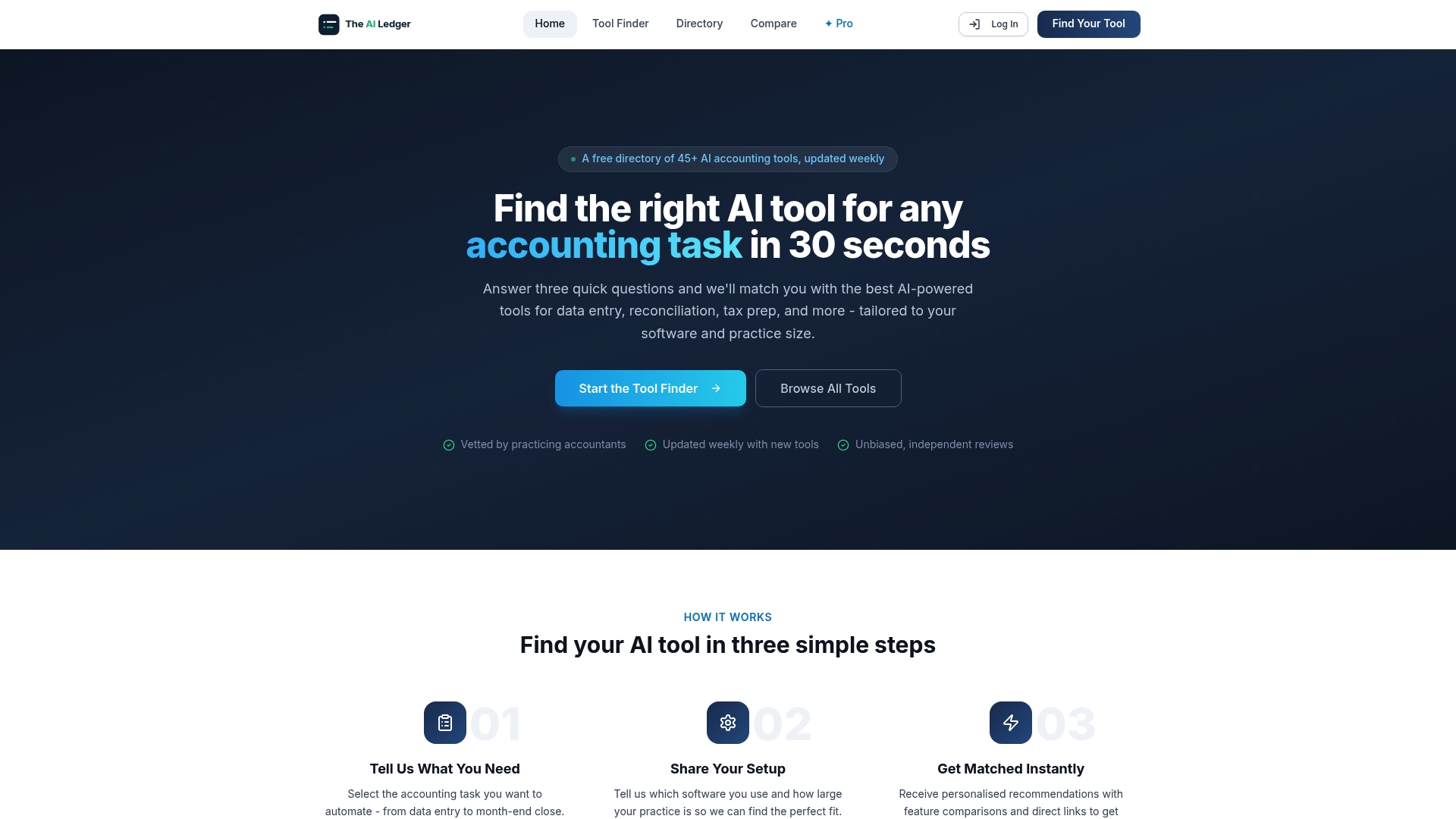
Every listing carries an independent editor score, an honest verdict, and a last verified date. Editor scores are never for sale. The 30 second tool finder matches your practice size, current software, and specific task (reconciliation, close management, source capture, consolidated reporting) to the tools most likely to fit, without you having to read every vendor's marketing page. Side-by-side comparisons let you check multi-entity features, UK localisation, and pricing model in one view.
Visit The AI Ledger and use the tool finder to build your shortlist in under a minute.
Sources and further reading
The following sources informed the analysis and comparisons in this article. Each is worth consulting directly during your procurement or implementation process.
- Month-end close process for multi-entity (MultiEntityAccounting) — Detailed breakdown of the multi-entity close lifecycle, including intercompany reconciliation and currency translation stages. Useful for scoping your current process before selecting a tool.
- Multi-Entity Accounting: What It Is and How It Works (Nominal) — Explains intercompany automation mechanics and common stack patterns. Good background reading before vendor demos.
- Sage Intacct multi-entity setup guide (Truewind) — Step-by-step configuration guidance for Sage Intacct's self-balancing intercompany setup. Essential reading before implementation.
- NetSuite multi-entity management (Houseblend) — Covers OneWorld architecture, intercompany automation, and close time improvements from case studies.
- Accounting workflow management for multi-client firms (Relay) — Practical guidance on workflow standardisation and banking connectivity as scaling prerequisites.
- Multi-entity journal entries and AI automation (Ledge) — Explains how AI agents handle journal entry creation and audit-ready workflows across entities.
- G2 comparisons: AccountsIQ vs NetSuite, Sage Intacct, Dynamics 365, Xero, QuickBooks Online — User review data across the main platforms; useful for validating vendor claims with real user experience.
- Dext reviews (Trustpilot) — Independent user reviews of Dext's document capture quality and classification accuracy.
- The AI Ledger: accounting workflow automation examples — Practical examples of workflow automation relevant to multi-entity finance teams.
- The AI Ledger: automated financial reporting guide — Covers consolidated reporting automation and dashboard design for finance teams.
To validate any vendor's claims, request a live demo using your own entity structure and ask to see the audit trail for a real consolidation run, not a pre-built scenario. That single step will tell you more than any feature comparison table.