Artificial intelligence is now the primary driver of efficiency and accuracy in modern financial operations. Organisations deploying agentic AI achieve nearly 40% improvements in forecast accuracy and ROI, with decision-making quality improving by 70%. These are not aspirational figures. They reflect what finance teams are already delivering in 2026 by combining AI with unified data foundations, continuous monitoring, and governance frameworks built for the demands of regulated financial work.
How does AI integrate with finance data and operational systems?
The role of AI in financial operations depends entirely on the quality of the data it reasons over. Raw transactional data scattered across disconnected systems produces unreliable outputs. Unified charts of accounts and embedded driver relationships transform that raw data into context-rich insights that AI can actually use.
Finance functions increasingly treat AI as an operating system rather than a point tool. AI orchestrates ERP, cloud, and analytics platforms into a continuous data flow, giving finance leaders real-time visibility into risk and performance across the enterprise. That shift from periodic reporting to live intelligence is the most significant structural change in finance architecture in a generation.

Siloed systems are the single biggest obstacle to this model. When your general ledger, payroll platform, and procurement system do not share a common semantic layer, AI cannot reason across them effectively. The fix is not just a technology purchase. It requires deliberate decisions about data governance, naming conventions, and integration standards before AI deployment begins.
AI also integrates external signals, including market data, competitor pricing, and macroeconomic indicators, into planning models. That capability transforms traditional budgeting from a backward-looking exercise into a forward-sensing process.
Key integration requirements for finance teams:
- A unified chart of accounts with consistent coding across all entities
- A semantic layer that encodes business rules and driver relationships
- API connections between ERP, cloud storage, and analytics tools
- Data lineage tracking so AI outputs can be traced back to source records
- Governance policies that define who can query, modify, and approve AI-generated outputs
Pro Tip: Before selecting any AI tool, audit your chart of accounts for inconsistencies across entities. A misaligned data foundation will undermine even the most capable AI model.
What are the practical applications of AI in tax and finance workflows?
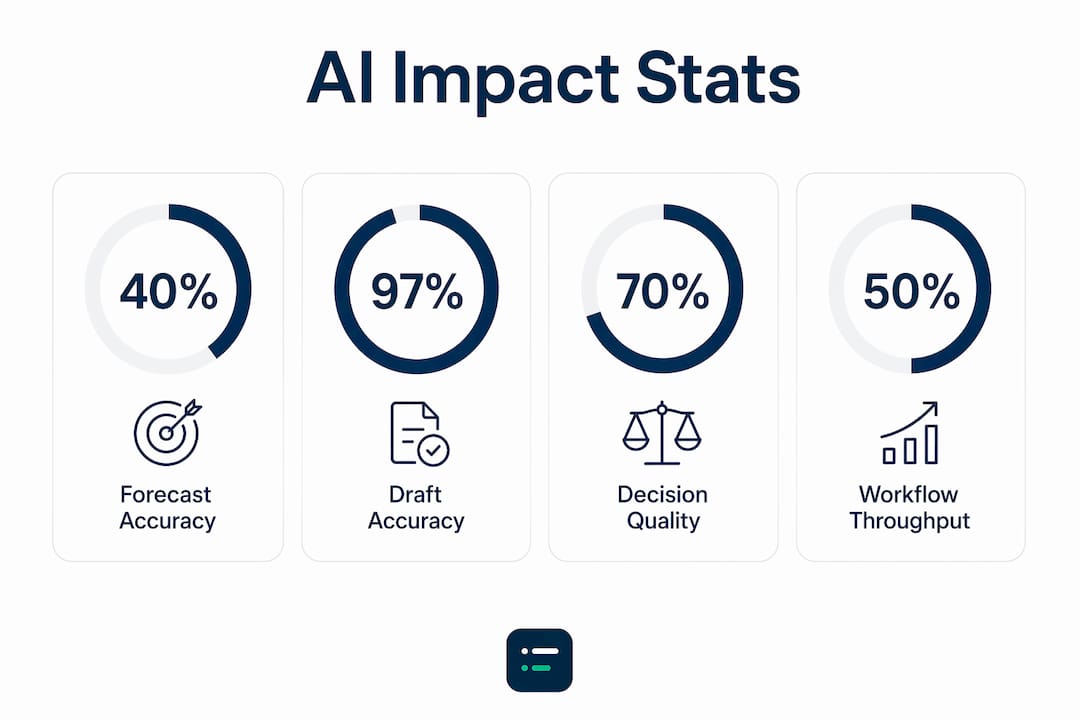
AI-assisted tax preparation, formally known as AI-augmented tax workflow automation, is one of the most measurable applications in finance. Tax practitioners using AI tools report a 50% throughput increase with up to 97% accuracy in draft returns, primarily through document extraction and categorisation. That means a practitioner handling 200 returns can effectively process the workload of 300 without adding headcount.
Beyond tax, AI applications in financial services cover four core workflow categories:
- Continuous monitoring. AI scans transaction data in real time, flagging anomalies that would take a human analyst hours to surface manually. Variance analysis that previously consumed two days of month-end close time now runs automatically overnight.
- Scenario modelling. AI generates multiple financial projections simultaneously, adjusting assumptions based on live data inputs. Finance teams can stress-test a budget against three macroeconomic scenarios in the time it previously took to build one.
- Document extraction and categorisation. AI reads invoices, receipts, and bank statements, then maps them to the correct accounts. Extraction accuracy at the 97% level means human review focuses on exceptions rather than routine entries.
- Regulatory reporting preparation. AI pre-populates compliance reports by pulling structured data from verified sources, reducing the manual assembly work that creates most reporting errors.
| Application | Primary benefit | Human role |
|---|---|---|
| Tax document extraction | 97% draft accuracy | Review exceptions and sign off |
| Anomaly detection | Real-time flagging | Investigate and resolve alerts |
| Scenario modelling | Faster planning cycles | Validate assumptions and interpret outputs |
| Regulatory report prep | Reduced assembly errors | Approve and submit |
Risks exist alongside these gains. AI-generated outputs carry genuine risks of hallucination and logic errors in financial contexts. Each AI output requires independent verification for factual and legal correctness. Blind reliance on AI violates professional standards and, in tax contexts, creates direct liability exposure.
Pro Tip: Build a mandatory review checkpoint into every AI-assisted tax workflow. Treat AI draft outputs the same way you would treat work from a junior staff member: useful, but never final without your sign-off.
For a deeper look at how these workflows apply to bookkeeping specifically, the Ailedger guide on AI in bookkeeping covers time savings and accuracy benchmarks in practical detail.
What governance and compliance rules apply to AI in finance?
Ethical and regulatory obligations do not change when AI enters the workflow. The IRS Office of Professional Responsibility has confirmed that practitioners must maintain competence, diligence, and confidentiality when using AI tools. Lack of technological competence is not a defence. It is a compliance failure.
The consent requirement under IRC Section 7216 is the most frequently overlooked legal obligation in AI-assisted tax work. Using an AI platform to process client tax return data constitutes a third-party disclosure under federal law. Written, affirmative client consent is legally required before that processing begins. The consent must specifically name the AI platform and describe the security safeguards in place.
Governance architecture, not checklist compliance, is what separates firms that scale AI safely from those that create liability. Audit trails must document what data the AI accessed, what model version processed it, what output it produced, and who reviewed and approved that output. Without that chain of evidence, you cannot defend a filing, pass an external audit, or demonstrate professional accountability.
Firms that build trustworthy audit evidence capabilities see error reduction rates improve by 33% compared to those relying on ad hoc review processes. That figure reflects the compounding benefit of systematic verification rather than reactive error correction.
Core governance requirements for AI in finance:
- Written client consent for all AI processing of tax return data under IRC Section 7216
- Version-controlled audit trails linking AI outputs to source data and reviewer approvals
- A defined escalation path for outputs that fall outside expected parameters
- Regular competency assessments to confirm staff can evaluate AI-generated analyses
- No AI tool is currently authorised to file returns or represent clients before tax authorities. Final filings remain a professional responsibility that no AI platform can discharge on your behalf.
How is the finance professional's role changing with AI?
The finance professional's core value is shifting from data compilation to data interpretation. Finance leaders now emphasise shifting workforce roles toward interpreting AI outputs and guiding strategic responses in real time. That is a fundamentally different skill set from the one that dominated finance hiring a decade ago.
Data fluency is the new baseline competency. Finance professionals need to understand how AI models are built, what assumptions they encode, and where they are likely to fail. That does not require a computer science degree. It requires enough literacy to ask the right questions and recognise a suspicious output when you see one.
The practical upskilling priorities for finance teams in 2026 are:
- AI output validation. Learn to spot hallucinations, check data lineage, and verify that AI-generated variance analyses match underlying source records.
- Prompt design. Understand how to frame queries to AI tools so outputs are specific, auditable, and relevant to the decision at hand.
- Scenario interpretation. Develop the judgement to evaluate multiple AI-generated forecasts and recommend a course of action to leadership.
- Governance participation. Finance professionals must contribute to AI policy design, not just follow it. The people closest to the data are best placed to identify where AI governance needs strengthening.
Focusing AI deployment on high-judgement processes, such as scenario modelling and risk assessment, yields greater impact than pure transactional automation. That insight from KPMG's research reframes the upskilling conversation. The goal is not to replace finance professionals with AI. It is to free them from low-judgement work so they can do more of the high-judgement work that actually moves the business.
Pro Tip: Start your team's AI literacy programme with a single use case, such as variance analysis review, rather than a broad training initiative. Concrete practice on a live workflow builds competence faster than classroom learning.
The Ailedger guide on automated financial reporting covers the specific ways finance roles are evolving as AI takes over report assembly.
Key takeaways
AI in financial operations delivers measurable gains in forecast accuracy, tax workflow throughput, and decision speed only when built on unified data, rigorous governance, and skilled human oversight.
| Point | Details |
|---|---|
| Data foundation first | Unified charts of accounts and semantic layers are prerequisites for effective AI deployment. |
| Tax workflow gains are real | AI-assisted tax prep delivers up to 97% draft accuracy and a 50% throughput increase for practitioners. |
| Governance is non-negotiable | IRC Section 7216 consent, audit trails, and human sign-off are legal requirements, not optional best practice. |
| Human oversight remains mandatory | No AI tool can file returns or represent clients; professionals retain full legal and ethical responsibility. |
| Workforce skills must evolve | Data fluency and AI output validation are now core competencies for every finance professional. |
My honest view on where AI in finance actually stands
I have watched the AI in finance conversation cycle through hype, scepticism, and back to cautious optimism over the past few years. What strikes me most in 2026 is how the firms making real progress are not the ones with the most sophisticated AI tools. They are the ones that did the unglamorous work first: cleaning their data, standardising their chart of accounts, and building governance policies before they deployed anything.
The 40% forecast accuracy improvement and 70% decision-making quality gain from agentic AI are genuine. But they are not defaults. They are outcomes that require a foundation most finance teams have not yet built. The firms chasing AI tools without that foundation are generating impressive demos and unreliable outputs.
The governance piece is where I see the most underestimation. IRC Section 7216 consent requirements catch practitioners off guard because they do not think of an AI platform as a third-party disclosure. It is. And the liability exposure from getting that wrong is not theoretical.
My practical advice: treat AI adoption as a capability-building programme, not a software purchase. The technology is ready. The question is whether your data, your governance, and your team are ready to use it responsibly. Start with one high-impact workflow, build the review process around it, and expand from there. That approach compounds. The sprint-and-hope approach does not.
— Aaron
AI tools for accounting and finance professionals
Finance professionals ready to act on these insights need tools that are already vetted for security, accuracy, and compliance fit.
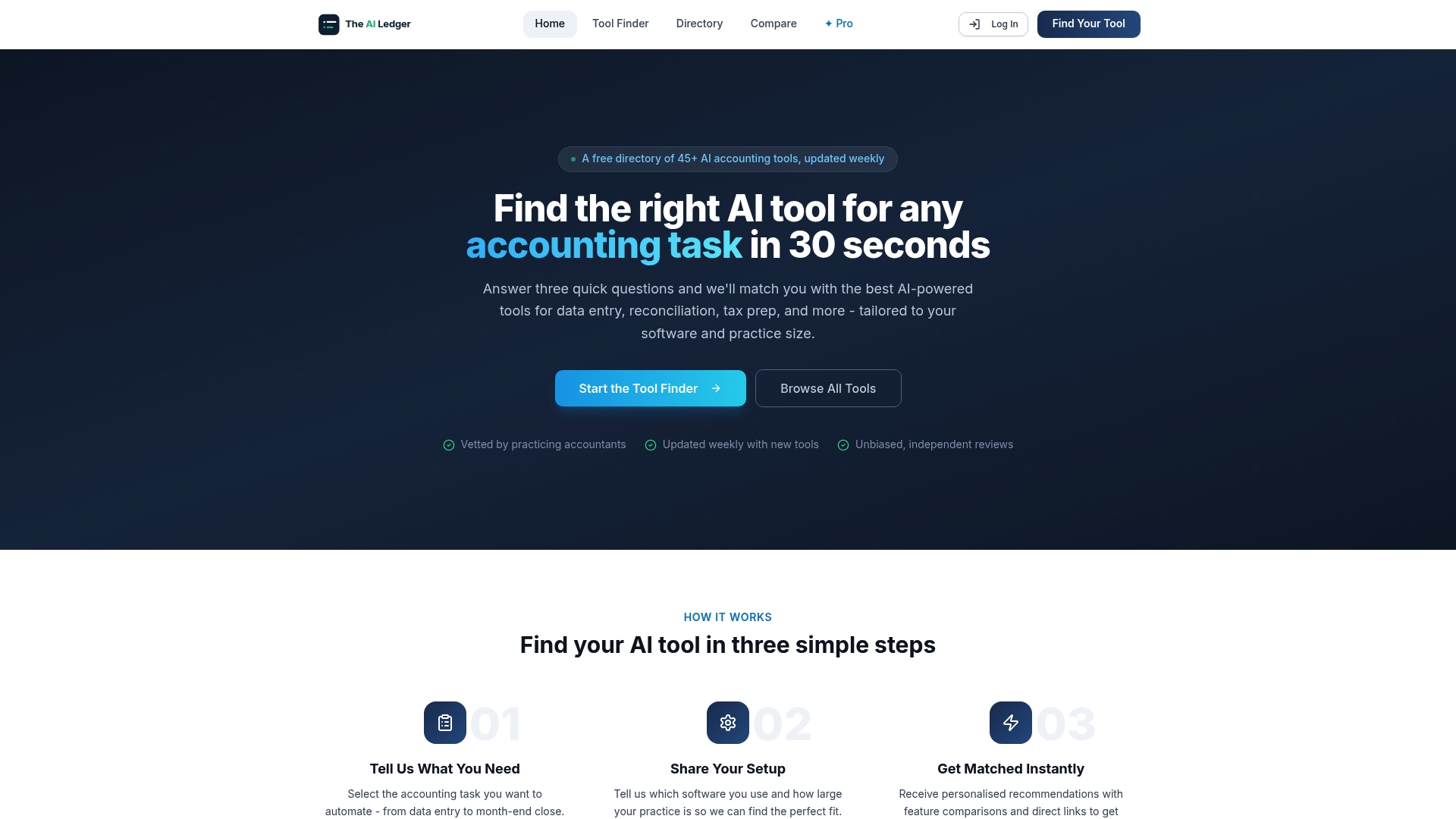
Ailedger's curated directory covers AI tools built specifically for accounting and financial operations workflows. From document processing automation that handles invoice extraction and categorisation, to AI-assisted tax and accounting workflows designed for practice efficiency, every tool in the directory has been evaluated against the criteria that matter to finance professionals: extraction accuracy, audit trail capability, data security, and integration with existing platforms. If you are building out your AI toolkit for 2026, the Ailedger directory is the place to start.
FAQ
What is the role of AI in financial operations?
AI automates data extraction, anomaly detection, scenario modelling, and regulatory report preparation in financial operations. Organisations using agentic AI report nearly 40% improvements in forecast accuracy and 70% gains in decision-making quality.
What is AI-assisted tax filing?
AI-assisted tax filing, formally called AI-augmented tax workflow automation, uses AI to extract and categorise documents and draft returns. No AI tool is currently authorised to file returns or represent clients before tax authorities; human review and sign-off remain legally required.
Does AI in tax preparation require client consent?
Yes. Processing client tax return data through an AI platform constitutes a third-party disclosure under IRC Section 7216. Written, affirmative client consent naming the specific AI platform is legally required before processing begins.
How accurate is AI in tax preparation workflows?
Tax practitioners using AI tools report up to 97% accuracy in draft returns and a 50% increase in throughput. Accuracy at that level still requires human review of exceptions before any return is finalised.
What skills do finance professionals need to work with AI?
Data fluency, AI output validation, and prompt design are the core competencies finance professionals need in 2026. The ability to interpret AI-generated forecasts and identify errors or hallucinations is now a baseline expectation in most finance roles.