Balance sheet reconciliation means comparing a general ledger balance against independent supporting evidence, a bank statement, a sub-ledger, or a third-party confirmation, and documenting every difference until the two figures agree. The goal is a balance you can defend to an auditor without hesitation. Start this period by pulling your GL ending balance and the matching subledger or statement for the same cut-off date. Everything else in this guide builds from that single action.
TL;DR:
- Regularly reconcile high-risk accounts such as cash, intercompany, and tax balances monthly to prevent small discrepancies from escalating over time.
- Use a structured six-step process and a standardized work paper to ensure consistency, thoroughness, and ease of review for every reconciliation.
- Automate routines like daily matching and exception flagging to reduce reconciliation time by over 96 percent and improve process reliability.
- Focus on upstream tasks like clearing suspense accounts weekly to keep the month-end reconciliation process smooth and minimize errors.
- Choose reconciliation tools based on their exception handling, audit trail, and ERP integration capabilities to mitigate risks of incorrect automation outputs.
Table of Contents
- What balance sheet reconciliation is and why it matters
- Which accounts to prioritise and how often to check them
- The six-step reconciliation process and work paper checklist
- Real examples: cash, receivables, and fixed assets
- Where reconciliations go wrong
- Templates, sign-off, and the metrics that show you're improving
- What automation can and can't do for you
- Where to compare reconciliation tools without guessing
- What actually separates good reconciliation practice from the rest
- Find reconciliation software without the trial-and-error
- Sources
What balance sheet reconciliation is and why it matters
At its core, the process ties a general ledger account to something outside the ledger itself, a bank statement, a fixed asset register, an accounts receivable aging report, so you can prove the number on your financial statements is real. When that tie-out doesn't happen, unreconciled items don't disappear. They roll forward month after month, often growing quietly until they distort a balance sheet enough to trigger a restatement or a difficult audit conversation.
The stakes touch more than the finance function:
- Audit readiness: auditors test reconciliations first because they reveal control weaknesses fast.
- Cash management: an unreconciled bank account can hide fraud, duplicate payments, or simple timing errors for weeks.
- Reporting integrity: management, lenders, and investors all rely on balance sheet figures that have actually been checked, not just posted.
Skip reconciliation and you're not saving time. You're deferring the work to a moment when it's harder, more expensive, and more visible.
Which accounts to prioritise and how often to check them
Not every account deserves the same attention, and treating them as if they do wastes hours you don't have. A tiered triage framework works better: rank accounts by inherent risk and reconcile the riskiest ones most often.
High-risk accounts that belong in your top tier include:
- Cash and bank accounts
- Intercompany balances
- Accruals and provisions
- Inventory
- Fixed assets
- Payroll liabilities
- Tax accounts
- Deferred revenue
- Debt and loan balances
A practical Tier 1/2/3 cadence:
- Tier 1 (monthly, high risk): cash, intercompany, payroll liabilities, tax accounts.
- Tier 2 (monthly or quarterly, moderate risk): prepaid expenses, accrued liabilities, inventory.
- Tier 3 (quarterly or semiannual, low risk): low-activity or immaterial balances that rarely move.
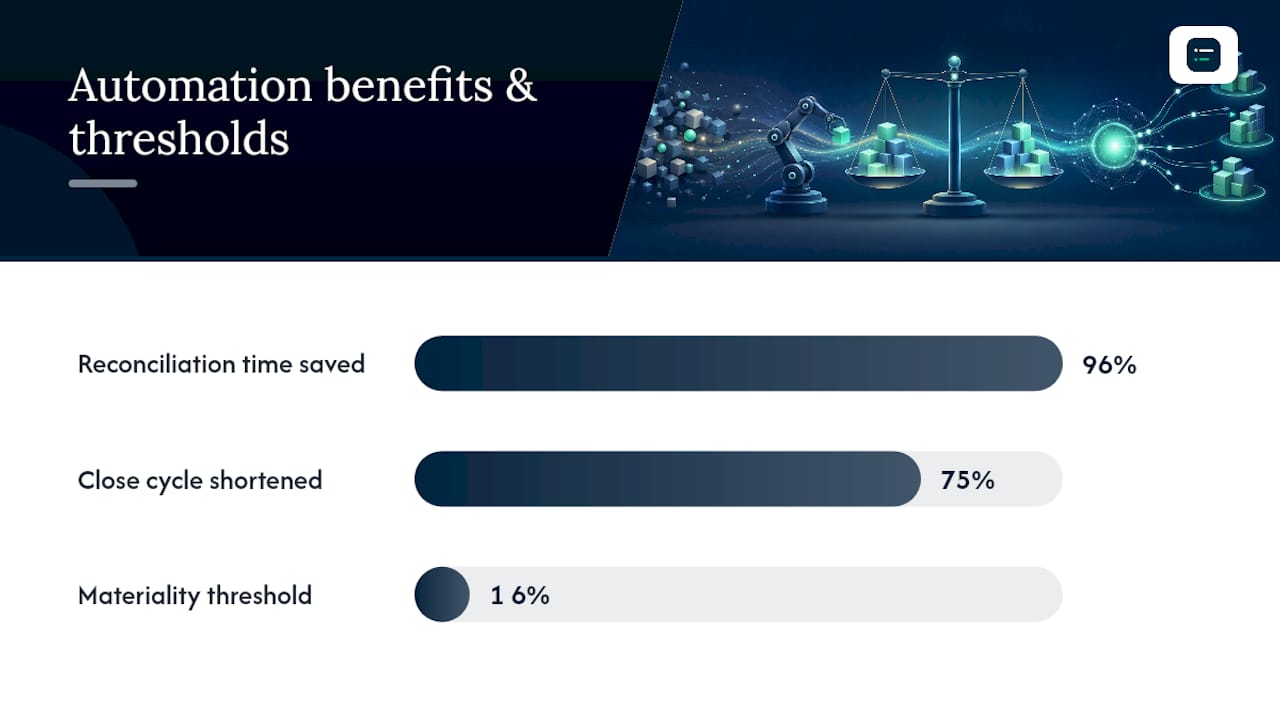
Statistic to note: automation platforms can reduce time spent on daily reconciliations by more than 96% and shorten the overall close cycle by over 75%, which makes a strict monthly cycle for Tier 1 accounts far more achievable than it used to be.
For materiality, a common approach sets a threshold as a percentage of the account balance, often 1 to 5%, with a fixed minimum floor so genuinely small accounts don't get chased over pennies.
The six-step reconciliation process and work paper checklist
A reconciliation is only as good as the sequence behind it. A structured six-step process gives you something repeatable, and repeatable is what auditors and reviewers actually trust.
- Lock the period. Confirm the cut-off date and stop new postings to the account until reconciliation is complete.
- Extract the GL balance. Pull the exact ending balance for the account as of that cut-off.
- Obtain the supporting source. Gather the bank statement, subledger report, asset register, or third-party confirmation covering the same date.
- Compare the two balances. Identify the variance, however small.
- List and age reconciling items. Every difference gets a line: description, amount, date it originated, and an owner.
- Investigate, post corrections, and document. Resolve genuine errors with journal entries, note timing differences separately, and write down what you found.
Once that's done, a reviewer who wasn't involved in preparation signs off. That separation matters more than most teams realise. A preparer who checks their own work is far more likely to miss the error they made in the first place.
Your reconciliation cover sheet should include:
- Account name, number, and owner
- GL balance and supporting balance, side by side.
- A table of reconciling items with dates and named owners
- Evidence attached (bank statement PDF, asset register export, confirmation email)
- Preparer sign-off and reviewer sign-off, both dated
Assign ownership for every open item, set an escalation timeline (many teams flag anything unresolved after 30 days), and keep evidence of remediation, not just a note that it was "fixed."
Pro Tip: Build your cover sheet template once, lock the layout, and reuse it across every account. A reviewer who sees the same structure every month spots anomalies in seconds instead of minutes.
Real examples: cash, receivables, and fixed assets
The mechanics above look abstract until you apply them to accounts you actually reconcile every month.
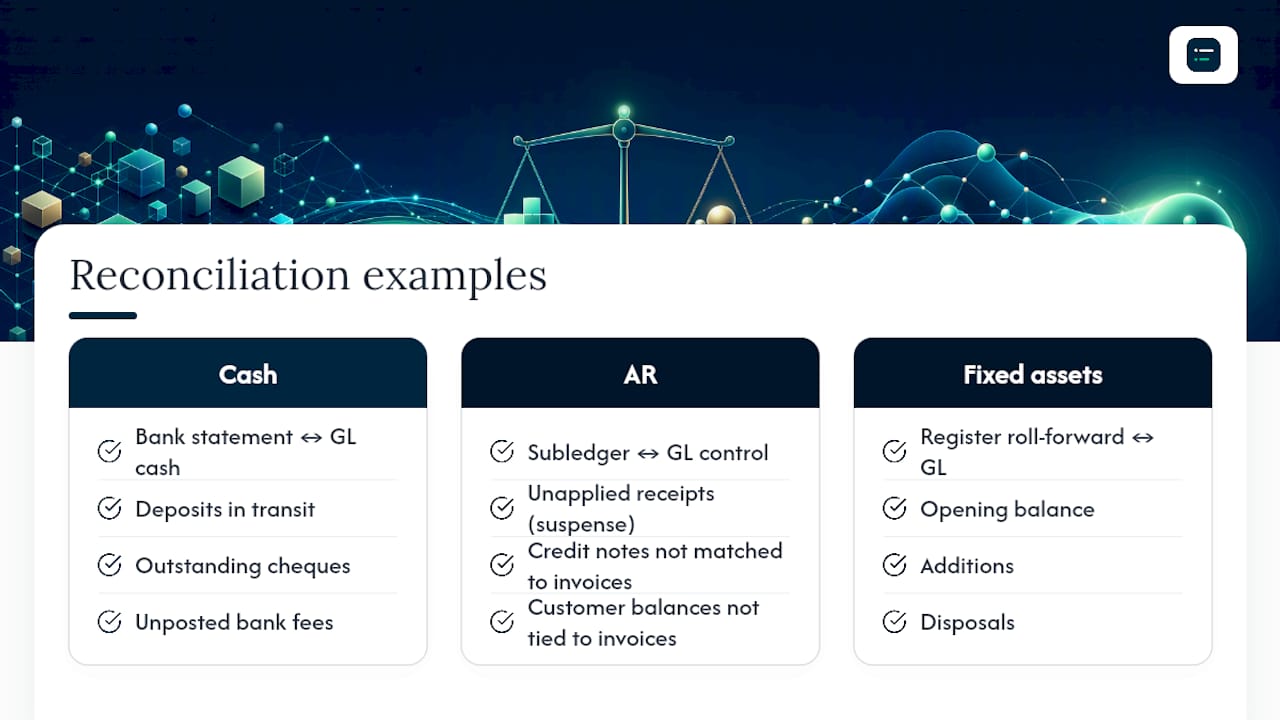
Cash tie-out. Compare the bank statement balance to the GL cash account. Common reconciling items include deposits in transit (cash recorded on your books but not yet cleared by the bank), outstanding cheques (issued but not yet cashed), bank fees you haven't posted yet, and timing differences from transactions processed after the cut-off.
AR roll-forward. Reconcile the accounts receivable subledger total to the GL control account. Watch for unapplied receipts sitting in a suspense account, credit notes issued but not yet matched to invoices, and customer accounts with balances that don't tie to actual open invoices.
Fixed asset reconciliation. Roll the asset register forward: opening balance, plus additions, minus disposals, minus depreciation, plus or minus reclassifications, equals the closing GL balance. Most variances here trace back to an asset added to the register but not yet posted to the GL, or a disposal recorded in one system and forgotten in the other.
Where reconciliations go wrong
Most reconciliation failures aren't dramatic. They're small, boring gaps that compound.
- Stale reconciling items. An item that's sat unresolved for 60 or 90 days almost always signals a bigger problem, missing documentation, a dispute, or an error nobody wants to own.
- Offsetting errors. Two mistakes that cancel each other out can leave a balance looking clean while masking real misstatements underneath. Reviewers should check reconciling items individually, not just the net variance.
- Wrong-period data. Comparing a GL balance to a supporting statement from the wrong cut-off date produces a false variance and wastes hours chasing a problem that doesn't exist.
- Incomplete support. Reconciliations fail most often because the supporting evidence attached is inconsistent, not because the underlying math was wrong.
Remediation works when it's specific: name an owner, set a date, and require evidence the item actually closed, not just a checkbox.
Templates, sign-off, and the metrics that show you're improving
Consistency is what turns reconciliation from a monthly scramble into a predictable control. A standardised work paper with a fixed minimum documentation standard means every account, regardless of who prepares it, produces the same evidence trail.
Keep preparer and reviewer roles genuinely separate. A reviewer's sign-off checklist should confirm:
- The cut-off date matches across GL and supporting evidence
- All reconciling items have dates, amounts, and owners
- Support is attached and legible
- Aged items carry a remediation plan, not just a note
Statistic to track: given that automation can cut daily reconciliation time by over 96%, a team still spending days on Tier 1 accounts each month has a process problem, not a resourcing problem.
Track a small set of health metrics over time: number of aged items past 30 days, recurring exceptions on the same account, and post-close adjustments that trace back to a missed reconciliation. A rising trend in any of these is an early warning, well before an auditor finds it for you.
What automation can and can't do for you
Automation platforms genuinely excel at high-volume, rules-based matching, transaction-level matching, exception flagging, and alerting when a previously reconciled balance moves unexpectedly. Some tools also offer transaction-level drill-down and live ERP integrations, which cuts a lot of the manual chasing out of Tier 1 accounts. A controller's guide to automating bank reconciliation is worth reading if you're weighing this for cash accounts specifically.
The risk is what practitioners call "fast wrong": a tool that matches transactions quickly but with weak exception logic will confidently produce an incorrect reconciliation faster than a human ever could. Before adopting any tool, check its exception handling capability specifically:
- Does it flag unmatched items clearly, or bury them?
- Can you see a full audit trail for every automated match?
- Does it integrate with your actual ERP, or require manual exports?
Automation handles volume. It doesn't replace judgement on what a reconciling item actually means.
Where to compare reconciliation tools without guessing
The AI Ledger runs an independent directory of 100+ AI tools built for accountants and bookkeepers, each carrying an editor score, an honest verdict, and a last verified date. Its side-by-side comparisons and 30 second tool finder help you shortlist candidates against the exception-handling and audit-trail checklist above, so automation adds speed without adding risk.
What actually separates good reconciliation practice from the rest
The teams that reconcile well aren't the ones with the fanciest software. They're the ones who do the boring upstream work, clearing suspense accounts, matching invoices promptly, filing bank statements the day they arrive, so month-end reconciliation is confirmation rather than archaeology.
Pro Tip: Clear your clearing accounts weekly, not monthly. A suspense account that never sits idle for more than seven days rarely turns into a month-end fire drill.
— Aaron
Find reconciliation software without the trial-and-error
If you're ready to bring automation into your close process, you don't need to test five platforms yourself to find out which one handles exceptions properly. The AI Ledger is built exactly for this: an independent directory of 100+ AI tools for accountants and bookkeepers, each with an editor score, an honest verdict, and a last verified date, so you're comparing real capability, not marketing copy.
Its side-by-side comparisons let you check exception logic, audit trails, and ERP integrations across tools side by side, while the 30 second tool finder narrows the field to reconciliation-specific options that fit your practice size and software stack. If you'd rather stay on top of new releases and price changes without doing the digging yourself, the free weekly Friday newsletter covers exactly that in plain English. Head to The AI Ledger's tool finder and match your reconciliation task to the right platform in about half a minute.
Sources
For deeper procedural detail, Stanford's Fingate reconciliation guide covers university-grade documentation standards. Sage's step-by-step reconciliation guide offers worked examples. Equility's process breakdown explains risk-tier triage in more depth, and Arvexi's reconciliation guide sets out cadence frameworks worth adapting to your own chart of accounts.
- Balance Sheet Account Balance Reconciliation - Fingate
- How to reconcile balance sheet accounts: step-by-step - Equility
- Step-by-step balance sheet reconciliation (with examples and best practices) | Sage Advice UK
- Gartner: financial reconciliation solutions overview