Artificial intelligence reduces accounting errors by automating repetitive data processing and detecting anomalies that manual review consistently misses. A QuickBooks 2025 survey found that 98% of finance professionals reported improved accounting accuracy after adopting AI and automation. That figure is not a rounding error. It reflects a structural shift in how financial data moves through a practice. This guide explains the mechanisms behind that improvement, from workflow automation and anomaly detection to the governance frameworks that make AI-driven accuracy sustainable. If you want to reduce accounting errors with AI, understanding the "why" is where it starts.
Why AI reduces accounting errors at the workflow level
AI reduces errors primarily by removing humans from the tasks where humans make the most mistakes. Repetitive, high-volume processes like bank reconciliation, transaction matching, and journal entry preparation are exactly where fatigue, distraction, and copy-paste errors accumulate. AI handles these tasks through pattern recognition and rule-based matching, applied consistently at scale.
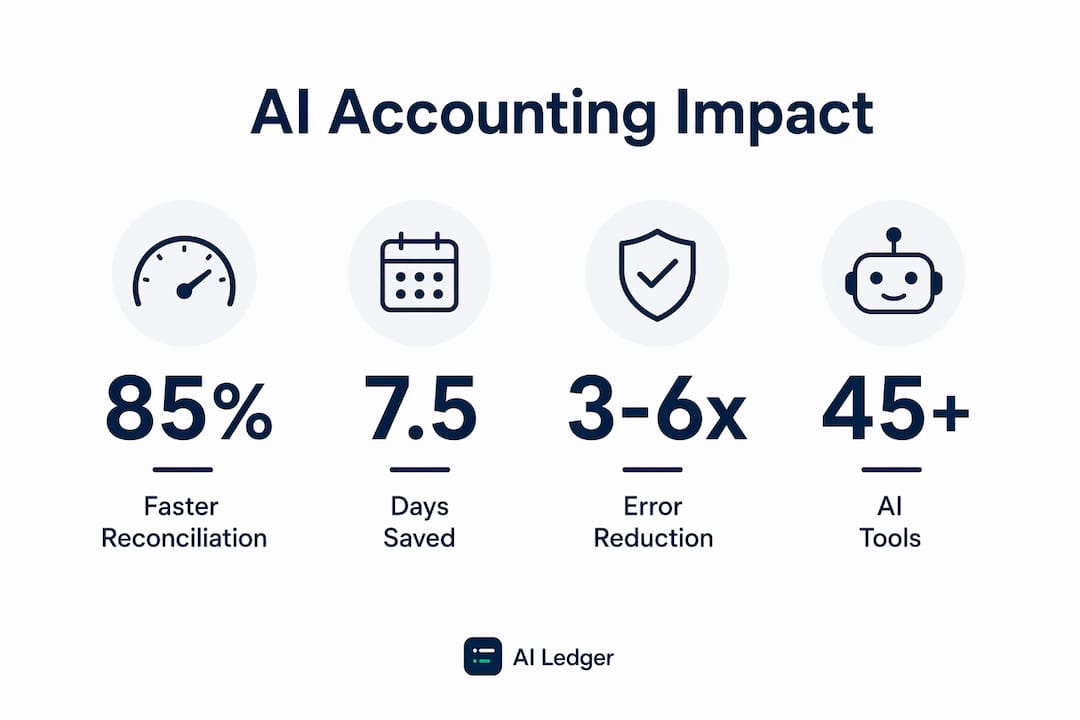
The efficiency gains are measurable. AI-driven reconciliation runs up to 85% faster than manual methods and reduces monthly close duration by 7.5 days, according to a 2025 MIT and Stanford study. That speed reduction does not just save time. It compresses the window in which errors can compound before they are caught.

AI systems also improve over time. Machine learning models trained on a firm's own transaction history become better at categorising entries, flagging mismatches, and predicting correct coding. The more data the system processes, the more accurate its outputs become. This is fundamentally different from a manual process, where accuracy depends on the individual doing the work on a given day.
Automation without oversight, however, creates its own risks. An AI system that misclassifies a transaction type will repeat that error at scale. That is why controls matter as much as the automation itself.
- Set approval thresholds so AI auto-posts only low-risk, high-confidence transactions
- Route exceptions above a confidence threshold to a human reviewer
- Run a weekly sample audit of AI-posted entries to catch systematic drift
- Document the rules governing each automated workflow for audit purposes
Pro Tip: Start automation with your highest-volume, lowest-complexity transaction type. Reconciling a single bank account with AI before expanding to the full ledger gives you a controlled environment to validate accuracy before scaling.
Why human-in-the-loop verification matters for AI accuracy
AI alone is not sufficient for reliable accounting accuracy. The concept of "human-in-the-loop" verification describes a workflow where AI proposes actions and humans validate them before they are finalised. This model is not a workaround for weak AI. It is the architecture that makes AI outputs trustworthy in a regulated environment.
Morgan Stanley's deployment of agentic AI in P&L reconciliation illustrates this clearly. The firm's AI agents cut reconciliation time by 50%, reducing six-hour tasks to two or three hours and saving an estimated 1,500 weekly hours across 100 controllers. Critically, Morgan Stanley deliberately limited agent autonomy on complex decisions, keeping human approval on exceptions and high-risk items. That constraint improved overall accuracy rather than reducing it.
Thomson Reuters has made a similar point from a governance perspective: "almost right" AI is insufficient in accounting automation. Transparency, verification, and explainability are not optional features. They are the conditions under which AI outputs can be trusted, audited, and defended.
A practical human-in-the-loop framework for accounting teams looks like this:
- Define the AI's scope. Specify which transaction types the system can post automatically and which require human sign-off.
- Set confidence thresholds. Require human review for any AI output below a defined confidence score.
- Build an exception queue. Route flagged items to a named reviewer with a response deadline.
- Log every AI decision. Maintain an audit trail showing what the AI proposed, what the human decided, and why.
- Review the exception rate monthly. A rising exception rate signals model drift or a change in transaction patterns that needs attention.
Pro Tip: Treat your exception queue as a training dataset. Patterns in what your AI gets wrong tell you exactly where to refine your rules or retrain the model.
How does AI detect errors that manual review misses?
AI's anomaly detection capability is where it most clearly outperforms human review. A skilled accountant can spot an unusual entry when reviewing a report. AI monitors every transaction continuously, comparing each one against historical patterns, peer benchmarks, and predefined rules simultaneously.
AI flags anomalies proactively, identifying unusual payments, duplicate invoices, and miscategorised transactions before they reach year-end review. That shift from reactive to proactive error detection changes the cost of mistakes. An error caught at posting costs minutes to fix. The same error found during an audit can cost days and carry regulatory consequences.
Firms that deploy AI agents within workflows also see faster exception flagging and better documentation, which directly improves audit readiness. Consistent, timestamped records of every flagged item and its resolution give auditors a clear trail without the manual effort of reconstructing it.
The categories of error AI commonly identifies include:
- Duplicate payments: same invoice number, amount, or supplier appearing more than once within a period
- Miscategorised transactions: entries coded to the wrong account based on historical patterns for that supplier or transaction type
- Unusual payment timing: transactions processed outside normal cycles or at atypical times
- Round-number anomalies: payments in suspiciously round figures that deviate from typical invoice patterns
- Missing supporting documentation: entries without an attached invoice or approval record
- Variance from budget or forecast: line items that exceed expected ranges without a corresponding journal note
The practical implication for finance professionals is that AI does not just reduce errors in processing. It surfaces errors that already exist in the ledger, giving you a cleaner starting point for reporting and analysis.
What operational benefits come from AI reducing accounting errors?
The operational benefits of AI in accounting accuracy extend well beyond fewer mistakes on the ledger. Time saved on error correction gets reallocated to work that adds value. AI reduces time spent on manual matching by 20–30%, freeing finance professionals for analysis, forecasting, and client advisory work.
Decision quality improves as well. The KPMG Global AI in Finance Report 2026 found that organisations directing AI at judgement-heavy tasks achieved over 70% better decision quality and 71% faster decision speed. That improvement comes from cleaner data feeding into forecasting models, not from AI replacing financial judgement.
Governance integration amplifies these gains significantly. Organisations that build AI governance and audit trails into their workflows from the start reduce errors 3–6 times more effectively than those that add governance as an afterthought. A 33% error reduction with governance in place compares to just 6% without it.
| Metric | Traditional accounting | AI-enhanced accounting |
|---|---|---|
| Reconciliation speed | Baseline manual process | Up to 85% faster |
| Monthly close duration | Standard close cycle | Reduced by up to 7.5 days |
| Time on manual matching | Full allocation | 20–30% reduction |
| Error detection timing | Reactive, often at year-end | Proactive, at point of posting |
| Audit trail quality | Manual, inconsistent | Automated, timestamped, consistent |
The cultural shift required to realise these benefits is real. A phased transition over several months, with team confidence built through early wins and human-review checkpoints maintained throughout, is the approach that works in practice. Firms that try to automate everything at once typically see resistance, errors from misconfigured rules, and a loss of trust in the system.
Key takeaways
AI reduces accounting errors most effectively when automation, anomaly detection, and human oversight work together within a governed workflow.
| Point | Details |
|---|---|
| Automation removes high-volume error risk | AI handles reconciliation and matching consistently, eliminating fatigue-driven mistakes at scale. |
| Human-in-the-loop is non-negotiable | Limiting AI autonomy on complex decisions improves accuracy and maintains audit defensibility. |
| Anomaly detection is proactive | AI flags duplicates, miscategorisations, and unusual payments before they reach year-end review. |
| Governance multiplies the gains | Firms with built-in audit trails reduce errors up to six times more than those without governance. |
| Phased adoption drives lasting results | Starting with one workflow and expanding builds team confidence and reduces implementation risk. |
The uncomfortable truth about AI and accounting accuracy
I have watched finance teams adopt AI tools with genuine enthusiasm, then quietly revert to manual checks six months later. The reason is almost always the same. They treated AI as a replacement for process rather than an improvement to it.
The evidence on AI in accounting accuracy is compelling. The role AI plays in bookkeeping and financial reporting is no longer theoretical. But the firms that see the largest error reductions are not the ones with the most sophisticated tools. They are the ones that defined clear rules, maintained human review checkpoints, and built governance into the workflow from day one.
What I find most interesting is the shift in what accountants actually do when AI handles the grunt work. Exception management, governance oversight, and analytical judgement become the core of the role. That is a better use of professional expertise than keying in source documents. The accountants I speak to who have made this transition do not want to go back.
My practical advice: start with automated financial reporting for one process, measure the error rate before and after, and use that data to build the case for broader adoption internally. Numbers from your own practice are far more persuasive than any industry survey.
— Aaron
AI tools for accountants that reduce errors in practice
Knowing why AI reduces accounting errors is one thing. Finding the right tool for your practice is another.
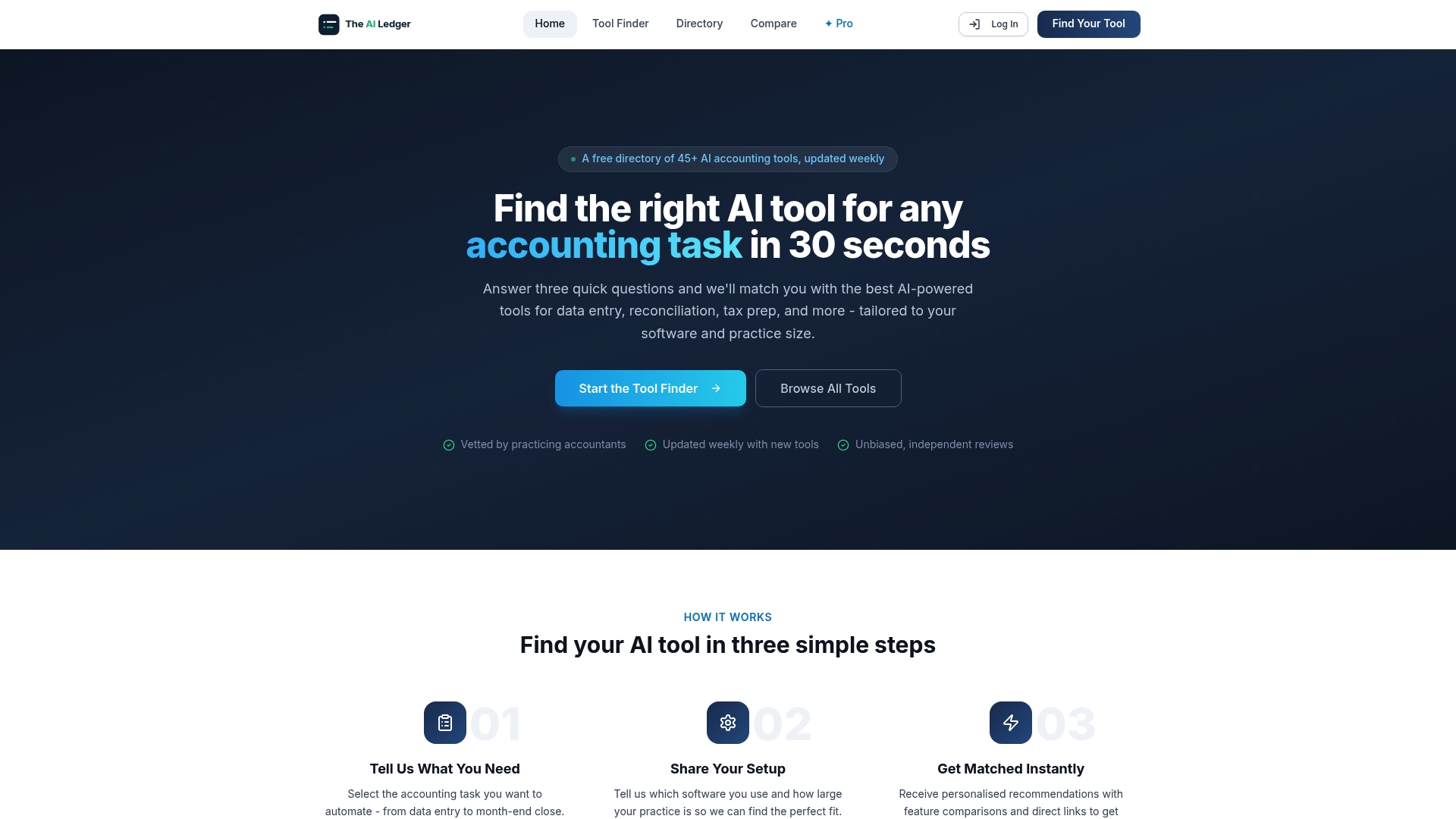
Ailedger's curated tools directory is built specifically for accounting and bookkeeping professionals evaluating AI for data entry, reconciliation, and month-end close. Two tools worth reviewing for error reduction are CPA Pilot, which focuses on accuracy and workflow automation for accountants, and Datamolino, an AI-powered solution that improves data extraction speed and accuracy from source documents. Both are listed with full feature breakdowns so you can evaluate fit before committing. The Ailedger finder tool lets you filter by task type, firm size, and integration to narrow the field quickly.
FAQ
Why does AI reduce accounting errors more than manual processes?
AI applies the same rules consistently across every transaction, without fatigue or distraction. Manual processes introduce human error at scale, particularly in high-volume, repetitive tasks like reconciliation and data entry.
What is human-in-the-loop verification in accounting?
Human-in-the-loop verification is a workflow where AI proposes actions and a human reviews and approves them before they are finalised. It maintains accuracy and audit defensibility by keeping professional judgement in the process.
How much faster is AI reconciliation compared to manual methods?
AI-driven reconciliation runs up to 85% faster than manual methods and can reduce monthly close time by 7.5 days, according to a 2025 MIT and Stanford study.
Does AI in accounting require governance to be effective?
Organisations that integrate AI governance and audit trails from the start reduce errors 3–6 times more effectively than those without governance. Governance is not optional. It is what makes AI accuracy sustainable and auditable.
What types of errors does AI detect in accounting workflows?
AI commonly identifies duplicate payments, miscategorised transactions, unusual payment timing, round-number anomalies, and entries missing supporting documentation, typically before they reach a formal review cycle.