AML automation embeds risk-based checks directly into onboarding and monitoring workflows, cutting manual review time and generating auditable evidence at every step. It works by replacing partner-level judgement calls with configurable rules that apply the same way across every client file, every service line, every time.
The single first move is to pick your highest-manual-burden AML touchpoint, usually client onboarding, and pilot automated ID verification plus sanctions screening on it before rolling out further. Firms already doing this report a shift from ad hoc checklists to something closer to a First AML style rule engine that fires the same way regardless of which partner opens the file. The result is fewer inconsistencies for a supervisor to query and less time spent re-keying data that already exists on Companies House.
- Automation embeds risk-based checks into onboarding and monitoring, not just faster paperwork.
- Pilot one touchpoint (ID plus sanctions screening) before a full roll-out.
- Expect audit evidence, not just speed, as the main early win.
Under the Money Laundering Regulations, firms must apply risk-based due diligence and keep evidence of the decisions behind it. Automation is one of the more reliable ways to do both consistently, which is precisely why it has moved from "nice to have" to a standard fixture on most practice technology shortlists.
Key Takeaways
AML automation succeeds when firms pair a configurable rule engine with a genuine pilot, since the audit trail it produces matters more than the speed it promises.
| Point | Details |
|---|---|
| Start with one touchpoint | Pilot automated ID verification and sanctions screening on a small client cohort before rolling out further. |
| Prioritise auditability over speed | Choose software whose evidence trail would survive a supervisor's questions, not just the fastest checks. |
| Ask vendors direct questions | Confirm data jurisdictions, exportable audit trails, escalation rules and retention policies before signing. |
| Train continuously, not once | Refresh staff training whenever risk templates change, not only during initial onboarding. |
| Compare options before committing | The AI Ledger's directory and 30-second tool finder let you shortlist AML platforms with independent editor scores rather than vendor marketing alone. |
Table of Contents
- Why accountants are automating AML checks now
- Core automation features and workflows worth prioritising
- How to evaluate and select AML automation for your practice
- Implementation checklist: from pilot to firm-wide roll-out
- Why trust this guide: The AI Ledger and further resources
- Best practices for training accountants on automated AML systems
- Data privacy and cybersecurity in AML automation
- Future trends in AML automation for accounting practices
- Challenges and limits of AML automation in accounting
- The judgement call most guides get wrong
- Find and compare AML automation tools faster
- Frequently asked questions
- Sources
Why accountants are automating AML checks now
Manual AML reviews eat chargeable hours that never get billed. A trainee spending forty minutes chasing a passport scan and manually checking a sanctions list is forty minutes not spent on the return that actually pays the invoice. Automation returns that time by handling identity checks, screening and document capture in minutes rather than hours, and it does so without depending on which member of staff happens to be free that afternoon.
There's a regulatory dimension too. Supervisors increasingly expect firms to show a consistent, risk-based approach applied the same way across every office and every partner, not a patchwork of personal habits. First AML argues that embedding compliance logic into workflow moves decision points out of partners' inboxes and into rules that are enforced automatically, which cuts inconsistency and protects billable time in the same move.
Cost and timeline expectations vary by firm size, but typically small and mid-sized practices pilot on a small client cohort before committing to a full license, with implementation phases spanning from several weeks to a few months depending on the firm's complexity and legacy data migration needs.
None of this requires ripping out your existing practice management system. Most AML tools are built to sit alongside it, not replace it.
Core automation features and workflows worth prioritising
Not every AML platform does the same job well, so it helps to know exactly what you're buying before you sign anything.
- Automated identity verification and sanctions/PEP screening. This is the baseline. FigsFlow was built specifically for UK accounting firms and offers instant ID verification alongside sanctions and PEP checks, paired with secure document capture so evidence never lives in an inbox.
- Risk-based rule engines and service-line templates. A firm-wide rule set means a tax-only client and an audit client get different checks automatically, rather than a single blunt checklist applied to everyone.
- Ownership and entity-structure mapping. For complex or corporate clients, the software should map beneficial ownership automatically rather than asking a trainee to trace a shareholding chain by hand. First AML builds this into its central client record, auto-mapping structures as part of the standard workflow.
- Ongoing monitoring with triggered reviews. Good systems don't stop at onboarding. They flag changes in risk (an adverse media hit, a sanctions list update) and route the alert to the right person automatically.
- Audit trails with timestamps and rationale. Every decision, every screening result, every escalation should be logged automatically, giving you a ready-made answer when a supervisor asks why a client was accepted.
- Integrations that matter. Look for direct links to Companies House, your practice management system and your accounting ledger, so client data doesn't need re-entering three times.
IRIS Elements AML leans into biometric ID checks and bulk verification, useful if you're onboarding dozens of clients at once, while SmartSearch uses triple-bureau data behind its identity checks, which the vendor states delivers a high pass rate for genuine applicants. Different platforms lean on different strengths, so match the feature to your client mix rather than picking on brand recognition alone.
Pro Tip: Before comparing platforms, list your last ten AML queries from a supervisor or reviewer. Whatever kept coming up (missing rationale, unclear escalation, slow document retrieval) tells you exactly which feature to prioritise first.
How to evaluate and select AML automation for your practice
Choosing badly here is expensive twice over: once in wasted subscription fees, and again in the compliance gaps a poor tool leaves behind. Work through a proper checklist rather than picking whatever a competitor mentioned last.
Your shortlist criteria should cover:
- Configurability – can rules be tailored to your service lines, or is it one-size-fits-all?
- Verified data sources – where does the screening data actually come from, and how often is it refreshed?
- Integration – does it talk to Companies House, your practice management software and your ledger without manual export/import?
- Auditability – can you pull a timestamped, rationale-included record for any client in seconds?
- Pricing model – flat fee, per-seat or per-check, and how does that scale as client numbers grow?
- Support – is there a real UK-based team you can reach when a screening result looks wrong?
Before signing anything, ask the vendor these questions directly:
- Which jurisdictions does your screening data cover, and where is that data hosted?
- Can I export a full audit trail in a format my supervisor or regulator will accept?
- What are the default escalation rules, and can I change them without a support ticket?
- How long is data retained, and what happens to it if we cancel?
Watch for a few red flags: vendors who won't name their underlying data sources, tools with no visible audit log (just a "completed" tick), and pricing structures that charge per check with no volume discount, which punishes exactly the growth you're trying to enable. TaxCalc's AML Centre is a useful benchmark here, since it bundles risk scoring, SAR logging and Companies House integration into one firm-wide view rather than charging piecemeal for each function.
Pilot on a real but low-risk client cohort, ten to twenty files is usually enough, and measure two things: time saved per onboarding and whether the audit trail would satisfy an external reviewer without further explanation.
Implementation checklist: from pilot to firm-wide roll-out
Moving from decision to delivery works best as a staged process with clear ownership at each stage, not a single big-bang switch.
- Define scope and appoint an owner. Your MLRO should sign off on the risk framework, while a project owner (often a practice manager) handles day-to-day configuration and staff questions.
- Map existing processes. Document exactly how onboarding and monitoring work today, including every manual handoff, before configuring the new rules around them.
- Confirm integrations and security requirements. Check API access to your practice management system and ledger, and confirm data residency meets your firm's own policies.
- Run the pilot. Choose a small client cohort, run it in parallel with your existing process if you can, and log time saved plus any gaps in evidence completeness.
- Iterate the rules. Adjust risk templates based on what the pilot actually surfaced, not what you assumed in advance.
- Train staff properly. Everyone touching a client file needs to understand what the system flags and why, not just how to click through it.
- Scale with governance checkpoints. Set monthly KPI reviews for the first quarter (time saved, alerts actioned, files with complete audit trails) before expanding to every office.
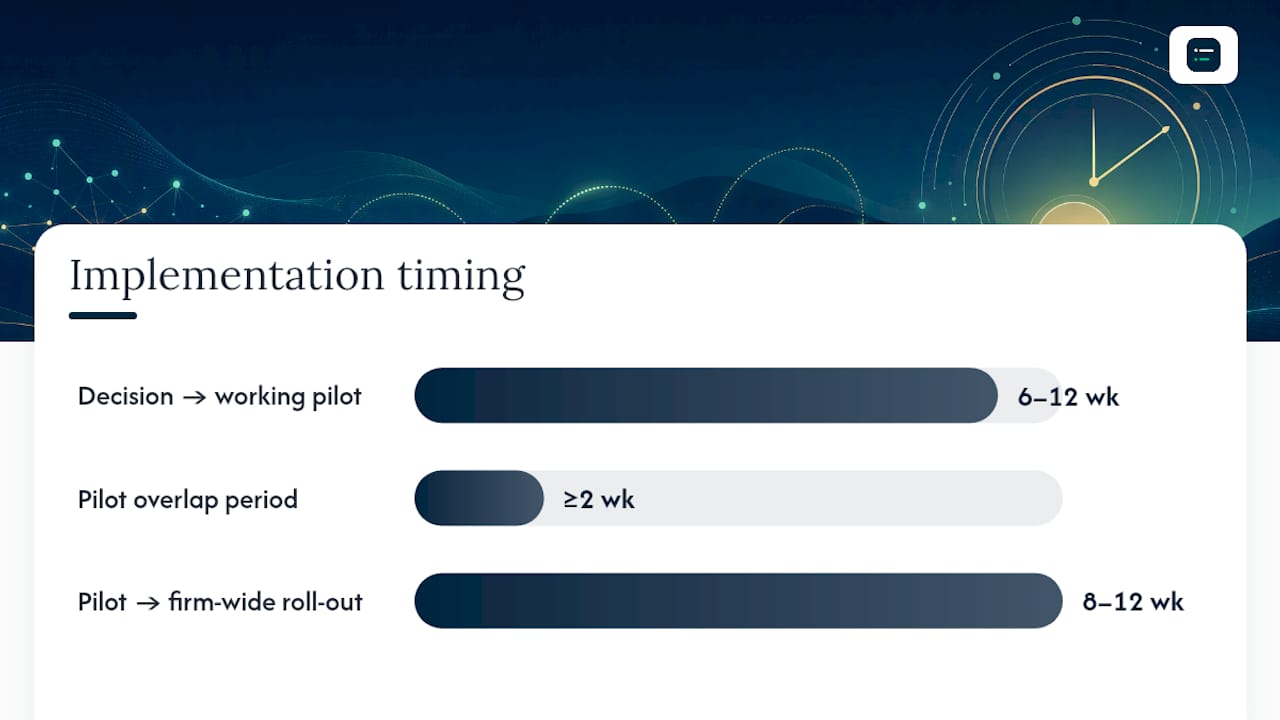
Pro Tip: Run the pilot and your existing manual process side by side for at least two weeks before switching over fully. The overlap period is where you catch configuration errors before they touch a real client file.
Realistically, budget six to twelve weeks from decision to a working pilot, and a further two to three months to reach full firm-wide coverage, longer if you're migrating years of legacy client files into the new system.
Why trust this guide: The AI Ledger and further resources
The AI Ledger runs an independent directory of 100+ AI tools for accountants and bookkeepers, each with an editor score, an honest verdict and a last verified date, so you're not relying on marketing copy alone when comparing options.
Alongside this guide, you'll find further reading worth bookmarking:
- Accounting workflow automation examples for 2026, useful when designing your own AML pilot workflow.
- How to build accounting workflow templates in 2026, for turning rules into repeatable templates.
- Common accounting workflow bottlenecks: your 2026 fix, which helps identify where AML duplication is actually costing you time.
The free weekly Friday newsletter tracks feature and price changes across this category in plain English, and the 30-second tool finder narrows a long shortlist down to the handful worth a proper demo.
Best practices for training accountants on automated AML systems
The biggest training mistake firms make is treating AML software as something staff learn once, during onboarding week, and never revisit. Rules change, risk templates get updated, and new starters join without ever seeing the original walkthrough.
Build training around real files, not generic demos. Walking a trainee through an actual (anonymised) client onboarding, showing exactly what the system flagged and why, sticks far better than a slideshow of features. Pair this with a short reference sheet covering what each alert type means and who owns the escalation, so nobody's guessing at 4pm on a Friday.
Refresh training whenever you change a risk template or add a new service line, since a rule that was never explained is a rule staff will quietly work around. Build in a short annual refresher too, timed to coincide with your firm's own risk assessment review, so the training stays current rather than static.
Finally, make sure whoever configures the escalation logic can explain it in plain language to the rest of the team. A system nobody understands gets treated as a black box, and staff either over-trust it (accepting every "pass" without a second look) or under-trust it (manually re-checking everything anyway, which defeats the point of automating in the first place).
Data privacy and cybersecurity in AML automation
AML platforms hold some of the most sensitive data a practice touches: passports, proof of address, beneficial ownership details and screening results tied to named individuals. That makes data privacy a genuine operational concern, not a box-ticking exercise.
Ask any vendor where client data is hosted and stored, and whether that meets your firm's obligations under UK data protection law. Look for encryption both in transit and at rest, clear data retention policies (how long is a rejected applicant's passport scan kept, and why), and a documented process for what happens to your data if you cancel the contract.

Access controls matter as much as encryption. Not every member of staff needs to see every client's full identity documents, and a platform that lets you restrict access by role reduces both accidental exposure and insider risk. Check too whether the vendor supports two-factor authentication as standard, rather than as a paid extra.
Finally, ask about breach notification commitments. If a vendor suffers a data incident, you need to know how quickly they'll tell you, since your own regulatory obligations may require you to notify clients or the Information Commissioner's Office within a set window.
Future trends in AML automation for accounting practices
Screening is getting faster and broader at the same time. Multi-bureau identity checks, where a platform cross-references several independent data sources rather than one, are becoming the expected standard rather than a premium feature, and biometric verification is following the same path as more clients complete onboarding entirely on a phone.
Expect risk engines to grow more granular, moving beyond a single "low/medium/high" score toward templates that weight specific risk factors (jurisdiction, industry sector, ownership complexity) differently for each service line a firm offers. That granularity should reduce the number of borderline cases that need a human decision, freeing MLROs to focus on the genuinely ambiguous ones.
Integration depth is likely to keep improving too, with tighter links between AML platforms, Companies House data and practice management systems reducing the double entry that still plagues many firms. The direction of travel is clear: less manual re-keying, more automatic cross-referencing, and audit trails that assemble themselves as a by-product of the workflow rather than a separate task bolted on afterwards.
Challenges and limits of AML automation in accounting
Automation isn't a cure-all, and pretending otherwise sets firms up for a rough second year. The most common limitation is over-reliance: staff start treating a "pass" from the system as the end of the conversation, when a genuinely unusual client structure still needs a human to ask an extra question.
Configuration burden is real too. A rule engine is only as good as the risk templates behind it, and building those properly takes time upfront, time many smaller firms underestimate when they first sign a contract. Get the templates wrong and you either flag too much (alert fatigue) or too little (a genuine risk slipping through unchallenged).
Legacy client files are another sticking point. Migrating years of existing client due diligence into a new system rarely goes smoothly, and firms often end up running two processes in parallel for months longer than planned.
Pricing structures can also work against firms as they grow. A per-check model that looked reasonable at fifty clients can become genuinely expensive at five hundred, so it's worth modelling costs at your projected client volume before committing, not just your current one.
The judgement call most guides get wrong
Most AML software content treats automation as a binary: manual is broken, software fixes it. That framing undersells the real work, which is building the risk templates that sit behind the automation. A poorly configured rule engine is arguably worse than a careful manual process, because it gives a false sense of consistency while quietly missing exactly the cases that mattered.
What the evidence actually supports is more specific: automation is worth adopting because it produces auditable evidence and returns chargeable time, not because it removes judgement from the process. The judgement moves earlier, into template design, rather than disappearing. Firms that treat the pilot phase as a genuine test, measuring both time saved and whether a supervisor would accept the audit trail without further questions, get far more value than firms that buy on vendor promises alone.
If there's one thing worth prioritising first, it's this: don't evaluate AML software on speed alone. Evaluate it on whether the audit trail it produces would survive a difficult conversation with a supervisor.
Find and compare AML automation tools faster
There are several credible routes to shortlisting AML software, reading vendor comparison pages, asking peers in a practice forum, or working through a demo call with each provider on your list. All of them take time you're trying to claw back in the first place.
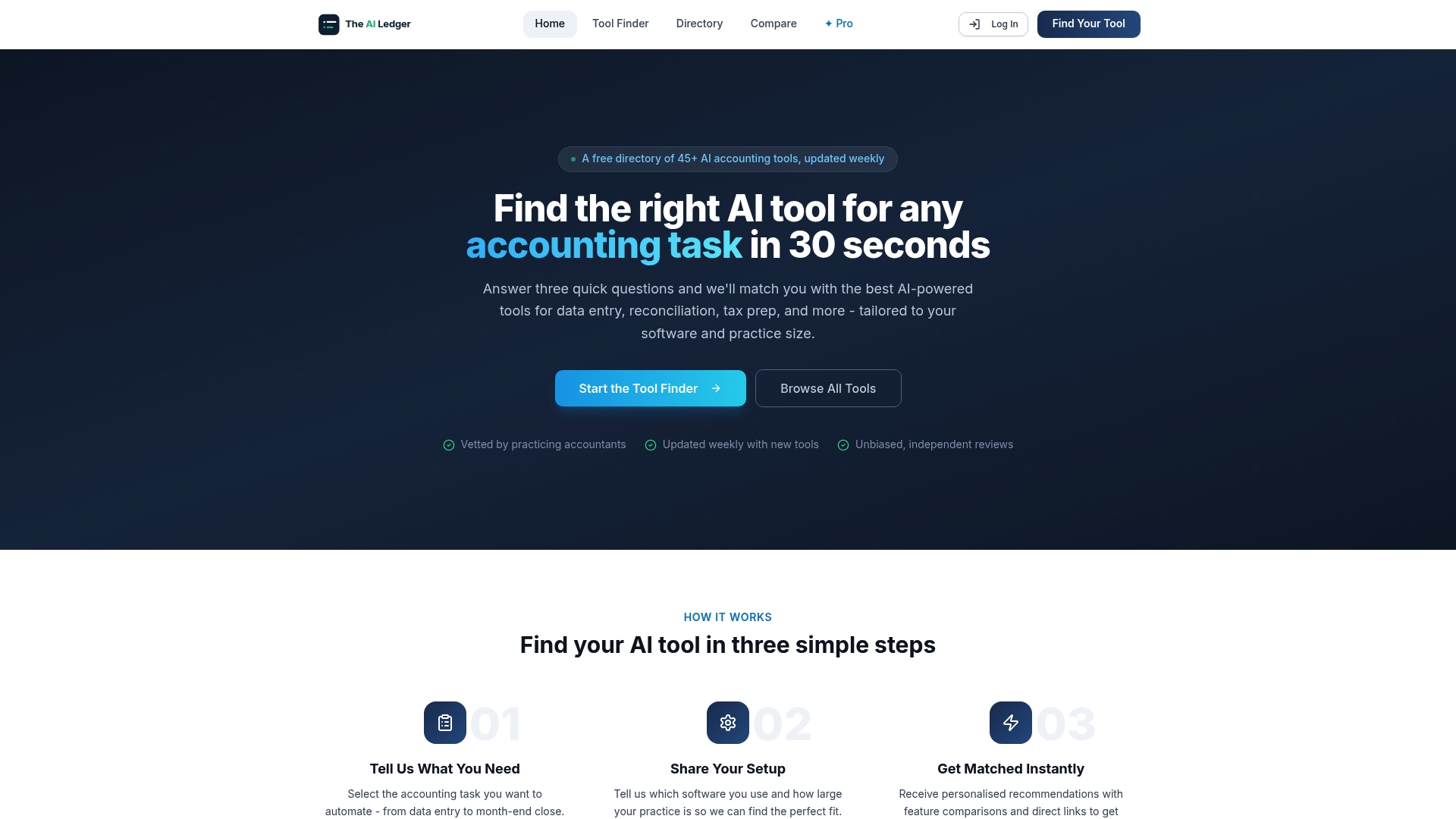
The AI Ledger takes a different route: an independent directory of 100+ AI tools for accountants and bookkeepers, each carrying an editor score, an honest verdict and a last verified date, so you can compare AML automation options side by side without booking a single demo call first. The 30-second tool finder narrows the field to a shortlist matched to your practice size and the specific task you're automating, whether that's onboarding, monitoring or document capture. Listings are editorially independent and scores are never for sale, so what you're reading is a genuine assessment rather than a paid placement dressed up as one.
Visit the AI tools directory to compare AML automation platforms directly, and sign up for the free weekly Friday newsletter to catch feature and price changes across this category before your renewal date arrives.
Frequently asked questions
What is AML automation for accountants? It's software that embeds risk-based identity checks, sanctions and PEP screening, and ongoing monitoring directly into a firm's onboarding and review workflows, replacing manual checklists with rules that apply consistently and log every decision automatically.
How long does it take to implement AML software in a practice? A focused pilot typically takes four to eight weeks to configure and test, with full firm-wide roll-out taking a further one to three months, depending on how many legacy client files need migrating.
Does AML automation replace the need for an MLRO? No. It changes what an MLRO spends time on, shifting effort away from manual checklist chasing and toward designing risk templates and reviewing the genuinely ambiguous cases the system flags.
Which AML software integrates with Companies House? Several platforms built for UK accounting firms, including TaxCalc's AML Centre, offer direct Companies House integration to pull company data automatically rather than requiring manual entry.
Is AML automation only worth it for larger firms? No. Smaller practices often see the biggest proportional time savings, since a solo practitioner or small team has less capacity to absorb manual AML admin without it eating into billable hours.