Vendor onboarding automation centralises intake, validates tax and banking data, enforces compliance checks, and pushes a verified vendor record directly into your ERP or AP system. If you take one action this week, run a one-week intake audit: time your current average cycle from first contact to activated vendor, and note the three documents most often missing at the point of payment. That single exercise will tell you exactly where automation will cut the most time.
- Automation replaces scattered email threads with a single, auditable digital workflow covering intake, tax verification, insurance, banking and compliance screening.
- A clean vendor record, synced to your accounting system before the first purchase order, prevents duplicate vendor records and downstream invoice exceptions.
- The repeatable onboarding sequence runs: intake, tax classification, certificate of insurance (COI) check, bank verification, security review, signed agreement, then activation.
- Automation frees procurement and finance capacity for higher-value risk reviews rather than chasing PDFs.
Pro Tip: Stop accepting bank details by email. Move to an encrypted portal with a secondary verification step, either an independent callback or a micro-deposit confirmation, before any bank record is written to your ERP.
Key takeaways
Vendor onboarding automation delivers its fastest ROI when you tier vendors by risk, enforce stage gates technically rather than by policy, and sync verified records to your ERP before the first purchase order is raised.
| Point | Details |
|---|---|
| Run an intake audit first | Measure current cycle time and the three most common missing documents before configuring any platform. |
| Tier vendors by risk and spend | Route low-risk commodity vendors through a lightweight flow; reserve full due diligence for high-risk or high-spend suppliers. |
| Enforce stage gates technically | Configure the platform so no vendor record is created until tax and insurance checks are verified, not just documented in policy. |
| Pilot banking details via a secure portal | Stop accepting bank details by email; use an encrypted portal with micro-deposit or callback verification before writing to ERP. |
| Schedule a 30-day post-activation review | Check GL coding, payment terms and pricing in the first payment run to catch errors before they compound across a quarter. |
| Use The AI Ledger to shortlist | The independent directory of 100+ tools with editor scores and last verified dates cuts shortlisting time significantly. |
Table of Contents
- Why automating vendor onboarding pays off faster than most teams expect
- Core automation capabilities your vendor onboarding workflow must include
- UK compliance checkpoints to embed in every automated vendor setup
- Designing the onboarding workflow: swimlanes, stage gates and parallel approvals
- Integrations and the vendor master: how to avoid duplicate records
- How to choose vendor onboarding software: a prioritised evaluation checklist
- Implementation roadmap: a pilot plan you can reuse
- KPIs to track and a simple way to prove ROI
- Common pitfalls when automating onboarding and how to avoid them
- Where to research and shortlist tools for UK procurement and finance teams
- The AI Ledger helps you shortlist onboarding tools without the guesswork
- Sources
Why automating vendor onboarding pays off faster than most teams expect
The business case is straightforward once you look at where time actually goes. Email-based onboarding creates queues at every handoff: a missing VAT number holds up finance, an expired COI holds up legal, and a mis-keyed sort code holds up AP. Each hold costs time and, when a supplier is waiting to be activated before they can deliver, it costs operational continuity too.
Portal-based onboarding reduces activation times and lost documents dramatically compared with email workflows. It also produces a far stronger audit trail. The gains show up across four areas:
- Faster activation: vendors complete self-service forms in one sitting rather than responding to sequential email requests over days.
- Fewer payment holds: real-time validation catches missing or incorrect data at intake, not at the point of payment run.
- Fewer duplicate vendor records: deduplication at intake stops the same supplier appearing under three name variants in your vendor master.
- Stronger audit evidence: tamper-evident logs and timestamped document storage give auditors and regulators a complete, unbroken record.
The use cases where automation delivers most value split into three tiers. High-volume, low-risk commodity vendors, such as office supplies or courier services, benefit from a lightweight, mostly automated flow. Mid-tier consultants with recurring spend need a richer workflow that captures IR35 status, a signed contract and payment terms. High-risk data processors require a full security review, a Data Processing Agreement (DPA), and beneficial ownership checks before activation. A well-configured supplier onboarding platform handles all three tiers from a single interface, routing each vendor to the right workflow automatically based on spend threshold or risk classification.
Core automation capabilities your vendor onboarding workflow must include
Not every platform delivers the same depth. When you evaluate supplier onboarding software, these are the capabilities that actually matter for compliance and operational control:
- Self-service intake forms with required-field validation and real-time deduplication checks at the point of submission, so a vendor cannot complete registration without supplying a valid VAT number or Companies House reference.
- Document collection and expiry tracking for COIs, licences, DPAs and any sector-specific certificates, with automated reminders sent to the vendor before expiry rather than after a payment hold.
- Real-time tax ID and bank account validation, including sort code and account number verification against banking databases, plus sanctions and AML screening and beneficial ownership checks at intake.
- Configurable workflow routing by spend band, risk tier or supplier type, with parallel approval paths so Finance and Legal can review simultaneously rather than sequentially.
- Audit trail and tamper-evident logs with secure document storage, giving auditors a complete, time-stamped record of every action, approval and change.
Pro Tip: Require your shortlisted platforms to demonstrate their deduplication logic in a live demo using your own test data. Generic demos rarely surface the edge cases, such as a supplier registered under a trading name that differs from its legal entity name, that cause real problems in production.
Purpose-built onboarding portals go further by offering single-link invites, self-service document uploads and a live status dashboard so internal teams can see exactly where each vendor sits in the workflow without chasing by email.

UK compliance checkpoints to embed in every automated vendor setup
UK procurement and finance teams carry specific regulatory obligations that a generic onboarding template will not cover by default. Build these checks into your workflow as mandatory stage gates, not optional fields.
Tax classification and verification
Confirm VAT registration status via HMRC's online VAT checker for any supplier billing VAT. For sole traders and partnerships, capture the Unique Taxpayer Reference (UTR) and verify the name matches the tax record. For limited companies, cross-reference the Companies House registration number. Automation tools can validate these in real time against HMRC and Companies House APIs, flagging mismatches before the record is written.
Certificate of insurance verification
At a minimum, confirm the COI covers public liability, employers' liability (where the supplier has staff working on your premises) and professional indemnity where relevant. Check the policy period, the insured entity name, and the limit of indemnity. Automated expiry tracking then sends reminders at 60 and 30 days before renewal, removing the manual calendar chase.

Sanctions, AML and beneficial ownership screening
Automation tools should screen against UK sanctions lists, EU consolidated lists and, where your supply chain has US exposure, OFAC and SAM.gov. For regulated entities, AML checks and beneficial ownership verification are mandatory; for others, they are a risk-based decision. SLA targets for these gates typically run within a few business days depending on the complexity of the check. Build automatic escalation into your workflow so that any screening hit routes immediately to your compliance officer rather than sitting in a queue.
Data protection and GDPR-compliant data handling
Collecting bank details, personal identification and beneficial ownership information means you are processing personal data under UK GDPR. Your onboarding portal must store this data in UK or EEA data centres (or document an adequacy decision for any third-country transfer), apply role-based access controls, and provide a clear retention and deletion schedule. Capture a DPA from any supplier who will process personal data on your behalf before activation.
Designing the onboarding workflow: swimlanes, stage gates and parallel approvals
A well-designed workflow prevents tasks falling between teams and stops premature payments. The swimlane approach assigns clear ownership at every stage and enforces exit criteria before the next gate opens.
Step 1: Map your swimlanes. Define the role each function plays:
- Procurement owns intake, risk classification and contract execution.
- Finance owns tax verification, bank validation and payment-term setup.
- Legal owns contract review, DPA execution and any sector-specific compliance sign-off.
- IT/Security owns data processor assessments and system access provisioning for high-risk vendors.
Step 2: Define stage gates with clear exit criteria.
- Intake complete: all required fields submitted, deduplication check passed.
- Risk review passed: risk tier assigned, screening results documented.
- Contract executed: signed agreement and DPA (where required) uploaded.
- Payment ready: bank details verified, payment terms confirmed in ERP.
Step 3: Enable parallel approvals. Finance and Legal reviews should run simultaneously wherever possible. Sequential approvals are the single biggest source of unnecessary cycle time. Configure your platform to notify both teams at the same gate and to escalate automatically if either review is not completed within the SLA.
Step 4: Set SLA targets per gate. Measure cycle time by gate, not total elapsed time. A typical target: intake to risk review within one business day, risk review to contract within three business days, contract to payment-ready within two business days. Tracking per-gate SLAs tells you exactly which function is the bottleneck, which total elapsed time obscures.

Pro Tip: Add a 'no vendor record creation until tax and insurance are verified' rule as a hard system constraint, not a policy document. If the platform cannot enforce this technically, it will be bypassed under time pressure.
Integrations and the vendor master: how to avoid duplicate records
The onboarding platform is only as valuable as the data it pushes downstream. If approved vendor records do not flow cleanly into your ERP or AP system, teams will rekey data manually and duplicates will reappear within weeks.
When evaluating vendor management software, check for prebuilt, two-way connectors to the platforms your finance team actually uses:
- NetSuite and Sage Intacct for mid-market and multi-entity environments.
- Xero and QuickBooks for smaller finance teams or subsidiary entities.
- Microsoft Dynamics Business Central for organisations already in the Microsoft ecosystem.
Two-way sync means the onboarding platform writes the approved vendor record to the ERP and can receive status updates back, such as a payment hold or a vendor deactivation, without manual intervention.
Deduplication strategies. Set matching rules that check legal entity name, VAT number and bank account number simultaneously. A name-only match will miss the same supplier registered as "Acme Ltd" and "Acme Limited". Force a human review whenever two or more fields match but the third differs. Canonical name rules, always storing the legal entity name from Companies House rather than a trading name, reduce false negatives significantly.
Integration test checklist before go-live:
- Run a staging sync with 20 test vendor records and verify every mapped field lands correctly in the ERP.
- Confirm field mapping for payment terms, GL code, currency and tax treatment.
- Test rollback: can you deactivate a vendor in the onboarding platform and have the ERP reflect that within one business cycle?
Pro Tip: Assign a named data owner for the vendor master record, document the canonical fields that are mandatory for every record, and schedule a quarterly deduplication audit. Without a named owner, the master degrades within a single financial year.
How to choose vendor onboarding software: a prioritised evaluation checklist
Start with must-haves. A platform that fails on integration maturity or compliance checks cannot be compensated for by a polished interface.
Must-haves:
- Native or API-based connectors to your ERP and AP system, with documented field mapping.
- Real-time VAT, bank and sanctions validation, not batch-overnight checks.
- Configurable workflow routing with parallel approval support.
- Tamper-evident audit trail with exportable logs.
- UK or EEA data residency, or a documented adequacy decision.
Nice-to-haves:
- AI-assisted document extraction for COIs and contracts.
- Vendor-facing status portal so suppliers can track their own progress.
- Pre-built risk-scoring templates by industry or spend band.
Questions to ask in demos and RFPs:
- What is the latency between a vendor completing intake and the record appearing in our ERP?
- Which validation APIs do you use for UK VAT and bank account verification?
- Where is our data stored, and what is your data residency certification?
- What is your SLA for document extraction accuracy, and how do you handle extraction failures?
- Can we configure different workflows for different vendor tiers without professional services?
Pricing models. Per-onboarding pricing suits low-volume, high-complexity environments. Per-seat pricing suits teams with stable headcount and variable vendor volumes. Per-connector pricing can escalate quickly if you have multiple ERP instances. Enterprise licensing gives cost certainty but requires accurate volume forecasting. Always model your expected annual vendor volume before accepting a per-onboarding quote.
Run your pilot against this matrix, not against the vendor's own benchmark.
Independent review channels, including G2 product reviews, surface real-world configuration and usability issues that vendor marketing does not. Include them in your shortlisting process alongside demos.
Implementation roadmap: a pilot plan you can reuse
A phased rollout reduces risk and proves value before you commit to full deployment.
- Discovery (weeks 1 to 2). Document your current process: average cycle time, missing document types, duplicate vendor rate, and the three most common reasons for payment holds. This baseline is your ROI benchmark.
- Configuration (weeks 3 to 4). Map your workflow tiers, configure intake forms, set validation rules, and complete the integration test checklist from the previous section.
- Pilot (weeks 5 to 8). Run a defined cohort of 15 to 25 new vendors through the platform. Choose a mix of vendor types that reflects your real volume split.
- Iterate (week 9). Review pilot results against success criteria, fix configuration gaps, and retrain any approvers who missed SLAs.
- Scale (weeks 10 onwards). Expand to all new vendors, then plan a backfill programme for existing vendors who lack complete documentation.
Pilot success criteria:
- Cycle time reduced versus your pre-pilot baseline.
- Missing documents at activation below a threshold you set in discovery.
- Zero duplicate vendor records created during the pilot.
- Vendor satisfaction score collected via a short post-onboarding survey.
Change management actions. Run a 60-minute training session for each internal approver group before the pilot launches. Prepare a one-page vendor communication template explaining why they are receiving a portal invite rather than an email request. Build a 30/60/90 support plan: daily check-ins in week one, weekly reviews through day 60, and a formal retrospective at day 90.
Technical go-live checklist: confirm staging sync is clean, complete field mapping verification, document rollback procedures, and agree a cutover date that avoids month-end close.
Pro Tip: Backfill is always slower than teams expect. Prioritise vendors with spend above your materiality threshold in the first backfill wave, and accept that long-tail vendors may take a full quarter to migrate.
KPIs to track and a simple way to prove ROI
Measure at the gate level, not just end-to-end. These are the core KPIs:
- Time to onboard: calendar days from first invite to activated vendor record in ERP.
- Approval cycle time by gate: days spent at each stage gate, averaged across the pilot cohort.
- Documentation completeness at activation: percentage of vendors with all required documents present on the day of activation.
- Duplicate vendor rate: number of duplicate records identified per quarter as a proportion of total active vendors.
- Days to first payment: calendar days from vendor activation to first successful payment run.
Data sources are straightforward: timestamps from the onboarding platform, ERP vendor master logs, and AP payment run reports. Most platforms export this data in CSV or via API.
A simple ROI calculation. If your current average cycle time is ten days and automation reduces it to three, and each delayed activation costs your procurement team two hours of chasing, the saving per vendor is fourteen hours across the cohort. At a blended internal rate of £45 per hour, onboarding 200 vendors per year produces a time saving worth £126,000 before accounting for payment hold avoidance and audit preparation time. Accounting automation ROI frameworks give finance leaders a structured way to present these numbers to the board.
When presenting to leadership, frame results around three themes: cashflow impact from faster supplier activation, audit risk reduction from complete documentation, and headcount reallocation from administrative tasks to higher-value work. Portal-based onboarding consistently delivers on all three, which is why the business case tends to be approved quickly once the baseline data is in place.
Common pitfalls when automating onboarding and how to avoid them
Most implementation problems are predictable. Here are the four that appear most often, and what to do about each.
Over-automation. Routing every vendor through full due diligence regardless of spend or risk wastes capacity and frustrates low-risk suppliers. Tier your vendors by risk and spend at intake, and configure lightweight flows for commodity vendors that skip the security review and DPA unless triggered by a specific data-sharing flag.
Poor vendor UX leading to abandoned onboarding. A form that asks for 40 fields on a single page will be abandoned. Test your intake form with three or four real vendors before the pilot launches, and reduce every field that is not genuinely required at intake. Progressive disclosure, showing additional fields only when triggered by a previous answer, keeps the experience manageable.
Missing handoffs between departments. The most common failure mode is a task that sits in a shared inbox with no named owner. Swimlane mapping and enforced stage gates fix this structurally. If your platform cannot send a named notification to a specific approver and escalate automatically after a defined period, it is not fit for purpose.
Inadequate data governance leading to duplicates. Automation does not eliminate duplicates if the canonical field rules are not enforced at the platform level. Set mandatory fields, apply matching rules across legal name, VAT number and bank account, and run a quarterly deduplication audit against your ERP vendor master.
Pro Tip: Schedule a 30-day post-activation review for every new vendor. Check that payment terms, GL coding and pricing are set correctly in the ERP before the first invoice arrives. Errors caught at 30 days cost a fraction of what they cost to unwind after a quarter-end close.
Where to research and shortlist tools for UK procurement and finance teams
A structured research process saves time and avoids the trap of buying on demo polish rather than integration depth.
- Define your use cases first. List the vendor tiers you need to support, the ERP systems you must integrate with, and the compliance checks that are mandatory for your sector.
- Review editorial directories. The AI Ledger's independent directory covers 100+ AI and automation tools with editor scores, honest verdicts and a last verified date on every entry. Use the 30-second tool finder to filter by task and accounting platform before you book a single demo.
- Check regulatory sources. The SRA, HMRC's VAT checker, Companies House and the UK Financial Sanctions Implementation Team (FSIT) publish the authoritative lists your screening tools must reference.
- Run 2 to 3 vendor demos against a standard dataset that includes edge cases: a supplier with a trading name different from its legal name, a foreign entity without a UK VAT number, and a vendor whose COI expires within 30 days.
- Time-box your pilot. Eight weeks is enough to validate integration behaviour, data flows and vendor experience. Anything longer delays the ROI evidence you need for the next budget cycle.
Pro Tip: Ask each vendor to demonstrate their integration in your staging environment, not a generic sandbox. Real integration behaviour with your ERP's field mapping is the single most reliable predictor of go-live success.
What procurement and finance teams consistently underestimate
The handoff complexity between Procurement, Finance, Legal and IT is almost always underestimated. Teams assume that configuring a workflow is the hard part. In practice, agreeing who owns each gate, what the exit criteria are, and who escalates when an SLA is missed takes longer than the technical setup. Swimlane clarity is not a nice-to-have process diagram; it is the operational foundation that determines whether the automation actually holds under volume.
The other blind spot is the post-activation period. Most teams declare success when a vendor is activated and move on. The errors that compound, wrong GL codes, incorrect payment terms, pricing mismatches, appear in the first payment run, not at activation. A 30-day post-activation review, run as a standard step rather than an exception, catches these while they are cheap to fix. The AI Ledger's side-by-side tool comparisons and category guides are a practical starting point for shortlisting platforms that support this kind of end-to-end process visibility.
The AI Ledger helps you shortlist onboarding tools without the guesswork
Picking the right platform from a crowded market is where most procurement and finance teams lose weeks. The AI Ledger's independent directory of 100+ AI and automation tools gives you editor scores, honest verdicts and a last verified date on every listing, so you are comparing current, verified information rather than marketing copy.
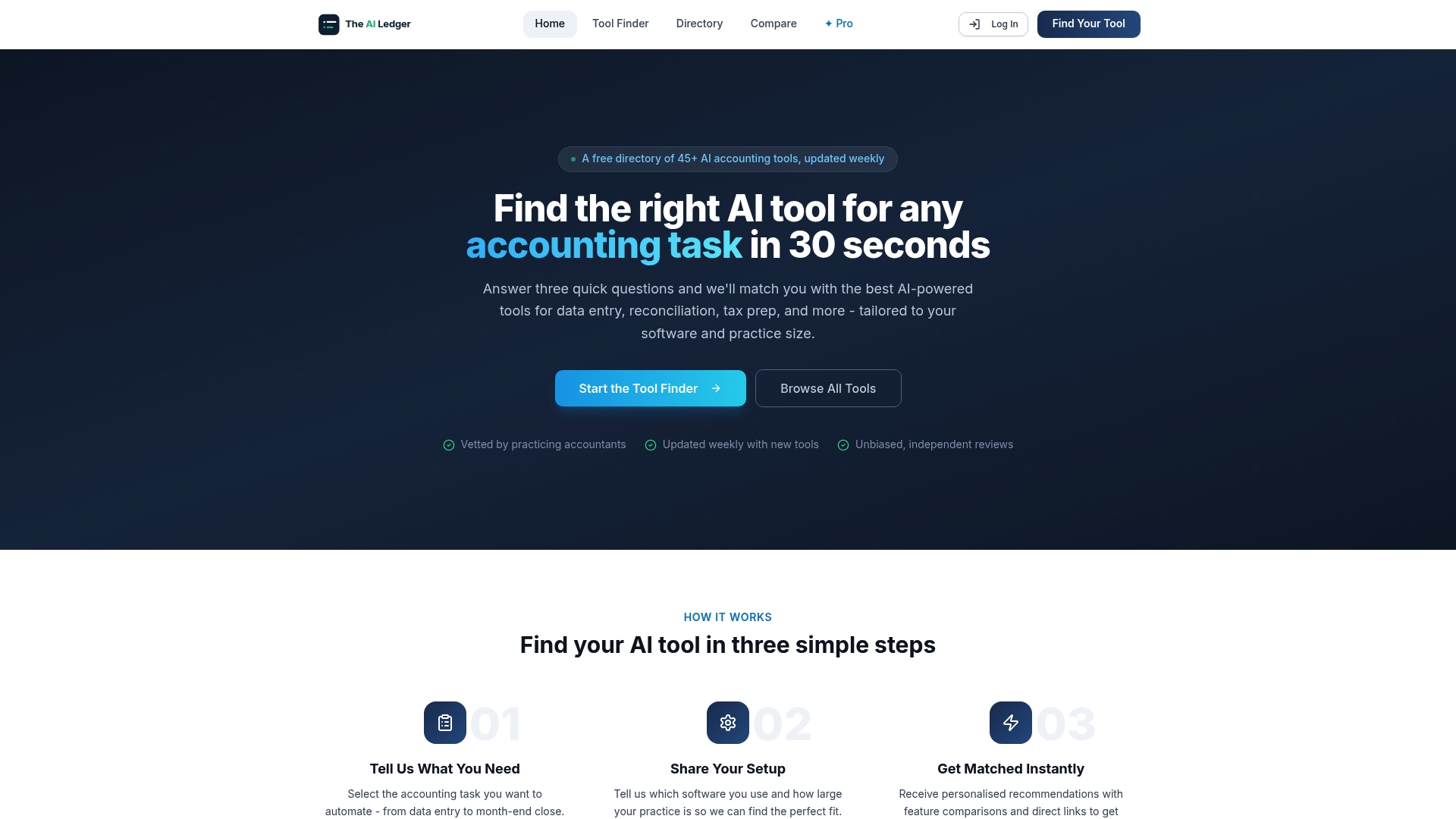
Use the 30-second tool finder to filter by your ERP, your compliance requirements and your team size, and produce a short vendor list in minutes. Every listing is independently reviewed; editor scores are never for sale. If you want to go deeper, the category guides and side-by-side comparisons let you evaluate platforms on the criteria that matter for your specific workflow. Start with the directory, run your demos, and use the pilot framework in this guide to validate the winner before you commit.
Sources
- Stripe: supplier and vendor onboarding
- Vendor Onboarding Process: A Practical Guide for Procurement Teams | OnboardMap
- Vendor onboarding process for finance teams | ProcureDesk
- Vendor Onboarding Process: Step-by-Step Guide 2026
- Vendor Onboarding | VendorJot