AI intercompany elimination is the use of machine matching, contextual mapping and automated journal generation to identify and remove intra-group transactions during consolidation, without a finance team manually chasing every mismatched invoice. It sits right at the point where individual entity ledgers become one consolidated set of accounts, and it exists because IFRS 10 requires a group to be presented as a single economic entity. Two things change once AI takes on this work:
- Faster close cycles, because matching that used to take days of spreadsheet reconciliation now happens continuously.
- Fewer manual exceptions, because the software surfaces genuine anomalies instead of asking a controller to eyeball thousands of rows.
Tools like BlackLine, HighRadius and Kognitos now build entire product lines around this problem, and The AI Ledger tracks how each one actually performs against the claims on its sales page.
Key Takeaways
AI intercompany elimination works by combining contextual matching, FX-aware logic and auditable journal generation to remove intra-group transactions faster and with fewer manual exceptions than spreadsheet-driven close processes.
| Point | Details |
|---|---|
| Definition matters first | Eliminations remove intra-group transactions like sales, loans and dividends so consolidated accounts under IFRS 10 don't double count. |
| Complexity scales with entities | Multiple ERPs, inconsistent mappings and timing differences make manual eliminations unmanageable past a handful of subsidiaries. |
| AI adds judgement, not just speed | Contextual matching and anomaly detection cut manual effort, but false positives and model drift still need human oversight. |
| Vendors specialise differently | BlackLine and Trintech Cadency suit enterprise governance, while Kognitos and DualEntry focus on dedicated intercompany matching. |
| Compare before you commit | The AI Ledger's directory and 30 second tool finder let finance teams check editor-scored, last-verified vendor pages before shortlisting. |
Table of Contents
- What are intercompany eliminations, with worked examples?
- Why are intercompany eliminations so hard to get right?
- How does AI actually streamline eliminations?
- Which AI features should you actually look for in a tool?
- Which AI-capable tools handle intercompany elimination well?
- How do you choose the right elimination solution?
- How does a pilot rollout actually work?
- How should finance teams manage the change internally?
- Ready to shortlist the right intercompany tool for your group?
- Frequently asked questions
- Sources
What are intercompany eliminations, with worked examples?
Eliminations strip out transactions that happened between entities inside the same group, so the consolidated accounts don't double count revenue, assets or profit that never actually left the business. AccountingTools defines the core categories as intercompany debt, intercompany revenue and expenses, and intercompany stock ownership. Eliminations happen only at the consolidation layer. Individual entity books stay untouched.
Two quick examples make this concrete:
- Unrealised profit on a goods sale. Entity A sells stock to Entity B for £100,000, having bought or made it for £70,000. If Entity B still holds that stock at year end, the group must eliminate the £30,000 profit, because from the group's perspective the inventory never left the business.
- Intercompany loan interest. Entity A lends Entity B £500,000 at 5%. Entity A books £25,000 of interest income and Entity B books £25,000 of interest expense. Both entries net to zero on consolidation, otherwise the group would report income it never earned from an outside party.
The transaction types that get eliminated most often include:
- Intercompany sales and purchases of goods or services
- Intercompany loans and the associated interest
- Intercompany dividends
- Cost allocations and management recharges between entities
- Intercompany stock or shareholding balances
Why are intercompany eliminations so hard to get right?
The mechanics above sound simple. The reality inside a group with a dozen subsidiaries rarely is. Several root causes stack on top of each other:
- Multiple ERPs across entities, each with its own chart of accounts and coding conventions
- Inconsistent intercompany account mappings between subsidiaries, sometimes maintained in different currencies
- Timing differences, where one entity books a transaction in one period and the counterparty books it a month later
- Currency translation mismatches that create phantom variances with no real economic cause
- Manual spreadsheets that were fine at three entities and become unmanageable at fifteen
Growth through acquisition is where this usually breaks. A group that adds two acquisitions in a year typically inherits two more ERPs, two more charts of accounts and a controller who now has to manually reconcile intercompany balances across systems that were never designed to talk to each other. Adding headcount doesn't fix this, because the problem is structural mismatch, not a lack of hands on keyboards.
How does AI actually streamline eliminations?
Vendors describe four broad architectures, and knowing the difference matters when you're comparing tools rather than trusting a marketing page. A 2026 IEEE paper on AI architectures for intercompany accounting sets out the categories clearly:
- Rule-based systems match transactions against fixed logic you configure. Predictable, but brittle when data is messy.
- Hybrid systems combine rules with statistical matching, catching more variance without needing constant reconfiguration.
- Learning-based systems improve their matching accuracy over time as they see more of your group's transaction patterns.
- Event-driven systems trigger matching and elimination the moment a qualifying transaction posts, rather than waiting for period end.
For a finance team, the practical translation is this: rule-based tools suit stable, well-mapped groups; learning-based and event-driven tools suit groups with messy data or high transaction volume, because they adapt rather than requiring you to anticipate every exception in advance.
What these systems actually do, in practice, is:
- Match counterparties across entities and ERPs contextually, not just on exact reference numbers
- Apply consistent account mapping logic across systems that were never harmonised
- Handle multi-currency FX variance calculation and separate genuine timing differences from real errors
- Flag anomalies for human review rather than silently suppressing them
- Propose elimination journal entries with a traceable link back to the source transaction
- Maintain an audit trail that shows exactly why a match was made
None of this removes the need for judgement. Learning-based models can drift as transaction patterns change after a reorganisation, and every model produces false positives and false negatives, particularly in the first few months of use. Governance matters as much as the technology: someone needs to own model-change decisions and control overrides, or you've simply moved the risk rather than removed it.
Pro Tip: Run any new matching engine in shadow mode against your last two closed periods before trusting it live. Comparing its proposed eliminations against what your team already approved is the fastest way to catch a badly tuned model before it touches production.
Which AI features should you actually look for in a tool?
Vendor demos tend to blur together after the third one. The features that separate a genuinely useful elimination tool from a glorified spreadsheet exporter are fairly specific:
- Automated AR/AP matching across entity pairs
- Configurable matching rules and thresholds you can tune per relationship
- FX variance separated cleanly from genuine mismatches
- Unrealised profit calculation built into the workflow, not a manual bolt-on
- Automated generation of elimination journal entries
- Approval workflows before anything posts to the consolidated set
- An immutable audit trail and full journal-tracing history
- Native ERP connectors, not a generic CSV import as the only integration path
An industry guide to AI-native elimination workflows describes exactly this pattern: contextual matching, mismatch investigation for timing and FX causes, unrealised profit calculation, and journal entries with traceable links to source transactions.
Pro Tip: Don't chase a 100% auto-match rate. Tune thresholds so genuinely unusual patterns get routed to a specialist for review rather than either blocked entirely or nodded through. A tool that suppresses every exception to look clean is hiding risk, not removing it.
Which AI-capable tools handle intercompany elimination well?
Eight names come up consistently when finance teams start evaluating this category, and they don't all solve the same problem. Some are full close-management suites with elimination as one module; others are purpose-built intercompany specialists.
| Tool | Best for | Automation focus | ERP integrations | FX handling | Audit controls | Deployment time | Pricing signal |
|---|---|---|---|---|---|---|---|
| BlackLine | Large enterprises with complex close cycles | Reconciliation and close orchestration | Broad, established connector library | Built-in FX variance handling | Strong, close-orchestration audit trail | Months, phased rollout | Enterprise licensing |
| Trintech Cadency | Enterprises needing strict close governance | Close workflow and structured controls | Broad ERP support | Configurable FX rules | Audit-focused, structured sign-off chains | Months | Enterprise licensing |
| HighRadius | High-volume AR/AP intercompany activity | Netting, dispute resolution, auto-posting | Wide ERP and treasury connectors | Netting-based FX handling | Traceable journal auto-posting | Weeks to months | Enterprise, usage-linked |
| FloQast | Mid-market teams focused on faster month end | Close orchestration | Strong GL system integration | Standard reconciliation FX support | Workflow-based sign-off | Weeks | Mid-market subscription |
| Kognitos | Teams seeking dedicated intercompany automation | Matching and exception management | Focused ERP connector set | Matching-level FX logic | Exception-driven audit logs | Weeks | Vendor-quoted |
| Nominal | Groups needing consolidation-focused features | Consolidation and multi-entity reporting | Consolidation-oriented connectors | Consolidation-level FX translation | Reporting-tied audit trail | Weeks to months | Vendor-quoted |
| DualEntry | Growing companies wanting continuous matching | Continuous matching, anomaly detection | Growing connector list | Continuous FX variance checks | Anomaly-flagged audit history | Weeks | Vendor-quoted |
| ChatFin | Teams wanting conversational access to insights | Chat-driven reconciliation queries | Depends on underlying data connections | Query-based, not a dedicated engine | Insight surfacing, not a full audit system | Weeks | Vendor-quoted |
BlackLine and Trintech Cadency sit at the enterprise end, built for groups where close governance and sign-off chains matter as much as the matching itself. HighRadius leans hardest into agent-based automation, and its own materials cite automating up to 80% of intercompany AR/AP reconciliation work through netting and dispute resolution features, a figure worth testing against your own volume rather than taking at face value.
FloQast fits mid-market teams whose priority is a faster month end rather than deep intercompany specialism. Kognitos and Nominal take narrower angles, one built around dedicated intercompany matching, the other around consolidation-first reporting. DualEntry's pitch is continuous matching rather than a period-end catch-up scramble, which suits a business scaling quickly through acquisition. ChatFin is the outlier: a conversational layer for surfacing reconciliation insight rather than a full elimination engine in its own right, useful as an add-on rather than a replacement.
None of these eight is the right answer for every group, which is exactly why a side-by-side comparison matters more than a single glossy demo. The AI Ledger's directory carries independently scored pages on several of these tools with a last verified date, so you can check whether a claimed feature still holds before you shortlist it for an RFP.
How do you choose the right elimination solution?
Run through this checklist before you take a single vendor call:
- Integration depth. Does it connect natively to your ERPs, or does it rely on manual file uploads?
- Data model fit. Can it handle your actual chart-of-accounts structure without a lengthy remapping project?
- Scale headroom. Will it still perform at double your current entity count?
- FX handling. Does it separate genuine currency variance from real mismatches, or lump them together?
- Auditability. Can you trace an elimination journal entry back to its two source transactions in one click?
- Exception workflow. Does it route unusual matches to a human, or silently force a match?
- Vendor support and security posture. Ask directly about SOC 2 or ISO certification.
Ask every vendor in a demo: "How do you handle timing differences between entities?" and "Show me an audit trail from a source transaction through to the elimination journal entry." Their answers tell you more than any feature list.
Watch for these red flags:
- No native ERP connectors, only generic file import
- An audit trail that can't be traced back to source documents
- Fixed matching rules with no configurable exception workflow
- No clear multi-currency policy, or FX treated as an afterthought
How does a pilot rollout actually work?
Most successful pilots follow a similar shape:
- Map intercompany relationships and entity pairs across the group
- Extract and standardise historical transaction data
- Run the matching engine against several closed historical periods
- Tune matching thresholds based on what the engine gets wrong
- Run the tool in parallel with your existing manual close for one full cycle
- Move to live posting with approval workflows still in place
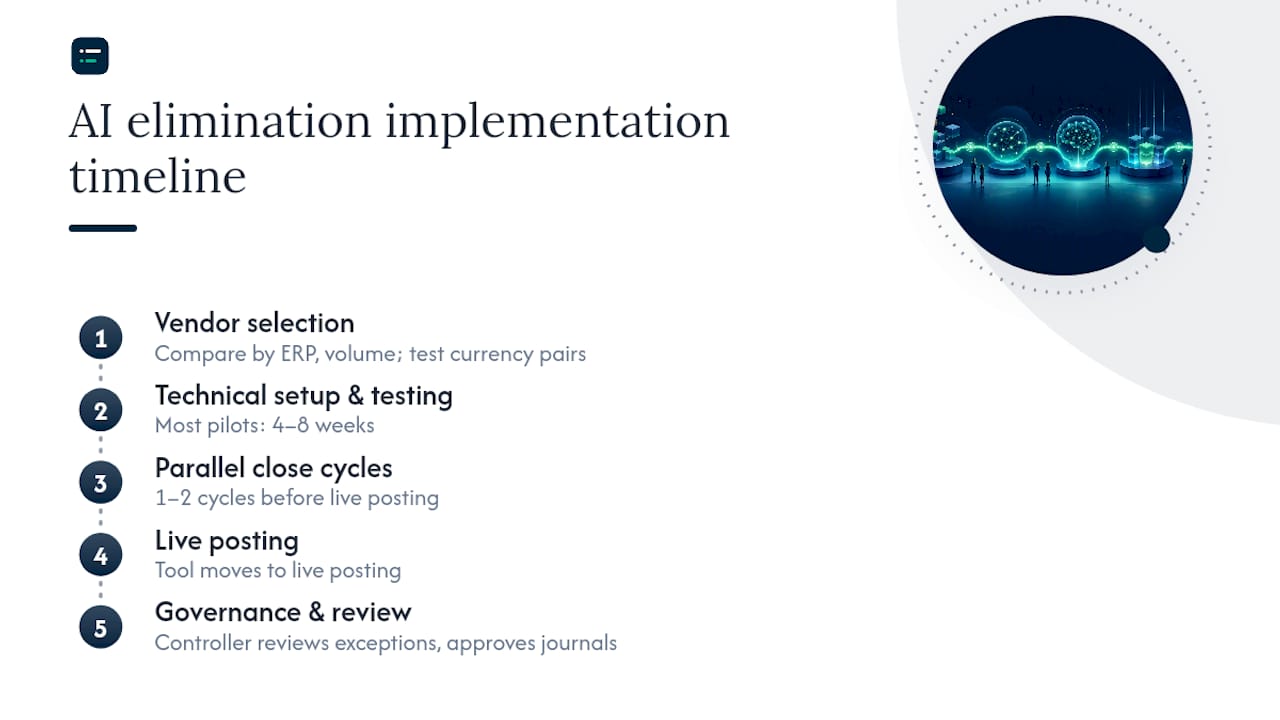
Expect four to eight weeks for the technical setup and historical testing, then one to two full close cycles running in parallel before anyone trusts it to post live. Pro Tip: Train your controllers on why a match failed, not just how to click approve. A team that understands the model's logic will catch drift long before it becomes a restatement risk.
What KPIs and controls should you track after go-live?
Track match rate, exception volume, time-to-close, days saved against your prior manual process, number of audit queries raised, and the percentage of elimination entries posted automatically without human override. Pair these with a governance checklist: documented approval workflows, a log of every model or rule change, a fixed reconciliation cadence, and internal audit sign-off before any control is loosened.
How should you verify vendor claims before signing?
Trust signals worth checking include published integration lists rather than vague "connects to most ERPs" language, real customer case studies, direct reference calls with existing customers, a sample audit trail you can inspect yourself, and SOC 2 or ISO certification. Ask referenced customers one blunt question: how many false matches did the tool produce in its first quarter of live use?
How should finance teams manage the change internally?
The technology is rarely the part that fails. Adoption fails when a controller who has owned intercompany reconciliation manually for years suddenly has a system proposing journal entries they don't fully trust yet. Treat this as a change management project first and a software rollout second.

Start by involving the team that will actually use the tool in vendor selection, not just IT or a project sponsor. People trust a system more when they've seen it get their own historical numbers right. Run training sessions that explain the matching logic in plain terms, not just which buttons to click, so staff can spot when a proposed elimination looks wrong rather than approving it by default.
Set clear escalation paths early: who reviews a flagged exception, who has authority to override a match, and who signs off before anything posts to the consolidated ledger. Groups that skip this step tend to see one of two failure modes, either everyone double-checks every match manually (which defeats the point of automation) or nobody checks anything (which is worse).
Give the rollout a defined review point, typically after the first full parallel close cycle, where the team formally decides what worked, what needs retuning, and whether thresholds need adjusting before scaling to more entities. That single checkpoint does more to build trust in the system than any amount of upfront training.
A publisher's view on where the value really sits
Automation here isn't about replacing judgement, it's about giving your team more of it back. The mechanical matching that ate a controller's week can run continuously instead, freeing up time for the exceptions that actually need a trained eye. That's why The AI Ledger built a directory of 100+ AI tools with editorially independent scores, a weekly newsletter, and a 30 second tool finder, so finance teams can separate genuine capability from a well-designed sales deck.
Ready to shortlist the right intercompany tool for your group?
Reading vendor comparisons is one thing. Knowing whether BlackLine's close orchestration or Kognitos's specialist matching actually fits your entity structure is another, and that's the gap The AI Ledger closes for accountants and bookkeepers evaluating this category.
Every listing on The AI Ledger carries an independent editor score, a plain-English verdict and a last verified date, so a feature claim you read in a demo doesn't go unchecked for a year. The side-by-side comparison tool lets you line up two or three intercompany platforms against the criteria that matter to your group, and the 30 second tool finder narrows a long shortlist down to the tools that actually fit your ERP setup and entity count. If you'd rather have the changes flagged for you, the free Friday newsletter tracks new features and price changes across this category so you're not the last to know when a vendor quietly reworks its FX handling. Start with the multi-entity accounting comparison guide to see how these tools stack up before you book a single demo.
Frequently asked questions
What is AI intercompany elimination in simple terms? It's the use of AI matching engines and automated journal generation to identify and remove transactions between entities in the same group during consolidation, replacing manual spreadsheet reconciliation with continuous, auditable matching.
Does AI intercompany elimination replace the need for a controller? No. It removes mechanical matching work but still needs a person to review flagged exceptions, approve journal entries and own governance decisions when the model gets something wrong.
How long does it take to implement an AI elimination tool? Most pilots need four to eight weeks of technical setup and historical testing, followed by one or two parallel close cycles before the tool moves to live posting.
Can AI elimination tools handle multi-currency groups? Most tools built for this category separate genuine FX variance from real transaction mismatches, though the depth of that logic varies significantly between vendors, so it's worth testing against your own currency pairs directly.
Which tool is best for a mid-sized group just starting to automate eliminations? It depends on your ERP landscape and transaction volume, which is exactly why a side-by-side comparison on a resource like The AI Ledger's directory is more useful than picking the first name that comes up in a search.
Sources
- Intercompany eliminations definition — AccountingTools
- Intercompany Elimination: The Complete Guide to Consolidation Adjustments | Arvexi
The IFRS and AccountingTools sources are best for regulatory grounding. The IEEE paper and the Arvexi guide are best for technical detail on how the matching engines actually work.