Natural language processing (NLP) turns unstructured accounting text into structured data you can act on. For accounting and finance professionals, that means software reads an invoice, an email, or a management report and extracts the vendor name, amount, VAT code, and payment terms without anyone keying a single field. The Strategic Finance magazine describes NLP as allowing financial institutions to parse textual data hundreds of thousands of times faster and more accurately than manual processing. Practical applications span invoice capture, bank reconciliation, contract review, audit sampling, and regulatory monitoring, and the UK's Information Commissioner's Office (ICO) sets the data-protection framework within which any UK practice must operate these tools. The AI Ledger tracks 100+ independently reviewed AI tools for accountants and bookkeepers, so you can find and compare the options that fit your workflow without wading through vendor marketing.
Table of Contents
- How does NLP work in an accounting workflow?
- What can NLP actually do for your accounting practice?
- What benefits and ROI should you realistically expect?
- What are the risks and limits you need to manage?
- How do you adopt NLP in a UK practice? A step-by-step checklist
- Which types of NLP tools suit your practice size?
- How The AI Ledger helps you find and compare NLP tools
- Key takeaways
- The gap between what NLP promises and what pilots actually deliver
- Find the right NLP tool for your practice with The AI Ledger
- Useful sources and further reading
How does NLP work in an accounting workflow?
The pipeline has six stages: ingest, preprocess, extract, enrich, verify, output. Each stage maps to a specific technique, and each technique maps to an accounting task.
- Ingest: Raw documents arrive as PDFs, scanned images, emails, or plain text. Optical character recognition (OCR) converts scanned pages into machine-readable text, which is the prerequisite for everything downstream.
- Preprocess: Tokenisation splits text into words and phrases; parsing identifies grammatical structure. Together they give the model a clean, structured representation of a sentence like "Invoice total £4,320 including 20% VAT."
- Extract: Named entity recognition (NER) identifies and labels entities: supplier name, invoice number, date, currency amount, VAT rate, and payment terms. This is where raw text becomes a structured record.
- Enrich: Embeddings and semantic search add metadata, linking an extracted supplier name to a chart-of-accounts code or flagging a clause in a lease agreement as a break option. MIT Sloan research shows that metadata tagging makes unstructured text searchable for topic-specific queries that simple keyword search would miss entirely.
- Verify: A human-in-the-loop review step checks low-confidence extractions before they pass to the accounting system. This is not optional if outputs need to be audit-ready.
- Output: Structured records flow into your accounting platform, reconciliation engine, or audit workpaper, ready for posting or review.
Transformer-based models such as BERT and its finance-specific variants handle the most demanding tasks: question-answering over contract documents, classification of disclosure sentiment, and detection of forward-looking statements. An SSRN literature survey confirms that accounting research increasingly favours deep learning for textual measures because it provides context-aware outputs that simple keyword counting cannot match. For a deeper look at how supervised and deep learning underpin these pipelines, the machine learning accounting basics guide on The AI Ledger blog is worth reading alongside this article.
Pro Tip: Raw model outputs rarely pass an audit without enrichment. Tag every extracted record with its source document reference, model confidence score, and the reviewer's sign-off before it enters your general ledger. That provenance trail is what makes NLP outputs defensible.
What can NLP actually do for your accounting practice?
Invoice and receipt extraction
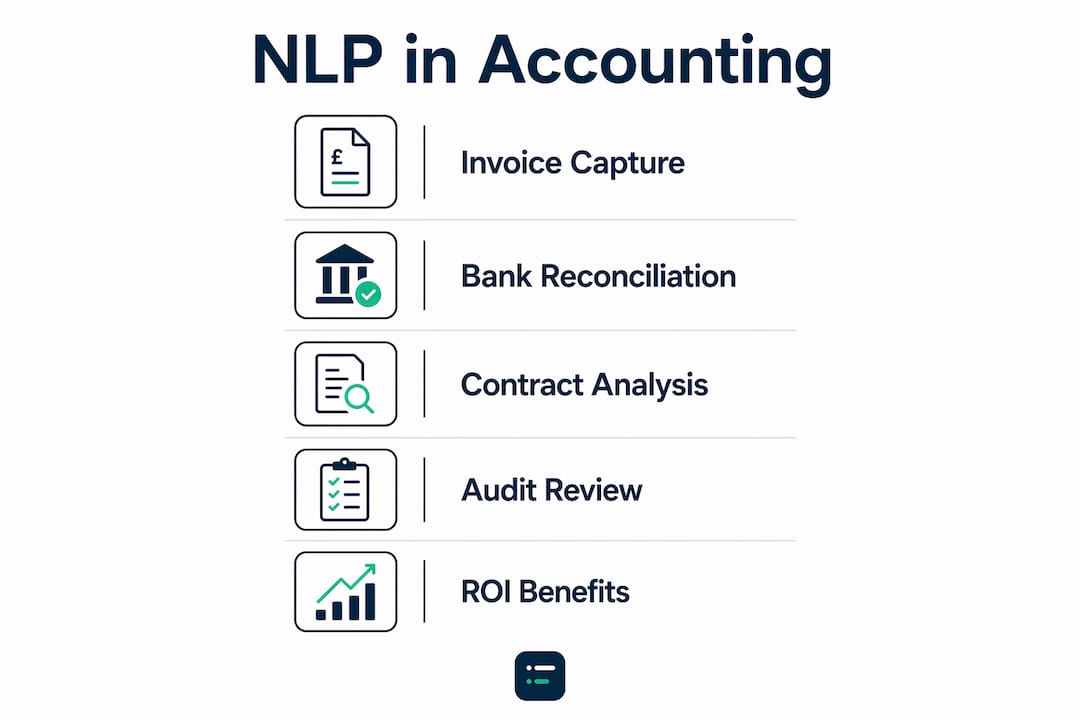
NLP-powered capture engines read supplier invoices in any layout, extract line-item data, match VAT codes to HMRC categories, and post draft entries to your ledger. Academic research published in Accounting and Finance demonstrates that word embedding methods can convert transaction-related natural language directly into bookkeeping entries using proprietary firm data. In practice, a small UK firm processing purchase invoices can reduce manual keying to exception handling, typically a minority of documents with poor scan quality or non-standard layouts.
Bank reconciliation
Semantic matching compares bank narrative text ("BACS PMT SMITH PLUMBING 14MAY") against open ledger items using meaning rather than exact string matching. This handles the abbreviations, reference truncations, and formatting inconsistencies that trip up rule-based systems. The AI in bookkeeping guide covers how this plays out in day-to-day reconciliation workflows.
Contract and disclosure analysis
NLP flags break clauses, rent review dates, and covenant thresholds in lease agreements, then extracts them into a structured register. For revenue recognition under IFRS 15, models can identify performance obligations and variable consideration language across a portfolio of contracts far faster than a manual review. The AI lease accounting automation guide goes into detail on this specific use case.
Audit document review and regulatory monitoring
Auditors use NLP to sample large document populations, flag anomalies in management representations, and cross-reference disclosures against prior-year filings. On the regulatory side, NLP monitors Companies House filings and FCA announcements for changes that affect client obligations. Textual analysis research confirms that disclosure sentiment, readability scores, and detection of forward-looking language are now standard measures in both empirical research and practical compliance work.
A mid-sized UK practice piloting NLP for purchase ledger automation typically runs a proof of concept on a single supplier category, involving a few hundred invoices, before expanding. The usual finding: extraction accuracy on clean PDFs is high, but accuracy on scanned paper documents depends heavily on scan resolution and drops noticeably below a certain DPI.
What benefits and ROI should you realistically expect?
Speed and consistency are the headline gains. NLP in finance can transcribe and tag earnings calls and management presentations within minutes, a task that previously took analysts hours. For a practice, the equivalent is purchase invoice processing: a document that takes two minutes to key manually can be processed in seconds at scale, with consistent field extraction regardless of who is on shift.
Track these pilot metrics from day one:
- Time per document: baseline manual time versus NLP-assisted time, including exception review.
- Extraction error rate: percentage of fields requiring manual correction after model output.
- Exception triage rate: proportion of documents flagged for human review; aim to reduce this over successive model iterations.
- Time to insight: for financial reporting tasks, how quickly structured data is available after source documents arrive.
To estimate ROI, multiply time saved per document by your staff cost rate, then add the value of error reduction (rework time, late payment penalties avoided, VAT corrections). A practice processing many invoices monthly can save substantial staff time if NLP handles the majority without manual intervention, resulting in significant cost savings before accounting for the tool cost. The AI accounting errors guide provides further context on quantifying accuracy improvements.
What are the risks and limits you need to manage?
Common technical failure modes
- Poor OCR output on low-resolution scans or handwritten documents degrades every downstream step.
- NER models misclassify entities when supplier names resemble common nouns or when invoice layouts deviate significantly from training data.
- Classification models produce false positives on edge cases, particularly for sentiment and forward-looking language detection.
- Model drift occurs when the distribution of incoming documents shifts over time and the model was not retrained.
UK GDPR and ICO checklist
Any NLP system processing personal data in a UK practice must satisfy the UK GDPR framework overseen by the ICO. Work through these before you go live:
- Lawful basis: identify whether you rely on contract, legitimate interests, or another basis for processing personal data in documents.
- Data minimisation: extract only the fields you need; do not store full document images longer than necessary.
- Data subject rights: confirm your vendor can support access, rectification, and erasure requests against extracted records.
- Record of processing activities (ROPA): add the NLP pipeline as a processing activity, including the vendor as a data processor.
- Vendor contracts: your data processing agreement must specify data residency (UK or EEA preferred), retention limits, and security standards.
Audit and explainability
The FCA and professional audit standards require that decisions supported by automated tools can be explained and evidenced. For each NLP-assisted classification or extraction, retain the source document reference, the model version, the confidence score, and the reviewer's sign-off. Strategic Finance is clear that NLP automates preliminary processing; it does not replace professional judgement on final accounting decisions.
How do you adopt NLP in a UK practice? A step-by-step checklist
Phase 1: Scope (weeks 1–2)
- Identify the highest-volume, most repetitive document task (usually purchase invoice processing or bank reconciliation).
- Audit document quality: scan resolution, format variety, language mix.
- Define success metrics before you start.
Phase 2: Pilot (weeks 3–10) 4. Select a vendor or platform and negotiate a time-limited trial on a representative document sample (200–500 documents minimum). 5. Prepare a labelled dataset: manually verified extractions that the model can be tested against. 6. Run the pilot on a parallel basis alongside your existing process, not as a replacement.
Phase 3: Validate (weeks 11–12) 7. Measure against your baseline metrics. If extraction accuracy on clean documents is below 90%, investigate OCR quality and model configuration before proceeding. 8. Complete the ICO/GDPR checklist above.

Phase 4: Integrate (months 4–6) 9. Connect the NLP output to your accounting platform via API or file export. Major UK platforms including Xero, QuickBooks, Sage, and FreeAgent all support import formats that NLP tools can target. 10. Train staff on the exception review interface and escalation process.
Phase 5: Scale (months 6–12) 11. Expand to additional document types or supplier categories. 12. Schedule quarterly model validation reviews.
Procurement questions to ask every vendor
- Where is data processed and stored? Is it within the UK or EEA?
- What audit logs does the platform produce, and how long are they retained?
- Which accounting platforms does it integrate with natively?
- What SLA applies to extraction accuracy, and how are disputes resolved?
- What onboarding and ongoing support is included?
- Does the platform hold ISO 27001 or SOC 2 certification?
Budgeting guidance
Pilot costs typically cover a vendor trial fee (often waived or nominal), internal staff time for data preparation (the largest hidden cost), and any integration development. Scale-phase licensing usually follows a per-document, per-user, or subscription-plus-usage model. Data preparation is consistently underestimated by practitioners; budget at least as much time for cleaning and labelling as for model configuration.
Which types of NLP tools suit your practice size?
Platform categories differ significantly in what they deliver and what they demand from your team.
Document capture and OCR engines handle ingestion and basic field extraction. They suit solo bookkeepers and small firms that need structured data from invoices and receipts without building a custom pipeline. Integration with Xero or QuickBooks is usually prebuilt.
Supervised classification tools let you train a model on your own labelled data to categorise transactions, flag anomalies, or detect specific clause types. These suit small-to-mid-tier firms with an analyst who can manage training data and review outputs. The accounting automation software guide covers how these fit into broader workflow categories.
Cloud NLP APIs (such as those from major cloud providers) give developers access to NER, sentiment analysis, and embeddings as services. Mid-tier and larger practices with in-house technical resource can use these to build bespoke pipelines. The trade-off is implementation effort versus flexibility.
LLM-based Q&A assistants answer plain-English questions over document sets: "Which of these contracts contain a break clause exercisable before 2027?" They suit practices doing contract review, audit sampling, or regulatory monitoring, and they require careful prompt design and output validation.
Prebuilt accounting automation platforms combine several of the above into a single product with accounting-specific connectors. These are the fastest route to production for most UK practices and carry the lowest technical overhead. Look for: integration with your existing accounting package, customisable extraction rules, a human-in-loop review interface, and a full audit log. Licensing typically runs on a per-document or per-user subscription basis, with usage charges on top for high-volume processing.
The SSRN textual analysis survey recommends assessing construct validity before choosing a model type: a simple rule-based extractor may outperform a deep learning model on a narrow, well-defined task, while a transformer model is worth the overhead for complex, context-dependent classification.
How The AI Ledger helps you find and compare NLP tools
The AI Ledger is an independent directory of 100+ AI tools for accountants and bookkeepers, with every listing carrying an editor score, an honest verdict, and a last verified date. No scores are for sale. The directory covers tools across data entry, reconciliation, month-end close, tax preparation, payroll, and audit, which maps directly to the NLP application areas covered in this article.
To shortlist tools for an NLP pilot:
- Use the 30-second tool finder to filter by task (for example, invoice capture or bank reconciliation) and by accounting platform (Xero, QuickBooks, Sage, FreeAgent).
- Check the side-by-side comparison feature to compare extraction accuracy claims, integration depth, and pricing models across shortlisted tools.
- Review the editor score and last verified date on each listing to confirm the information is current before you contact a vendor.
- Read the category guides for context on how different platform types compare on features that matter for NLP workflows: audit logs, human-in-loop interfaces, and data residency.
Sign up for the free weekly Friday newsletter to track price changes, new feature releases, and tool updates without having to monitor vendor sites yourself.
Key takeaways
NLP in accounting automates the extraction of structured data from unstructured text, cutting document processing time from minutes to seconds and shifting staff effort from data entry to exception review and higher-value decisions.
| Point | Details |
|---|---|
| Core value proposition | NLP converts invoices, contracts, and reports into structured records, eliminating manual keying at scale. |
| Pipeline essentials | Every production pipeline needs OCR, NER, metadata enrichment, and a human review step to produce audit-ready outputs. |
| UK compliance requirement | Complete the ICO/GDPR checklist (lawful basis, data minimisation, ROPA, vendor contracts) before going live with any NLP tool. |
| Pilot before you scale | Run a multi-week pilot on a representative sample of documents with defined success metrics before committing to full integration. |
| The AI Ledger | Use The AI Ledger's directory of 100+ independently reviewed tools and the 30-second tool finder to shortlist vendors before your pilot. |
The gap between what NLP promises and what pilots actually deliver
Most pilots I see go well on clean PDFs and struggle on everything else. That is not a reason to stop, but it is a reason to be honest with your stakeholders before you start. The firms that get the most out of NLP adoption are the ones that treat data preparation as the real project, not the model selection. Cleaning your document archive, agreeing on a chart-of-accounts mapping, and labelling a representative sample takes longer than configuring any tool, and it is the work that determines whether your outputs are usable.
The other thing that catches firms out is scope creep. A pilot that starts with purchase invoices quietly expands to expense receipts, then to supplier statements, then to contract review, and suddenly you are six months in with no production deployment. Pick one task, prove it, then expand. Stakeholders stay aligned when they can see a working system processing real documents, not a roadmap.
Ongoing validation matters more than most vendors admit. Model accuracy drifts as your supplier base changes, as document formats evolve, and as your chart of accounts is updated. Build a quarterly review into your process from the start, not as an afterthought.
Find the right NLP tool for your practice with The AI Ledger
Cutting through vendor claims on NLP tools is exactly what The AI Ledger is built for. The directory lists 100+ AI tools for accountants and bookkeepers, each with an independently reviewed editor score that is never for sale and a last verified date on every entry. You can run a side-by-side comparison of shortlisted tools in under a minute, or use the 30-second tool finder to match tools to your specific task, accounting platform, and practice size.
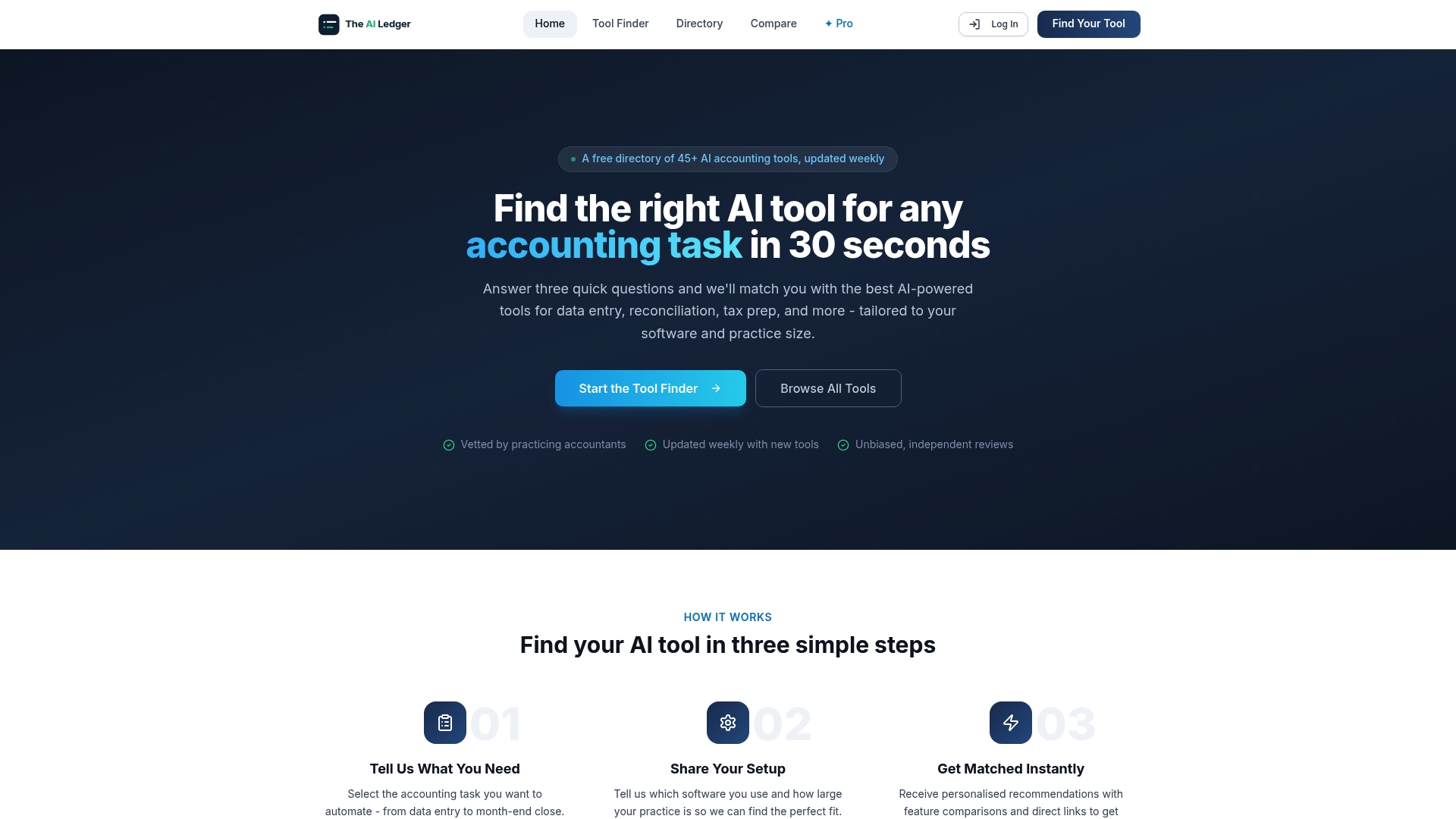
Ready to build your pilot shortlist? Browse the AI tools directory and filter by the task categories covered in this article. Then sign up for the free Friday newsletter to track price and feature changes as you move from shortlist to trial to full adoption.
Useful sources and further reading
- Natural Language Processing in Accounting, Auditing and Finance: A Synthesis of the Literature with a Roadmap for Future Research — the foundational academic literature review covering NLP applications across accounting, auditing, and finance domains.
- Natural Language Processing in Accounting | Strategic Finance (IMA) — a practitioner-focused explainer covering core techniques and applications.
- Why finance is deploying natural language processing | MIT Sloan — covers metadata enrichment, search, and timeliness benefits in financial analysis.
- Textual analysis in accounting: a survey and research agenda (SSRN) — academic survey of deep learning methods for textual measures in accounting research.
- From natural language to accounting entries (Accounting and Finance) — peer-reviewed study demonstrating automated bookkeeping via word embeddings.
- UK Information Commissioner's Office (ICO) — primary source for UK GDPR guidance, data processing requirements, and data subject rights obligations.
- The AI Ledger — independent directory of 100+ AI tools for accountants and bookkeepers, with editor scores, side-by-side comparisons, and a 30-second tool finder.
This article is general information, not legal, regulatory, or professional advice. Confirm current ICO requirements and any FCA obligations with a qualified adviser or the relevant primary source for your specific situation.